Art! Art! Art! › Works
Langlois Bridge at Arles with Women Washing, The
 Vincent van Gogh, 1888
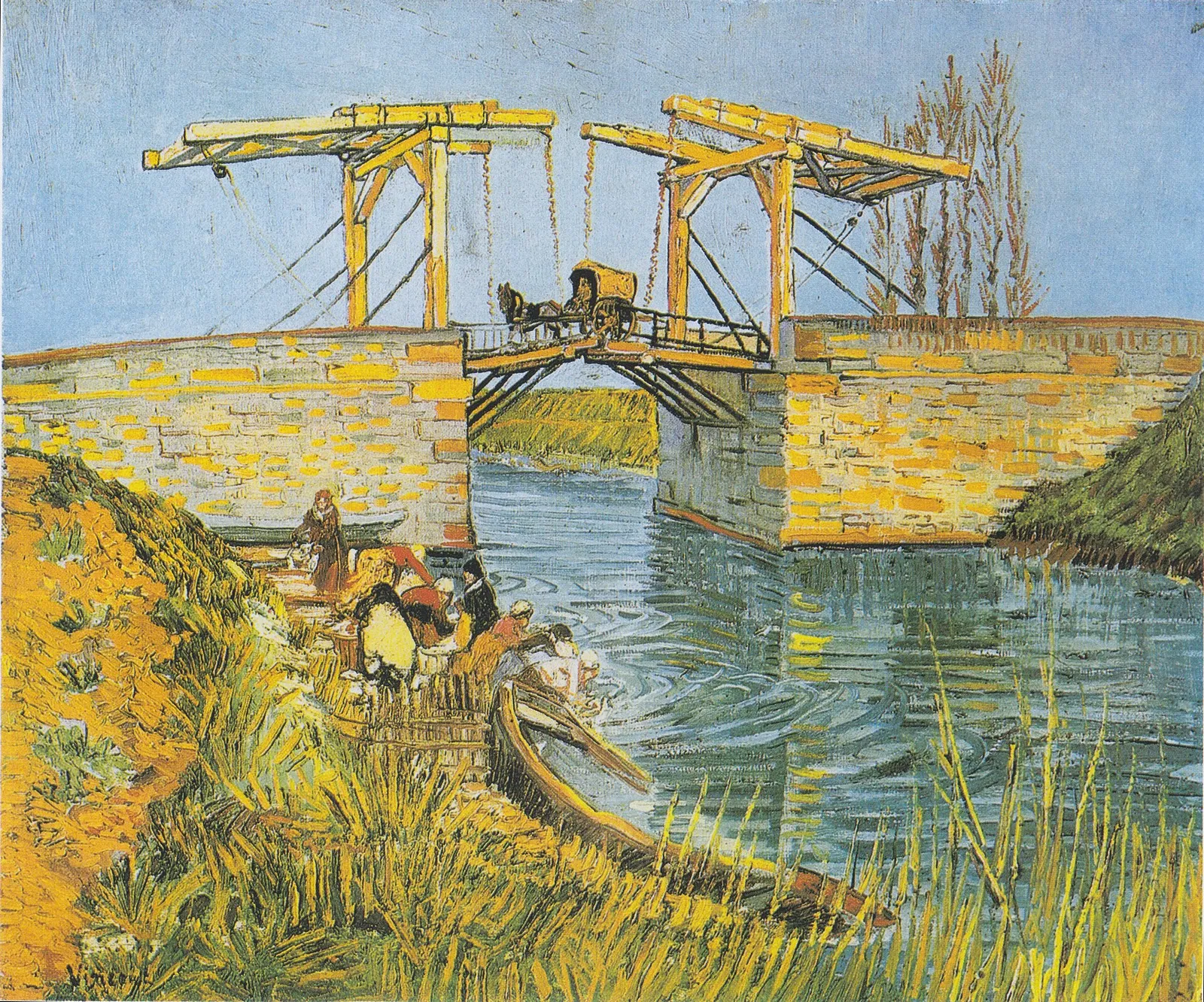
Vincent van Gogh painted The Langlois Bridge at Arles with Women Washing in 1888, soon after settling in the south of France. The canvas, 54 × 65 cm, belongs to the Kröller-Müller Museum, where it is part of the museum's collection of the artist's work. In front of it, look for the play of a simple wooden drawbridge, clear southern light and a small group of women at work by the water.
Where to see it
The painting is in the collection of the Kröller-Müller Museum. Works can be moved, rehung or lent to other institutions, so check the Kröller-Müller Museum's official website for current display status, opening hours and ticket information before you plan your visit.
What to look for in person
The drawbridge as a drawn structure
Start with the bridge itself. Van Gogh treats the drawbridge almost like a diagram of beams, posts and lines, outlining its parts with firm, dark contours that stand out against the sky. Notice how the raised arms and the cables seem to frame the open sky above the canal. Look along the span for the small horse-drawn cart crossing over, a detail that gives the scene its scale and reminds you that this was a working crossing on an everyday route rather than a monument.
The women washing at the water's edge
Move your eyes down to the bank in the foreground, where a group of women kneel at the edge of the canal doing their washing. They are painted with quick, compact strokes and bright touches of colour in their clothing. Around them, the water breaks into rings and ripples, set down as short curving marks. Compare this busy, textured surface with the calmer areas of water further back, and you can see how Van Gogh uses brushwork to show movement and activity in the scene.
Colour and the influence of Japanese prints
Step back and take in the colour as a whole. Strong blues in the sky and water are set against yellows and ochres in the bridge and the banks, with greens in the grass along the shore. These contrasting colours sit side by side in fairly flat areas, bordered by clear outlines. Van Gogh admired Japanese woodblock prints, and the simplified shapes, bold outlines and bright, even colour here are often linked to that interest. Notice how little modelling or shadow he uses.
About the painting
Van Gogh painted this picture in 1888, the year he left Paris and moved to Arles in Provence. He hoped the south would offer stronger light and colour, and he was strongly drawn to Japanese prints, which he had collected and studied in Paris. Scenes like this one show him testing those ideas on an ordinary local subject: a wooden drawbridge over a canal on the edge of town, with women washing clothes on the bank.
The bridge was a subject he returned to more than once. He made several paintings and drawings of it from different viewpoints and in different conditions, so the version at the Kröller-Müller Museum is best understood as one of a group rather than a single isolated image. Seeing it in person, it is worth paying attention to the scale: at 54 × 65 cm the canvas is modest, and the brushstrokes in the water and the figures are easy to read at close range.
When you visit, try looking twice. First stand close enough to follow individual strokes, especially the ripples around the washerwomen and the outlines of the bridge. Then move back a few steps so the areas of blue, yellow and green settle into a clear, balanced design. That shift from detail to overall pattern is one of the most rewarding ways to experience the painting.
Because hanging arrangements change, check the Kröller-Müller Museum's official website before your trip to confirm that the work is on view.
Key facts
| Artist | Vincent van Gogh |
|---|---|
| Date | 1888 |
| Size | 54 × 65 cm |
| Medium | oil paint, canvas |
| Collection | Kröller-Müller Museum |
How to visit: Kröller-Müller Museum
Ede, Netherlands · Museum guide
| Opening hours | Tue–Sun and public holidays 10:00–17:00 (museum and sculpture garden) Mon 21 Dec and Mon 28 Dec 2026 10:00–17:00 (special Christmas openings) |
|---|---|
| Closed | Mondays (except public holidays and announced exceptions); 1 January. Public holidays: Easter, Ascension Day, Pentecost, 25 and 26 December, King's Day 27 April, Liberation Day 5 May. |
| Admission | Adult (combined day ticket, museum + De Hoge Veluwe National Park) EUR 27.75 Youth 13–18 (combined day ticket) EUR 20.8 Child 6–12 (combined day ticket) EUR 6.95 Museumkaart / VriendenLoterij VIP-KAART holders (park only; museum free) EUR 13.85 (bring the card) Students / CJP / Cultuurkaart / EYCA (discounted museum ticket) EUR 6.95 (park ticket bought separately at the park entrance) Car / motorcycle in the park EUR 9.8 (parking at park entrance EUR 4.90) Audio tour (Podcatcher) EUR 2.5 (collection presentation only; max 90 minutes) |
| Free entry | Museum entry is free with a Museumkaart or VriendenLoterij VIP-KAART (park ticket still needed). Free with an ICOM or Vereniging Rembrandt card. One companion of a disabled-parking-permit holder enters the museum free. Park admission is required to reach the museum. |
| Booking | Booking is recommended; there is no timed entry. |
The exhibition “Van Gogh, All Our Paintings” (15 Sep 2026 – 3 Jan 2027) requires an additional free exhibition ticket with a start time. From 4 October the collection tour follows a different route. No closure has been announced.
Official ticket page
Official website
View on map
Hours and prices can change. Please check the official website before you go. (Checked on: 2026-11-09)
More by Vincent van Gogh
 Café Terrace at Night — Kröller-Müller Museum
 White House at Night
 The siesta (after Millet) — Musée d'Orsay
 The Church at Auvers — Musée d'Orsay
 Portrait of Père Tanguy
 Starry Night Over the Rhône — Musée d'Orsay
 The Potato Eaters — Van Gogh Museum
 The Red Vineyard
 The Yellow House — Van Gogh Museum
 Agostina Segatori Sitting in the Café du Tambourin — Van Gogh Museum
 Irises — J. Paul Getty Museum
 Blossoming chestnut trees — Kröller-Müller Museum