Art! Art! Art! › Works
Wheatfield with Crows
 Vincent van Gogh, 1890
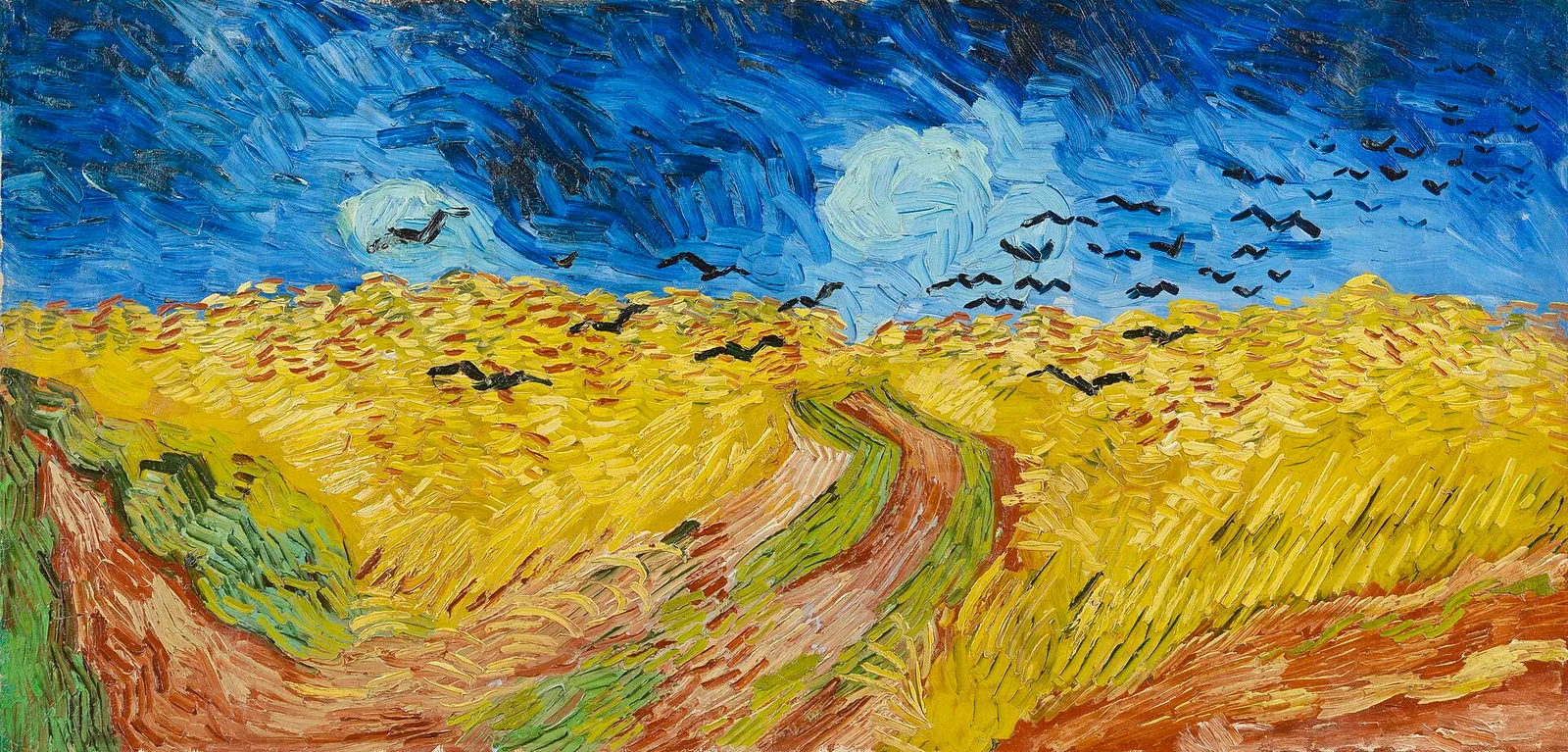
Wheatfield with Crows is an 1890 painting by Vincent van Gogh, held in the collection of the Van Gogh Museum. Its wide canvas, storm-dark sky and black birds over a yellow field make it one of the most recognised images from the final months of his career.
Where to see it
Wheatfield with Crows belongs to the Van Gogh Museum, which is also its recorded location. Works in any collection can be moved, rehung, rested or lent, so check the Van Gogh Museum's official website for current display status, opening hours and ticket information before you plan your visit.
What to look for in person
Three paths that lead nowhere
Start at the bottom edge. A reddish-brown path enters near the centre, and two greener tracks branch off to the left and right. None of them carries you through the scene: each fades into the wheat or runs out of the frame. Viewers have long found this unsettling, though the picture itself gives no single answer. In front of the canvas, notice how the central path draws your eye upward into the field and then simply stops, leaving you to cross the wheat towards the dark horizon on your own.
A sky built from brushstrokes
Step closer and look at the upper half. The sky is not a smooth wash but a mass of short, thick, directional strokes in deep blues, with lighter patches that read as clouds or breaks in the weather. The paint stands up from the surface, and the direction of each stroke gives the sky a sense of movement. Compare it with the wheat below, where the strokes are more upright and broken by touches of yellow and ochre. The contrast between the two zones is a large part of the painting's tension.
The crows and the wide format
Step back again to take in the whole canvas, which measures 50.2 by 103 cm, roughly twice as wide as it is tall. This stretched format suits a panoramic landscape and pushes your eye from side to side rather than into depth. The crows are painted with a few quick dark marks, often little more than angled strokes, scattered across the sky and over the wheat. Notice how loosely they are suggested, and how their black accents link the dark sky to the bright field below.
About the painting
Vincent van Gogh painted Wheatfield with Crows in 1890, the last year of his life, when he was working intensively outdoors and producing paintings at a rapid pace. Wheatfields were a recurring subject for him, and in this period he made a number of landscapes on elongated canvases like this one, which is 50.2 cm high and 103 cm wide. The format turns the field into a broad band of colour that stretches beyond the edges of the picture.
The composition is simple: a field of wheat, a few rough paths, a heavy sky and a flock of crows. What gives it force is the handling of paint. Van Gogh applied colour thickly and in visible strokes, setting strong yellows against deep blues, and letting the marks themselves carry energy and movement. Up close, the surface is dense and physical; from a distance, the shapes resolve into a coherent, if restless, landscape.
Because it dates from his final weeks, the painting is often read as an expression of distress, and it is frequently presented as a premonition of his death. Visitors should treat such readings with care. Van Gogh's own letters from this time describe wide wheatfields under troubled skies, and they mention both sadness and the healthy, restorative quality he found in the countryside. The painting can hold both readings, and part of the experience of standing before it is deciding how it feels to you rather than relying on a story attached to it afterwards.
Key facts
| Artist | Vincent van Gogh |
|---|---|
| Date | 1890 |
| Size | 50.2 × 103 cm |
| Medium | oil paint, canvas |
| Collection | Van Gogh Museum |
How to visit: Van Gogh Museum
Amsterdam, Netherlands · Museum guide
| Opening hours | 2–30 Nov 2026, daily 09:00–17:00 (Fri until 21:00, except 27 Nov) 1–18 Dec 2026, daily 09:00–17:00 (Fri until 21:00) 19–23 and 27–30 Dec 2026: 09:00–18:00 24, 25, 26 and 31 Dec 2026: 09:00–17:00 1 Jan 2027: 11:00–18:00 2–10 Jan 2027: 09:00–18:00 (Fri until 21:00) 11 Jan – 12 Feb 2027: 09:00–17:00 (Fri until 21:00) 13–28 Feb 2027: 09:00–18:00 (Fri until 21:00, except 26 Feb) March–September 2027: 09:00–18:00 (Fri until 21:00, except 26 Mar, 28 May, 30 Jul, 24 Sep) 1–3 and 11–31 Oct 2027: 09:00–18:00 (Fri until 21:00) 4–10 Oct 2027: from 09:00 (Mon–Thu until 17:00, Fri until 21:00, Sat–Sun until 18:00) 1–7 Nov 2027: 09:00–18:00 (Fri until 21:00) 8–30 Nov and 1–23 Dec 2027: 09:00–17:00 (Fri until 21:00, except 26 Nov) 24–26 and 31 Dec 2027: 09:00–17:00 27–30 Dec 2027: 09:00–18:00 |
|---|---|
| Closed | Open daily with no regular closing day (25 December 09:00–17:00, 1 January 11:00–18:00). |
| Admission | Adult EUR 25 (from 1 January 2027: EUR 26) Adult with multimedia guide EUR 28.75 (from 1 January 2027: EUR 30) Under 18 free (timed ticket still required) Student (EU/EEA institution) EUR 16 (valid until 31 December 2026; proof of enrolment required) Museumkaart, Vincent's Friends, VriendenLoterij VIP-KAART, ICOM, Rembrandt card, Stadspas holders free (reserve a free timed ticket online) |
| Free entry | Free for under-18s and holders of the Museumkaart, Vincent's Friends, VriendenLoterij VIP-KAART, ICOM card, Rembrandt card or Stadspas (a timed ticket must still be booked online). A companion of a visitor needing assistance is also free. The I amsterdam City Card has not been valid since 1 June 2022. |
| Booking | Booking is required, with timed-entry tickets. |
Official ticket page
Official website
View on map
Hours and prices can change. Please check the official website before you go. (Checked on: 2026-11-09)
More by Vincent van Gogh
 Café Terrace at Night — Kröller-Müller Museum
 White House at Night
 The siesta (after Millet) — Musée d'Orsay
 The Church at Auvers — Musée d'Orsay
 Portrait of Père Tanguy
 Starry Night Over the Rhône — Musée d'Orsay
 The Potato Eaters — Van Gogh Museum
 The Red Vineyard
 The Yellow House — Van Gogh Museum
 Agostina Segatori Sitting in the Café du Tambourin — Van Gogh Museum
 Irises — J. Paul Getty Museum
 Langlois Bridge at Arles with Women Washing, The — Kröller-Müller Museum