Art! Art! Art! › Works
Van Gogh's Chair
 Vincent van Gogh, 1889
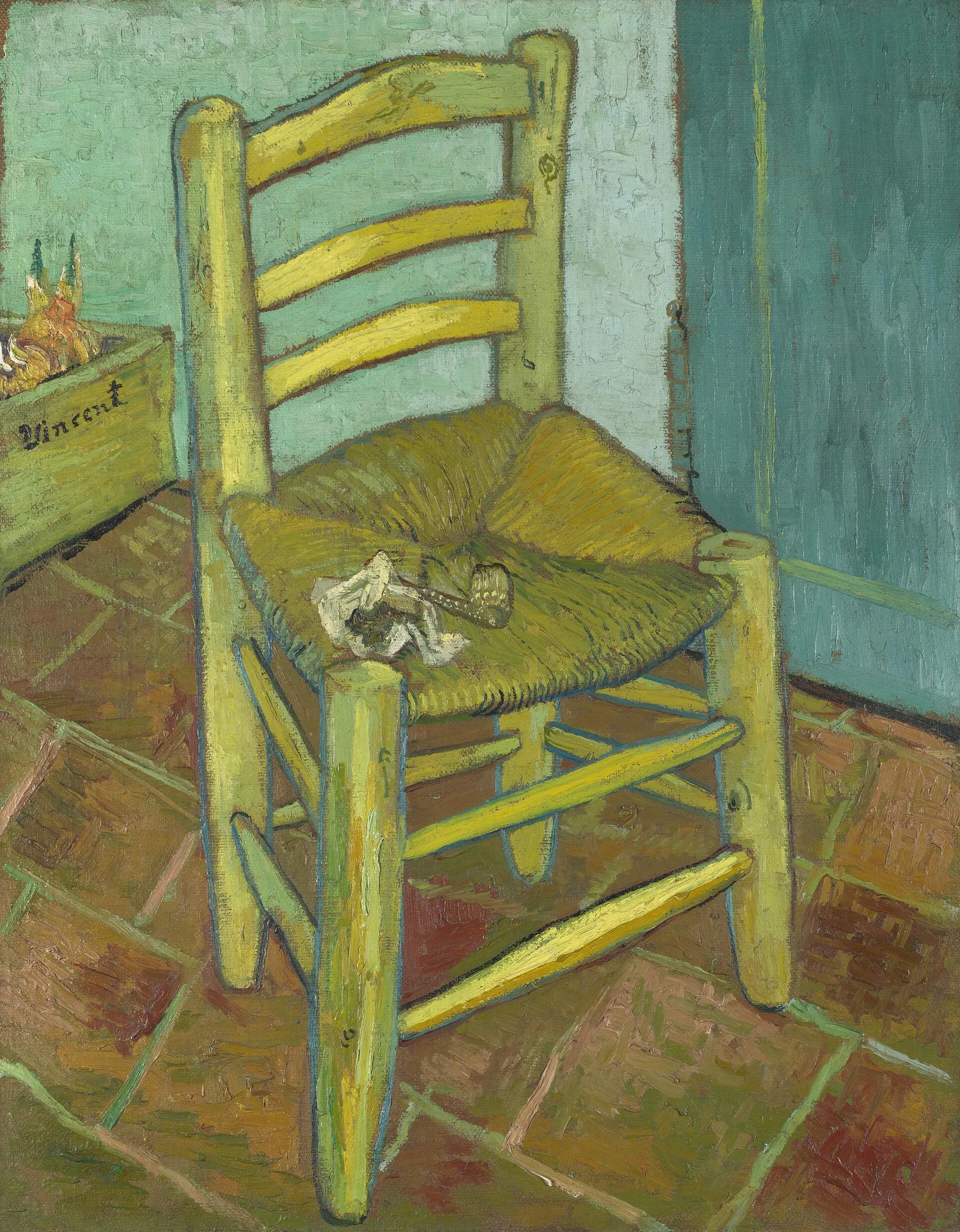
Van Gogh's Chair is a painting by Vincent van Gogh, dated 1889, and held in the collection of the National Gallery. A plain wooden chair with a pipe and tobacco on its seat stands in for the artist himself, painted in strong yellows, blues and reds. At 91.8 by 73 cm, it is close to the scale of the real object it shows.
Where to see it
Van Gogh's Chair belongs to the National Gallery, which is listed as both its collection and its location. Paintings in large collections are sometimes moved between rooms, taken off view for conservation or lent to other venues, so check the National Gallery's official website for the current display status before you plan your visit.
What to look for in person
An everyday chair as a self-portrait
The subject is a simple rustic chair with a woven rush seat, the kind found in modest homes in the south of France. There is no figure, yet the painting is widely read as a portrait of its owner. On the seat lie a pipe and a small packet of tobacco, personal objects that suggest the artist has only just stood up. Look at how the chair fills almost the entire canvas, pressed close to the viewer, so that this ordinary piece of furniture takes on the presence of a person.
Colour working in pairs
Step back and notice how the colours are set against one another. The warm yellow of the chair and the orange-red of the tiled floor are played off against the cool blue-green of the door and wall behind. Van Gogh was deeply interested in contrasting colours and their power to intensify each other. Up close, follow the dark outlines that trace the chair's legs and rungs; they hold the bright areas of colour in place, much like the bold contours he admired in Japanese prints.
The tilted floor and the box of onions
The viewpoint is unusual: you seem to look down on the chair from above, while the floor tiles rise steeply towards the back wall. This tipped perspective gives the composition a slightly unsteady energy. In the upper left corner, look for a wooden box holding sprouting onions. On that box Van Gogh painted his first name, Vincent, the way he often signed his work. Take time with the brushwork too: the paint is applied in visible, directional strokes that describe the grain of the wood and the weave of the seat.
About the painting
Van Gogh's Chair is one of the best-known still lifes by Vincent van Gogh, the Dutch painter whose short career produced a remarkable body of work in a little over a decade. The painting is linked to his time in the south of France, where he hoped to set up a community of artists and invited Paul Gauguin to join him. Van Gogh painted his own chair as a companion piece to a second canvas showing Gauguin's armchair, and the two works are generally understood as a pair that contrasts the two men. Where Gauguin's chair is shown as a more elegant piece of furniture, lit at night and holding a candle and books, Van Gogh's is a sturdy, plain chair seen in daylight, carrying only a pipe and tobacco. Many viewers read this contrast as a reflection of how Van Gogh saw himself: simple, rooted in everyday life and close to the working people he often painted. The choice to represent a person through an empty chair also gives the picture a quiet, personal mood that has made it widely recognised beyond the world of art history. The canvas measures 91.8 by 73 cm and is dated 1889 in the record used for this page. It is part of the National Gallery's collection. When you stand in front of it, it is worth taking a moment to imagine its missing partner, since the painting was conceived as one half of a conversation between two artists with very different ideas about how art should be made.
Key facts
| Artist | Vincent van Gogh |
|---|---|
| Date | 1889 |
| Size | 91.8 × 73 cm |
| Medium | oil paint, canvas |
| Collection | National Gallery |
How to visit: National Gallery
London, United Kingdom · Museum guide
| Opening hours | Mon–Thu, Sat, Sun 10:00–18:00 Fri 10:00–21:00 (Friday late) |
|---|---|
| Closed | 24–26 December and 1 January. |
| Admission | General admission (collection) free; donations invited Some exhibitions are charged (e.g. Renoir and Love, until 31 Jan 2027) |
| Free entry | General admission is always free. |
| Booking | No reservation or timed entry is required. Free timed booking gives fast-track entry. |
Building work and improvements are under way: some rooms are closed and some paintings have moved, so check the floorplans or collection search before visiting. A new Research Centre is due to open in 2028. On 17 November only, some east wing rooms and the Espresso Bar close from 16:00.
Official ticket page
Official website
View on map
Hours and prices can change. Please check the official website before you go. (Checked on: 2026-11-11)
More by Vincent van Gogh
 Café Terrace at Night — Kröller-Müller Museum
 Prisoners Exercising
 White House at Night
 The siesta (after Millet) — Musée d'Orsay
 The Church at Auvers — Musée d'Orsay
 Portrait of Père Tanguy
 Almond Blossom — Van Gogh Museum
 Starry Night Over the Rhône — Musée d'Orsay
 The Potato Eaters — Van Gogh Museum
 The Red Vineyard
 The Yellow House — Van Gogh Museum
 Agostina Segatori Sitting in the Café du Tambourin — Van Gogh Museum