Art! Art! Art! › Works
Almond Blossom
 Vincent van Gogh, 1890
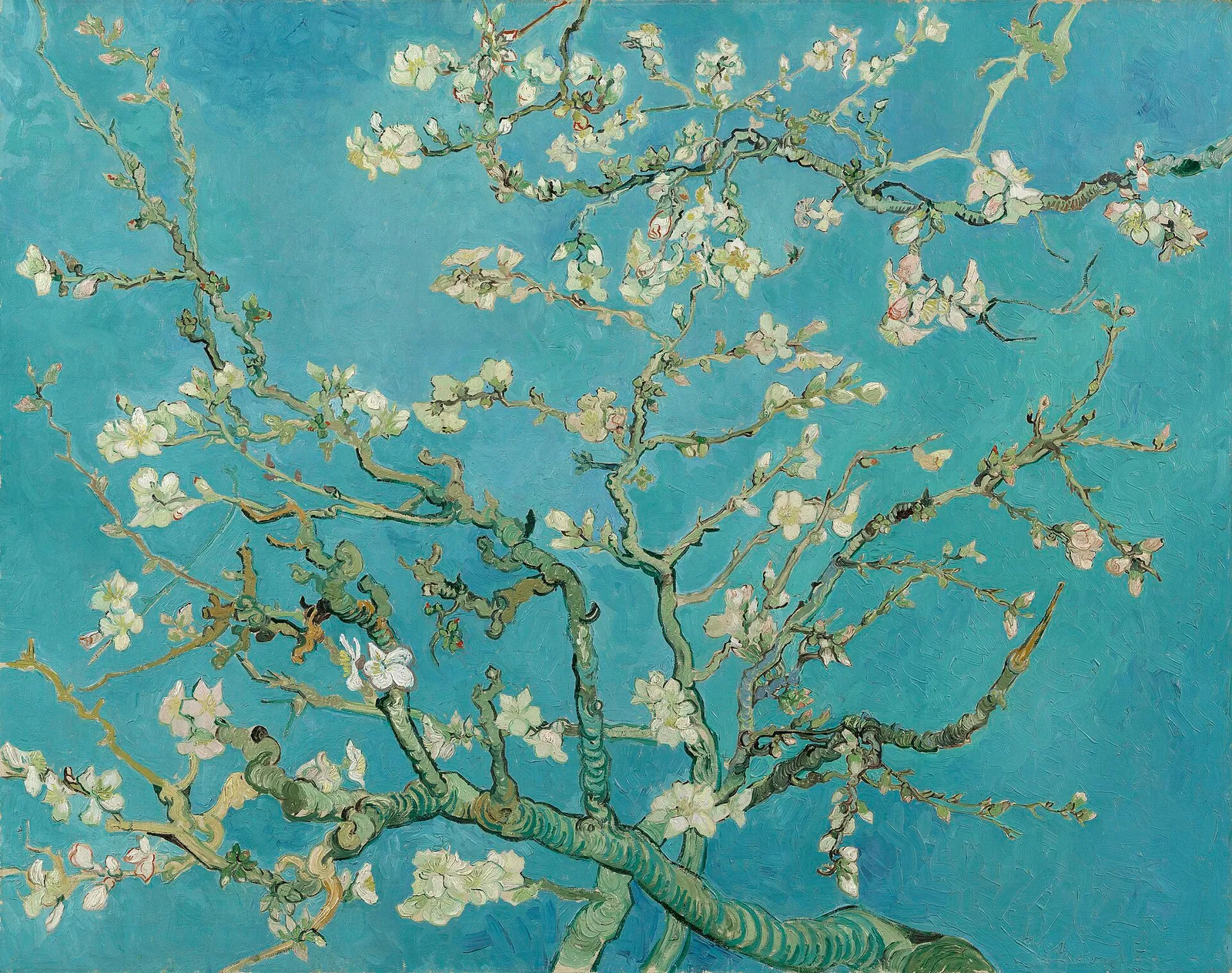
Vincent van Gogh's Almond Blossom, painted in 1890, is held by the Van Gogh Museum. Flowering branches spread across a clear blue sky, a work Van Gogh made to mark the birth of his nephew.
Where to see it
Almond Blossom is in the collection of the Van Gogh Museum, which is also its listed location. The canvas measures 73.5 x 92.4 cm, a moderate size that rewards both a step back and a closer look. Display arrangements can change, so check the Van Gogh Museum's official website for current display status before you visit.
What to look for in person
Branches against an open sky
Start by noticing what is missing. There is no trunk, no ground and no horizon, only branches entering from the edges of the canvas and twisting across a flat field of blue. You seem to be looking up into the tree from below. This close cropping, the strong outlines and the even background reflect Van Gogh's well-documented interest in Japanese woodblock prints, which he collected and studied. Stand back first to take in the pattern the branches make across the whole surface.
The blossoms up close
Move closer and look at the flowers themselves. Some are fully open and others are still tight buds, so the branches seem to be caught at an early moment of the season. The white petals are built up with thick paint that stands slightly off the canvas, and dark contour lines help them stand out against the sky. Then look at the blue background: it is not a smooth wash but is laid down in visible brushstrokes. That contrast between flat colour and textured paint is easy to miss from a distance.
A painting for a new baby
Van Gogh made this picture for his brother Theo and Theo's wife, Jo, after the birth of their son, who was named Vincent Willem after his uncle. Almond trees flower very early in the year, so blossoming branches suit the theme of new life and new beginnings. The painting stayed in the family, and the family's holdings of Van Gogh's work later formed the core of the Van Gogh Museum's collection. Knowing this personal purpose helps explain the work's calm, celebratory tone.
About the painting
Almond Blossom dates from 1890, the last year of Vincent van Gogh's life. He painted it while living in the south of France, after the news reached him that his brother Theo and sister-in-law Jo had a son and had named the boy after him. Rather than a conventional portrait or a scene with figures, Van Gogh chose a subject that carried the idea of renewal: almond trees, which come into flower at the very start of spring. The painting was a gift for the new family, and it remained in their possession.
The composition draws on lessons Van Gogh had absorbed from Japanese prints during his years in Paris and after. Like many of those prints, it isolates a detail of nature, cuts it off at the edges of the picture, and sets it against a flat, bright ground. Dark outlines define the branches, and the blossoms read as a decorative pattern as much as a view of a real tree. At the same time, the handling of the paint is unmistakably Van Gogh's own, with thick, deliberate touches in the flowers and visible strokes in the sky.
The canvas measures 73.5 by 92.4 cm, a landscape format that lets the branches stretch sideways across the surface. For visitors, the work is a useful counterpoint to Van Gogh's more turbulent landscapes: it is quiet, balanced and closely observed. Spend time on the transitions between open flowers and buds, and on the way the blue background shifts subtly in tone, before stepping back to see how the whole picture works as a single design.
Key facts
| Artist | Vincent van Gogh |
|---|---|
| Date | 1890 |
| Size | 73.5 × 92.4 cm |
| Medium | oil paint, canvas |
| Collection | Van Gogh Museum |
How to visit: Van Gogh Museum
Amsterdam, Netherlands · Museum guide
| Opening hours | 2–30 Nov 2026, daily 09:00–17:00 (Fri until 21:00, except 27 Nov) 1–18 Dec 2026, daily 09:00–17:00 (Fri until 21:00) 19–23 and 27–30 Dec 2026: 09:00–18:00 24, 25, 26 and 31 Dec 2026: 09:00–17:00 1 Jan 2027: 11:00–18:00 2–10 Jan 2027: 09:00–18:00 (Fri until 21:00) 11 Jan – 12 Feb 2027: 09:00–17:00 (Fri until 21:00) 13–28 Feb 2027: 09:00–18:00 (Fri until 21:00, except 26 Feb) March–September 2027: 09:00–18:00 (Fri until 21:00, except 26 Mar, 28 May, 30 Jul, 24 Sep) 1–3 and 11–31 Oct 2027: 09:00–18:00 (Fri until 21:00) 4–10 Oct 2027: from 09:00 (Mon–Thu until 17:00, Fri until 21:00, Sat–Sun until 18:00) 1–7 Nov 2027: 09:00–18:00 (Fri until 21:00) 8–30 Nov and 1–23 Dec 2027: 09:00–17:00 (Fri until 21:00, except 26 Nov) 24–26 and 31 Dec 2027: 09:00–17:00 27–30 Dec 2027: 09:00–18:00 |
|---|---|
| Closed | Open daily with no regular closing day (25 December 09:00–17:00, 1 January 11:00–18:00). |
| Admission | Adult EUR 25 (from 1 January 2027: EUR 26) Adult with multimedia guide EUR 28.75 (from 1 January 2027: EUR 30) Under 18 free (timed ticket still required) Student (EU/EEA institution) EUR 16 (valid until 31 December 2026; proof of enrolment required) Museumkaart, Vincent's Friends, VriendenLoterij VIP-KAART, ICOM, Rembrandt card, Stadspas holders free (reserve a free timed ticket online) |
| Free entry | Free for under-18s and holders of the Museumkaart, Vincent's Friends, VriendenLoterij VIP-KAART, ICOM card, Rembrandt card or Stadspas (a timed ticket must still be booked online). A companion of a visitor needing assistance is also free. The I amsterdam City Card has not been valid since 1 June 2022. |
| Booking | Booking is required, with timed-entry tickets. |
Official ticket page
Official website
View on map
Hours and prices can change. Please check the official website before you go. (Checked on: 2026-11-09)
More by Vincent van Gogh
 Café Terrace at Night — Kröller-Müller Museum
 Van Gogh's Chair — National Gallery
 Prisoners Exercising
 White House at Night
 The siesta (after Millet) — Musée d'Orsay
 The Church at Auvers — Musée d'Orsay
 Portrait of Père Tanguy
 Starry Night Over the Rhône — Musée d'Orsay
 The Potato Eaters — Van Gogh Museum
 The Red Vineyard
 The Yellow House — Van Gogh Museum
 Agostina Segatori Sitting in the Café du Tambourin — Van Gogh Museum