Art! Art! Art! › Works
Prisoners Exercising
 Vincent van Gogh, 1890
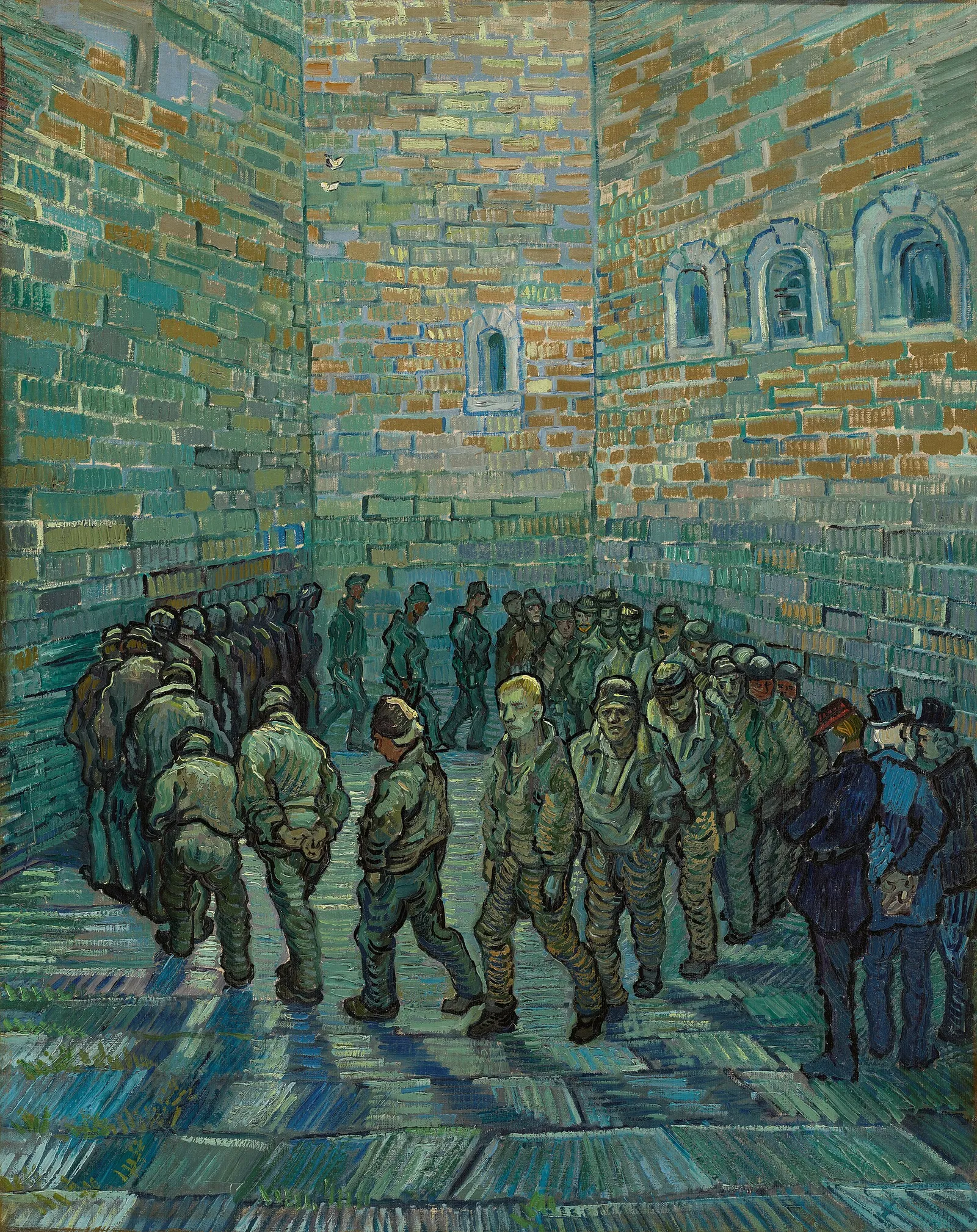
Prisoners Exercising is an 1890 painting by Vincent van Gogh in the collection of the Pushkin Museum of Fine Arts. It shows a ring of men walking in a closed prison yard, painted in a tall, upright format of 80 x 64 cm. In front of it, the walls, the circling figures and the restless brushwork are what hold your attention.
Where to see it
Prisoners Exercising is held by the Pushkin Museum of Fine Arts. Displays can change because of rehanging, conservation or loans, so check the Pushkin Museum of Fine Arts' official website for current display status, opening hours and ticket information before you visit.
What to look for in person
A circle with no way out
Start with the ring of prisoners at the bottom of the canvas. The men walk one behind another in a tight loop, heads mostly bowed, their bodies pressed close together. Follow the circle with your eye and notice how it returns to where it began. The composition gives the walk no destination. The repetition of hunched shoulders, dark caps and shuffling legs makes the movement feel endless rather than lively, and that sense of routine is central to how the scene works on a viewer.
Walls that fill the picture
Step back and look at how much of the canvas is given to brick walls. The upright 80 x 64 cm format pushes the walls high, so the prisoners occupy only a small floor of space at the base. Very little suggests open air above. Look closely at the bricks: they are not drawn evenly but built up from short, directional strokes in blues, greens and muted violets. The surface seems to shift as you look, which keeps the enclosing walls from feeling flat or static.
Colour and the watchers
Notice the cool palette. Van Gogh keeps much of the scene in blue-green and grey tones, with only small touches of warmer colour, which reinforces the chill of the yard. Then find the small group of figures standing apart at the lower right, outside the circle. Dressed differently and standing still, they watch the prisoners move. The contrast between the moving ring and the stationary observers is easy to miss at first, but it adds a quiet sense of supervision and control to the scene.
About the painting
Vincent van Gogh painted Prisoners Exercising in 1890, during the final year of his life. It is one of a group of works from this period in which he reworked images by other artists, translating them into his own colour and brushwork. Rather than copying exactly, he treated his sources the way a musician might interpret a score: the composition came from elsewhere, but the handling of paint and choice of colour were his own. The source for this painting is widely identified as a black-and-white print by the French illustrator Gustave Doré, showing an exercise yard in a London prison. Comparing the two is useful if you can find a reproduction of the print beforehand. Van Gogh kept the essential arrangement of a closed yard and a ring of walking men, but replaced Doré's tonal contrasts with colour, turning a documentary illustration into a painting with strong emotional charge. For visitors, the painting rewards both distance and close looking. From across the room, the overall shape reads clearly: towering walls, a cramped floor and the slow circle of figures. Up close, the canvas breaks into individual strokes, and you can see how Van Gogh varied their direction to describe brick, stone and clothing. The work is often discussed in connection with Van Gogh's own circumstances at the time, when he was living under medical care and had limited freedom of movement. That reading is common, but the painting can also be appreciated simply as a study of confinement, rhythm and colour. Take a few minutes to follow the circle of prisoners more than once; the experience of looking mirrors the subject itself.
Key facts
| Artist | Vincent van Gogh |
|---|---|
| Date | 1890 |
| Size | 80 × 64 cm |
| Medium | oil paint, canvas |
| Collection | Pushkin Museum of Fine Arts |
How to visit: Pushkin Museum of Fine Arts
Moscow, Russia
Hours and prices can change. Please check the official website before you go.
More by Vincent van Gogh
 Café Terrace at Night — Kröller-Müller Museum
 Van Gogh's Chair — National Gallery
 White House at Night
 The siesta (after Millet) — Musée d'Orsay
 The Church at Auvers — Musée d'Orsay
 Portrait of Père Tanguy
 Almond Blossom — Van Gogh Museum
 Starry Night Over the Rhône — Musée d'Orsay
 The Potato Eaters — Van Gogh Museum
 The Red Vineyard
 The Yellow House — Van Gogh Museum
 Agostina Segatori Sitting in the Café du Tambourin — Van Gogh Museum