Art! Art! Art! › Works
Two Chained Monkeys
 Pieter Bruegel the Elder, 1562
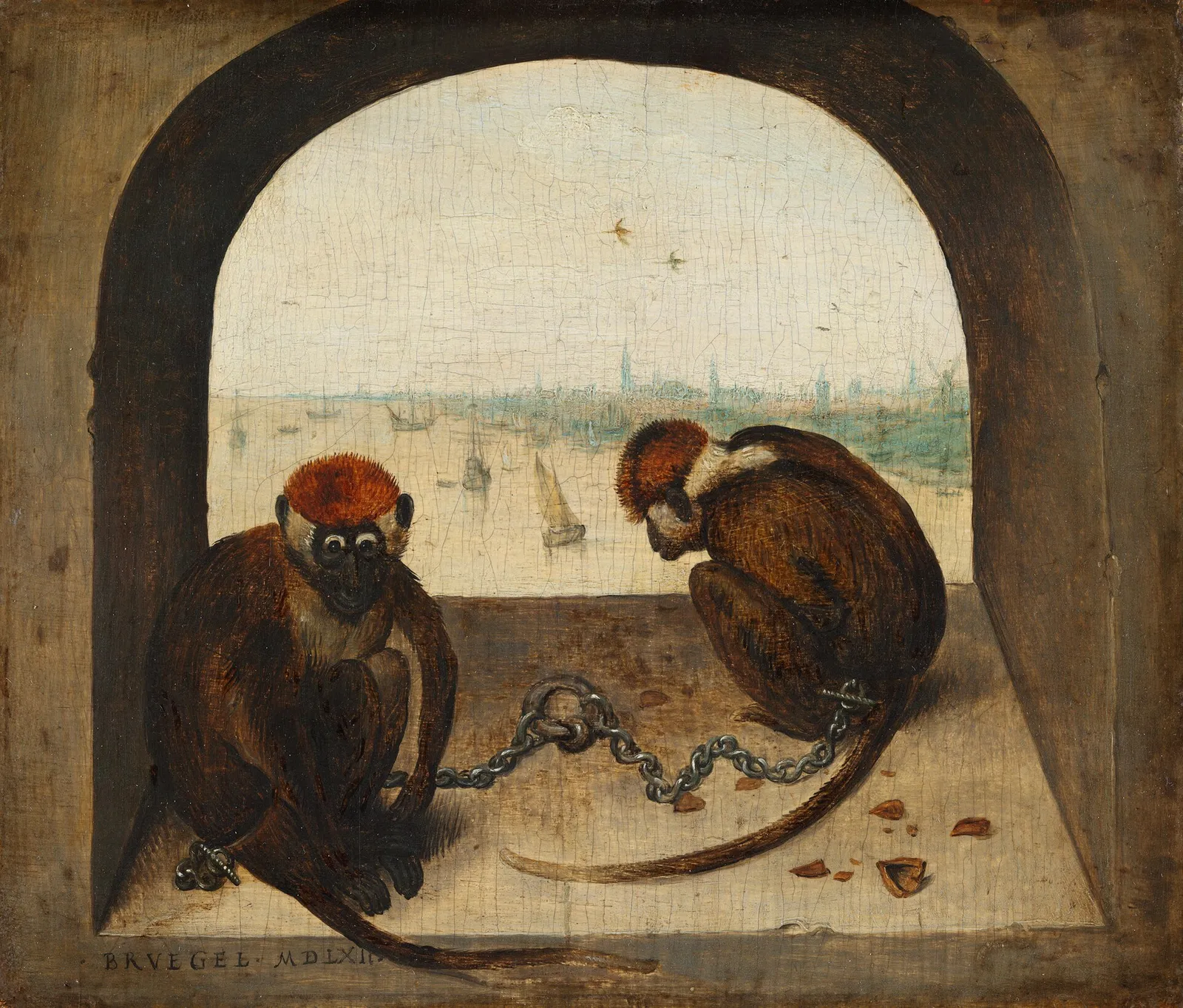
Two Chained Monkeys, painted by Pieter Bruegel the Elder in 1562, is in the collection of the Gemäldegalerie Berlin. At just 20 by 23 cm, it shows two monkeys chained inside a stone window opening, with a hazy view of water and a distant city beyond. The picture is small enough that it rewards a slow, close look.
Where to see it
Two Chained Monkeys is held by the Gemäldegalerie Berlin, which is also its listed location. Display arrangements can change, so check the museum's official website for the painting's current display status, opening hours and ticket information before you visit. The panel measures only 20 × 23 cm, so allow time to stand close and study its details.
What to look for in person
The chain, the ring and two contrasting poses
Start with the iron chain. Both monkeys are fastened to a single ring set into the stone, and Bruegel paints the links with care. Notice how differently the two animals sit. One faces outward toward the open view, while the other turns away, hunched, with its head lowered. Their fur is soft and closely observed, and it stands out against the hard, cold masonry around them. This contrast between living creature and fixed restraint is the core of the image, and it is what most visitors remember.
The view through the arch
Look past the monkeys through the arched opening. Behind them lies a wide, pale landscape of water, boats and a city skyline, painted in thin, misty tones. This distant scene is commonly identified as the port of Antwerp on the river Scheldt, the city where Bruegel was working at the time. The open, airy space outside heightens the sense of confinement in the foreground. The shift from crisp detail on the window ledge to soft haze on the horizon shows Bruegel's control of atmosphere, even on a very small panel.
Small details on the ledge
Bring your eyes down to the stone sill. Near the monkeys lie a few empty nutshells, a detail many viewers miss at first. Scholars have linked these shells to moralising ideas of the period in the Netherlands, such as the folly of giving up something valuable for a trifle, though no single reading is settled. Bruegel also signed and dated the painting, so look for the inscription as you scan the surface. Because the panel is so compact, it is worth stepping in close to catch these quiet touches.
About the painting
Pieter Bruegel the Elder is best known for crowded, busy scenes of peasants, proverbs and biblical stories set in sweeping landscapes. Two Chained Monkeys is very different. Dated 1562, it is one of his smallest known paintings, measuring 20 by 23 cm, and it contains no human figures and no obvious narrative. Instead it focuses on two animals and the window opening that confines them.
In the sixteenth century, monkeys reached the Low Countries through long-distance trade and were kept as exotic curiosities. In Netherlandish art and literature they often carried symbolic weight, standing for folly, vanity, sin or the foolish side of human nature. That tradition is the starting point for most interpretations of this picture. Many writers read the chained animals as an image of people who have lost their freedom through their own foolishness or attachment to worldly things, an idea that the nutshells on the ledge may reinforce.
Other readings have been proposed, and the painting's meaning remains open. What is clear is the strong visual contrast Bruegel builds: the tethered animals in the dark stone frame set against the bright, open harbour behind them. Whatever its intended message, the composition invites viewers to think about confinement and freedom.
The painting has also found a life beyond art history. The Polish poet Wisława Szymborska wrote a well-known poem inspired by it, which has drawn many readers to the picture. Today it is in the collection of the Gemäldegalerie Berlin, where its modest size makes it an intimate work to stand in front of, quite unlike Bruegel's larger, crowded panoramas.
Key facts
| Artist | Pieter Bruegel the Elder |
|---|---|
| Date | 1562 |
| Size | 20 × 23 cm |
| Medium | oil paint, oak panel |
| Collection | Gemäldegalerie Berlin |
How to visit: Gemäldegalerie Berlin
Berlin, Germany · Museum guide
| Opening hours | Tue–Sun 10:00–18:00 |
|---|---|
| Closed | Closed Mondays. Closed 24 Dec 2026 and 31 Dec 2026. Open Sunday hours on 25–26 Dec 2026; 1 Jan 2027 12:00–18:00. Most other public holidays: Sunday hours. |
| Admission | Adult (Paintings from the 13th to 18th century) EUR 14 Reduced (schoolchildren, apprentices, students, severely disabled, etc.; ID required) EUR 7 Adult incl. special exhibition “Portraits!” (16 Oct 2026 – 14 Mar 2027) EUR 16 (reduced EUR 8) Kulturforum-Ticket (all Kulturforum museums, one day) EUR 22 (reduced EUR 11) Under 18 free (free ticket required, at the counter or online) |
| Free entry | Free with a free ticket and proof for children and young people up to 18, school groups, ICOM/German Museums Association members, friends' association members, press, recipients of Bürgergeld and similar benefits, required companions of severely disabled persons, and annual-pass holders. |
| Booking | Booking is recommended; there is no timed entry. Tickets can be bought up to four weeks in advance. |
Official ticket page
Official website
View on map
Hours and prices can change. Please check the official website before you go. (Checked on: 2026-11-09)
More by Pieter Bruegel the Elder
 The Beggars — Louvre Museum
 The Hunters in the Snow — Kunsthistorisches Museum
 Netherlandish Proverbs — Gemäldegalerie Berlin
 The Land of Cockaigne — Alte Pinakothek
 The Fall of the Rebel Angels
 The Peasant Wedding — Kunsthistorisches Museum
 The Triumph of Death — Museo del Prado
 The Fight Between Carnival and Lent — Kunsthistorisches Museum
 Children's Games — Kunsthistorisches Museum
 The Harvesters — Metropolitan Museum of Art
 Dull Gret
 The Peasant Dance — Kunsthistorisches Museum