Art! Art! Art! › Works
The Land of Cockaigne
 Pieter Bruegel the Elder, 1550
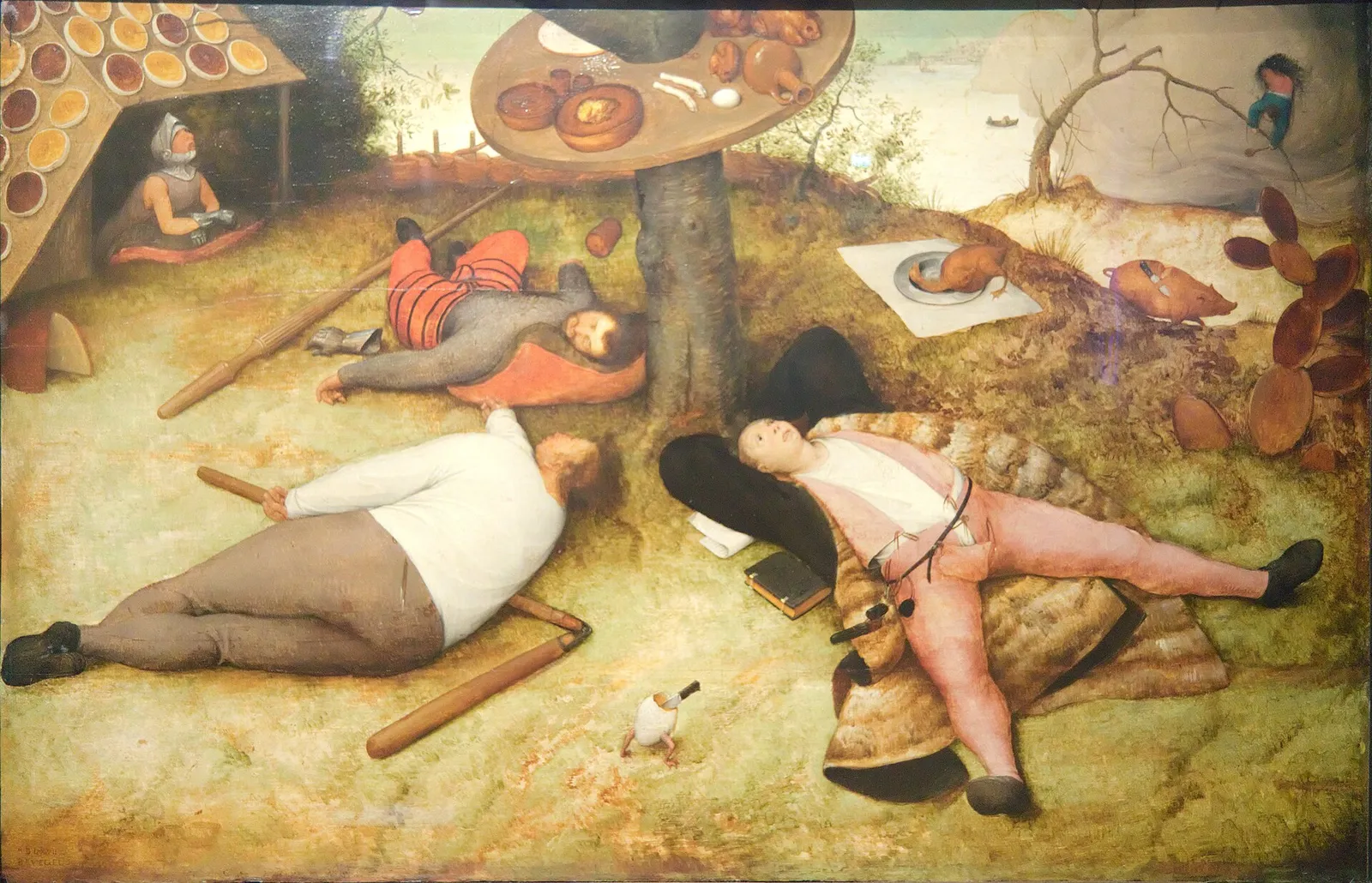
Pieter Bruegel the Elder's The Land of Cockaigne shows three men sprawled beneath a tree in a mythical country where food serves itself. It belongs to the Bavarian State Painting Collections and is housed at the Alte Pinakothek. At 51.5 × 78.3 cm, it is a modest-sized picture that rewards close, slow looking.
Where to see it
The Land of Cockaigne is held by the Bavarian State Painting Collections and is located at the Alte Pinakothek. Display arrangements can change because of rehanging, conservation or loans, so check the Alte Pinakothek's official website for current display status, opening hours and ticket information before you visit. The painting measures 51.5 × 78.3 cm, so allow time to stand close and study its many small details.
What to look for in person
Three sleepers, three walks of life
Start with the figures at the centre. Three men lie on the ground around a tree whose trunk supports a round tabletop. They are usually read as representatives of different social types: a peasant with his flail, a soldier or knight with his armour and lance set aside, and a clerk or scholar lying on his coat. None of them is working. Notice how their bodies point outward from the tree like the spokes of a wheel, a layout that makes the idleness feel total and shared.
Food that offers itself
Look around the edges for the jokes that define Cockaigne, a land where nobody needs to labour for a meal. A roofed shelter is covered with flat cakes or tarts, and a figure in armour waits beneath it with his mouth open for food to drop in. A roast pig trots past with a knife already stuck in its side, and a boiled egg moves along on little legs. These details are small, so move closer to spot each one.
Entering through the pudding
In the upper part of the painting, find a man pushing his way out of a great mass of porridge or pudding, holding a spoon. According to the old story, a traveller had to eat through such a mountain to reach Cockaigne. His arrival frames the whole scene as a destination of excess. Compare his effort with the motionless men in the foreground: the one act of effort in the picture is spent on reaching a place where no further effort will be needed.
About the painting
The idea of Cockaigne, a fantasy land of endless food and no work, was familiar in European popular literature and in proverbial culture in the Low Countries, where it was known as Luilekkerland, roughly the land of lazy delights. Bruegel turns this comic tale into a compact, carefully organised painting. Rather than celebrating abundance, the picture is widely understood as a gentle satire on gluttony and sloth, two of the traditional deadly sins, and on people of every station who give in to them.
What makes the painting work in front of you is its design. The tree and its circular table act as a hub, and the three reclining men fan out around it. The ground tilts upward, which lets the viewer see every figure and every edible detail clearly, almost as if looking down at a tabletop. Bruegel keeps the scene uncrowded compared with some of his larger, busier compositions, so each joke has space to register.
The humour is deadpan. Food is shown doing the work that people refuse to do: the pig runs up ready to be carved, the egg walks itself over, the roof supplies cakes on demand. The men, meanwhile, are heavy and still, their tools and symbols of status lying unused beside them. The effect is less a cautionary sermon than a sly observation, inviting the viewer to laugh and then to wonder whether the joke applies to them too.
Because the painting is relatively small, it is best viewed at close range. Give yourself several minutes to scan from the central figures out to the margins, where many of the details are found.
Key facts
| Artist | Pieter Bruegel the Elder |
|---|---|
| Date | 1550 |
| Size | 51.5 × 78.3 cm |
| Medium | oil paint, panel |
| Collection | Bavarian State Painting Collections |
How to visit: Alte Pinakothek
Munich, Germany · Museum guide
| Opening hours | Thu–Sun 10:00–18:00 Tue–Wed 10:00–20:00 |
|---|---|
| Closed | Closed on Mondays. Also closed on Shrove Tuesday (17.02.2026), Labour Day (01.05.), Christmas Eve (24.12.), Christmas Day (25.12.) and New Year's Eve (31.12.). Open until 18:00 on Epiphany, Easter (Good Friday to Easter Monday), Whitsun, Boxing Day, New Year's Day and, in 2026, on Ascension Day, Assumption Day, German Unity Day and All Saints' Day. |
| Admission | Adult (permanent collection) EUR 9 Reduced (students, visitors 65+, severely disabled visitors, groups of 15+) EUR 6 (ID required) Under 18 free Sundays (all visitors) EUR 1 Combined ticket (Alte Pinakothek, Pinakothek der Moderne, Museum Brandhorst, Sammlung Schack, one day) EUR 12 (museum ticket office only; excludes paid special exhibitions) Annual ticket EUR 90 (reduced EUR 60) |
| Free entry | Free for under-18s. Sundays cost EUR 1. Special exhibitions may be priced separately. |
| Booking | No reservation is needed and there is no timed entry. |
The Neue Pinakothek is closed for renovation, with reopening planned for 2029; a selection of its 19th-century main works is shown on the ground floor of the Alte Pinakothek (East Wing) and in Sammlung Schack. No closure of the Alte Pinakothek itself has been announced.
Official ticket page
Official website
View on map
Hours and prices can change. Please check the official website before you go. (Checked on: 2026-11-09)
More by Pieter Bruegel the Elder
 Two Chained Monkeys — Gemäldegalerie Berlin
 The Beggars — Louvre Museum
 The Hunters in the Snow — Kunsthistorisches Museum
 Netherlandish Proverbs — Gemäldegalerie Berlin
 The Fall of the Rebel Angels
 The Peasant Wedding — Kunsthistorisches Museum
 The Triumph of Death — Museo del Prado
 The Fight Between Carnival and Lent — Kunsthistorisches Museum
 Children's Games — Kunsthistorisches Museum
 The Harvesters — Metropolitan Museum of Art
 Dull Gret
 The Peasant Dance — Kunsthistorisches Museum