Art! Art! Art! › Works
Children's Games
 Pieter Bruegel the Elder, 1560
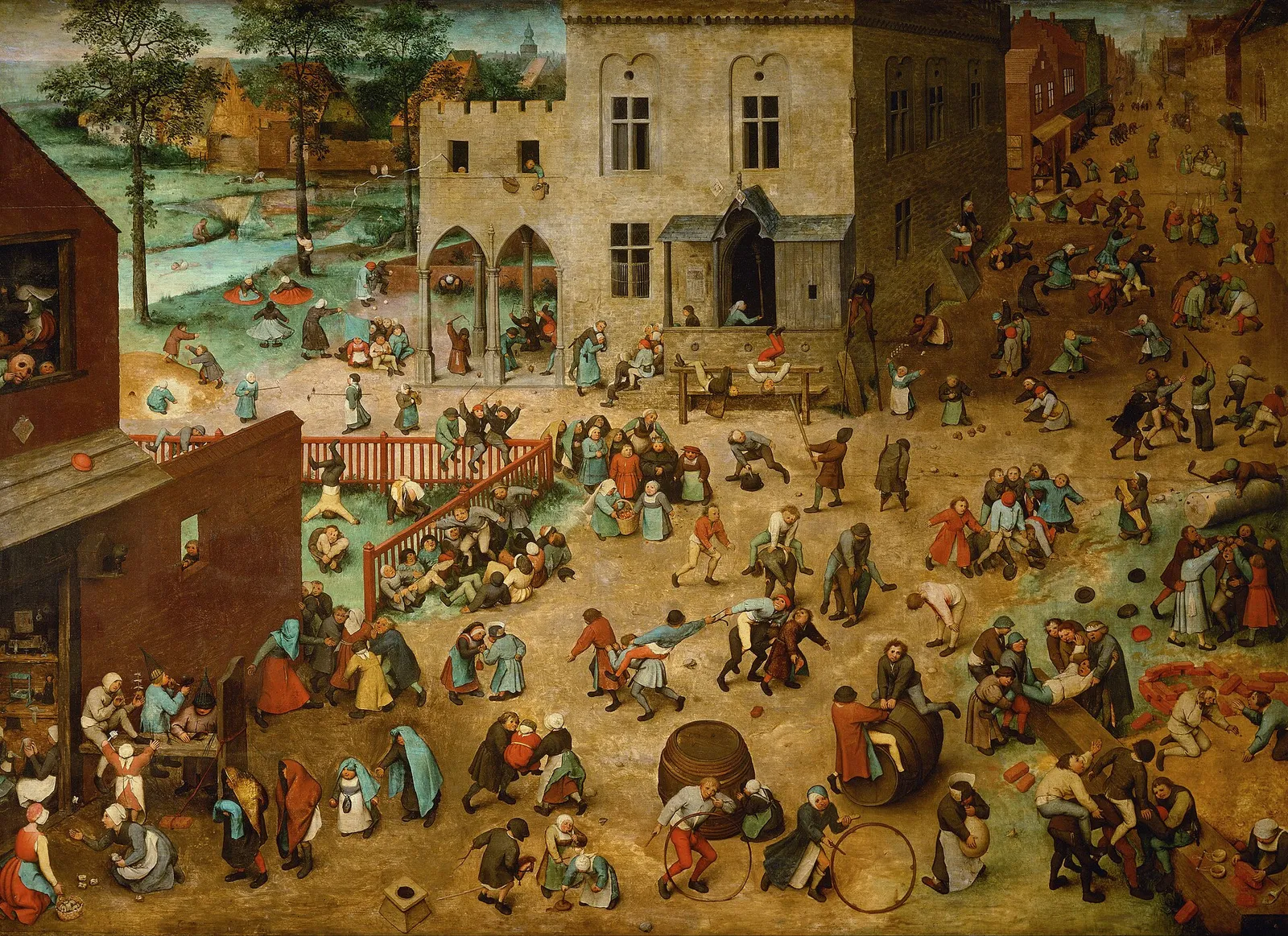
Pieter Bruegel the Elder's Children's Games, dated 1560, fills an entire town with children at play. It belongs to the Kunsthistorisches Museum, where its wealth of small figures rewards slow, close looking.
Where to see it
Children's Games is in the collection of the Kunsthistorisches Museum. Display arrangements can change because of rehanging, conservation or loans, so check the museum's official website for current display status, opening hours and ticket information before you visit.
What to look for in person
A town turned into a playground
Step back first and take in the whole scene. Bruegel sets out a square and a long street from a high viewpoint, so the ground seems to tilt toward you and every corner fills with figures. Children occupy the open space, the doorways, the steps of the large building on the right and the street running into the distance. At 118 by 161 centimetres the picture works at two distances: from afar it reads as a lively pattern of colour, and up close it breaks into many separate, self-contained games.
Finding individual games
Move closer and try to name what you see. Many games are still recognisable today: leapfrog, rolling hoops, walking on stilts, spinning tops, blind man's buff, handstands and climbing. Others are less familiar, such as games played with knucklebones, or children imitating adult ceremonies like a wedding procession. Bruegel shows each group mid-action, with bodies bent, arms flung out and balance about to be lost. A useful way to look is to choose one area, such as the foreground or a single doorway, and count the different activities before moving on.
Sturdy figures and the open edge
Notice that Bruegel's children are not idealised. Many have solid, heavy bodies and plain, almost grown-up faces, and they play with real physical effort: pulling, pushing, straddling and tumbling. Then look at the left side of the composition, where the street opens toward trees and water, offering a calmer view beyond the noise of the square. Comparing the crowded foreground with this open space shows how the artist organised the picture, using the long diagonal of the street and the solid block of the building to hold the many small figures together.
About the painting
Children's Games was painted by Pieter Bruegel the Elder and is dated 1560. It measures 118 by 161 centimetres and is held by the Kunsthistorisches Museum. Bruegel was a leading Netherlandish painter of the sixteenth century, known for crowded scenes of everyday life, landscapes and subjects drawn from popular culture. Around this period he produced several large compositions packed with small figures seen from above, an approach that invites viewers to explore a picture section by section rather than take it in at a single glance. Children's Games is one of the clearest examples. There is no single main event: instead, the eye travels from group to group, each absorbed in its own activity. For historians the painting is a valuable visual record of how children played in the Low Countries, since many of the games can be identified and some survive in similar forms today. Scholars have also debated what, if anything, Bruegel meant by it. Some read the scene as a straightforward, observant catalogue of play; others suggest it carries a moral message, with the children's earnest seriousness mirroring the follies of adult life. These readings are not mutually exclusive, and the painting does not settle the question. For the visitor, the most rewarding approach is simple: give it time. Pick out a single child, follow what they are doing, and then notice who is watching, joining in or ignoring them. The more closely you look, the more the crowd becomes a collection of individuals.
Key facts
| Artist | Pieter Bruegel the Elder |
|---|---|
| Date | 1560 |
| Size | 118 × 161 cm |
| Medium | oil paint, panel |
| Collection | Kunsthistorisches Museum |
How to visit: Kunsthistorisches Museum
Vienna, Austria · Museum guide
| Opening hours | Mon–Wed, Fri–Sun 10:00–18:00 Thu 10:00–21:00 (late opening) 24 December 10:00–15:00 31 December 10:00–21:00 |
|---|---|
| Closed | Open daily with no regular closing day. Rooms 24, VIII, 14 and IX are currently closed. |
| Admission | Adult (online) EUR 22 (EUR 24 on site) Reduced (online) EUR 19 (EUR 20 on site; EUR 23 with Vienna City Card) Under 19 free (registered at the entrance, no online booking needed) Combined Ticket “Habsburg Treasures” EUR 32 Masterticket EUR 37 |
| Free entry | Free for under-19s and accredited media (register 2 working days ahead). |
| Booking | Reservation is required, with timed entry. |
Official ticket page
Official website
View on map
Hours and prices can change. Please check the official website before you go. (Checked on: 2026-11-09)
More by Pieter Bruegel the Elder
 Two Chained Monkeys — Gemäldegalerie Berlin
 The Beggars — Louvre Museum
 The Hunters in the Snow — Kunsthistorisches Museum
 Netherlandish Proverbs — Gemäldegalerie Berlin
 The Land of Cockaigne — Alte Pinakothek
 The Fall of the Rebel Angels
 The Peasant Wedding — Kunsthistorisches Museum
 The Triumph of Death — Museo del Prado
 The Fight Between Carnival and Lent — Kunsthistorisches Museum
 The Harvesters — Metropolitan Museum of Art
 Dull Gret
 The Peasant Dance — Kunsthistorisches Museum