Art! Art! Art! › Works
Dull Gret
 Pieter Bruegel the Elder, 1563
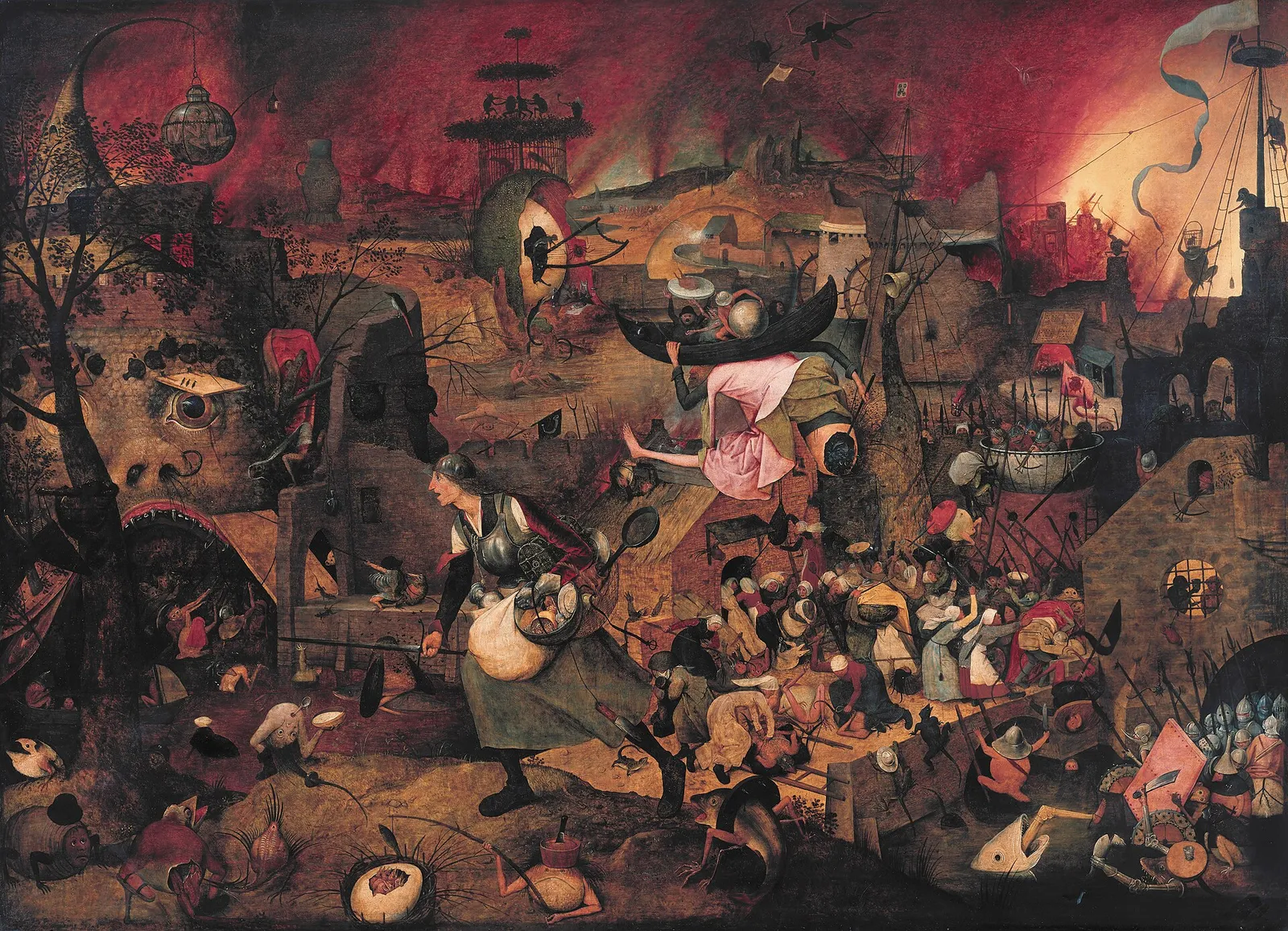
Dull Gret is Pieter Bruegel the Elder's crowded, fire-lit vision of a woman in armour marching toward the mouth of hell, dated 1563. It belongs to the Museum Mayer van den Bergh, and at 117.4 by 162 cm it rewards a slow, close look at its many small scenes.
Where to see it
Dull Gret is in the collection of the Museum Mayer van den Bergh, which is also listed as its location. Display arrangements at any museum can change because of conservation work, rehanging or loans, so check the Museum Mayer van den Bergh's official website for current display status, opening hours and ticket information before you visit.
What to look for in person
The striding central figure
Start with the tall woman at the centre, the Dull Gret of the title. She wears a breastplate and helmet over her ordinary dress, grips a sword, and carries an armful of household goods and loot as she strides across the scene. Notice how she seems oblivious to the chaos around her, her wide-eyed face fixed ahead. Her scale sets her apart from the much smaller figures elsewhere, so she works as an anchor: once you have found her, the rest of the panel can be read outward from her path.
The mouth of hell
Follow the direction she is walking, toward the left side of the painting. There a huge, gaping face forms an entrance into a dark, fortress-like hell, with strange creatures swarming around it. Look closely at the hybrid monsters scattered across this area: part animal, part object, part human. This kind of invented demon is widely seen as Bruegel's response to the fantastical imagery of Hieronymus Bosch, an earlier Netherlandish painter whose work was much admired and imitated in Bruegel's time. Standing close, you will find more creatures than you notice at first.
The crowd and the burning sky
Step back and look behind the central figure. A crowd of smaller women is busy plundering and scuffling with demons, carrying off goods amid the confusion. Above and around them, the sky and background glow with reds and oranges, as if the whole landscape is on fire. This palette ties the scattered episodes together and gives the panel its hot, unsettled mood. Try scanning the picture section by section, left to right, and you will see how Bruegel packs separate incidents into one continuous, crowded world.
About the painting
Pieter Bruegel the Elder was one of the leading painters of the sixteenth-century Netherlands, known for crowded scenes full of incident, peasant life, proverbs and moral satire. Dull Gret, dated 1563 in the fact sheet for this page, belongs to a group of his works that draw on the fantastical, demon-filled imagery associated with Hieronymus Bosch, while adding Bruegel's own interest in everyday people and folk sayings. The title refers to a figure from Flemish folklore, a quarrelsome, aggressive woman whose name became shorthand for that type. In the painting she appears as a determined figure in makeshift armour, laden with plunder, heading toward the entrance of hell as if nothing could frighten her. Around her, other women loot and fight while monsters crowd every corner. The painting measures 117.4 cm high and 162 cm wide, large enough that its details repay time spent in front of it. Viewers often find it helpful to treat the panel like a crowded stage: locate the central figure first, then move slowly through the background episodes and the creatures near the hellmouth. Scholars have offered several readings of the work, and its precise meaning is still discussed; what is clear is that Bruegel combined folklore, satire and an inventive world of demons into a single, tightly packed composition. Today the painting is held by the Museum Mayer van den Bergh. Because the museum's collection and displays may change, it is worth confirming on the official website that the painting is on view before planning a trip specifically to see it.
Key facts
| Artist | Pieter Bruegel the Elder |
|---|---|
| Date | 1563 |
| Size | 117.4 × 162 cm |
| Medium | oil paint, panel, oak panel |
| Collection | Museum Mayer van den Bergh |
How to visit: Museum Mayer van den Bergh
Antwerp, Belgium
Hours and prices can change. Please check the official website before you go.
More by Pieter Bruegel the Elder
 Two Chained Monkeys — Gemäldegalerie Berlin
 The Beggars — Louvre Museum
 The Hunters in the Snow — Kunsthistorisches Museum
 Netherlandish Proverbs — Gemäldegalerie Berlin
 The Land of Cockaigne — Alte Pinakothek
 The Fall of the Rebel Angels
 The Peasant Wedding — Kunsthistorisches Museum
 The Triumph of Death — Museo del Prado
 The Fight Between Carnival and Lent — Kunsthistorisches Museum
 Children's Games — Kunsthistorisches Museum
 The Harvesters — Metropolitan Museum of Art
 The Peasant Dance — Kunsthistorisches Museum