Art! Art! Art! › Works
The Fight Between Carnival and Lent
 Pieter Bruegel the Elder, 1559
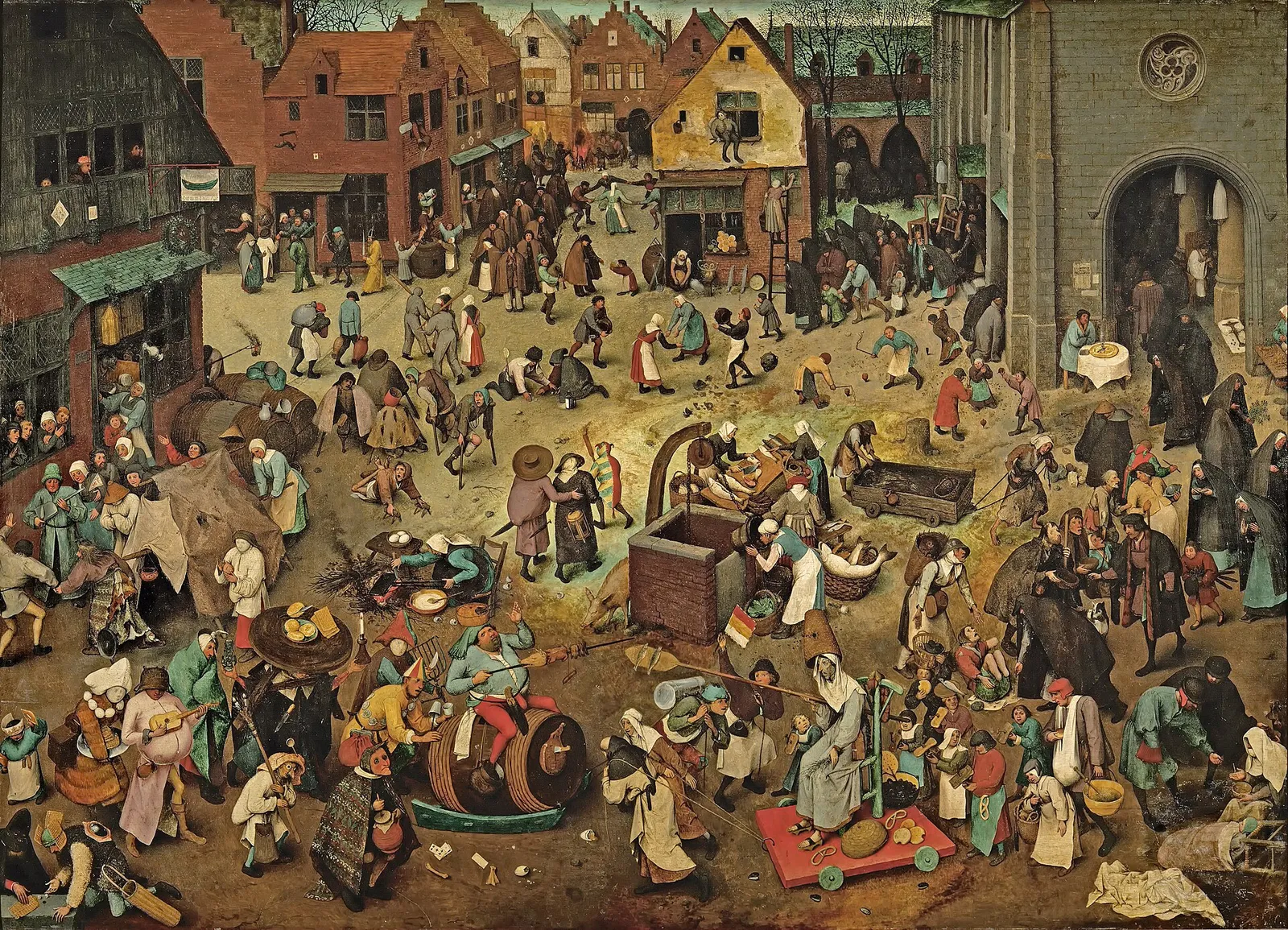
Pieter Bruegel the Elder's The Fight Between Carnival and Lent, dated 1559, turns a crowded town square into a mock contest between feasting and fasting. The painting is in the collection of the Kunsthistorisches Museum, where it rewards slow, close looking.
Where to see it
The Fight Between Carnival and Lent is held by the Kunsthistorisches Museum, which is listed as both its collection and its location. Display arrangements can change because of conservation, rehanging or other reasons. Before you visit, check the museum's official website for current display status, opening hours and ticket information. The painting measures 118 cm high and 164.5 cm wide, so allow time to view it both from a distance and up close.
What to look for in person
The mock joust in the foreground
The scene that gives the painting its title sits in the foreground. On the left, a stout figure representing Carnival rides astride a barrel and brandishes a spit loaded with meat. Facing him from the right, a thin figure representing Lent sits on a cart pulled by people in religious dress and holds out a long wooden paddle bearing two fish. Compare the two processions behind them. Each carries its own food and props, setting rich, indulgent fare against the plain food of the fasting season.
A square split between inn and church
The town square is divided roughly along a diagonal. The left side, near an inn, is given over to eating, drinking, games, music and street performance. The right side, toward a church, shows people leaving worship, giving alms and selling fish. Bruegel does not draw a hard border between the two halves. Figures drift through the middle, and both seasons share the same busy space. Stand back first to take in the overall split, then step closer to follow the smaller scenes on each side.
The couple seen from behind
Near the centre of the picture, close to a well, look for a man and a woman shown from behind. They are led by a figure carrying a lantern. Because they turn away from the viewer, they form a quiet point of focus among the many lively groups around them. Then let your eye move outward. Along the edges and in the background there are beggars, children at play, townspeople at windows and small domestic tasks, and these details are easy to miss on a quick visit.
About the painting
The Fight Between Carnival and Lent is dated 1559 and measures 118 by 164.5 cm. It belongs to a period when Pieter Bruegel the Elder was producing large, densely populated scenes of everyday life, packed with dozens of small figures spread across a high, wide view. Paintings of this kind ask the viewer to read the picture section by section rather than take it in at a glance. The subject draws on the calendar of the Christian year. Carnival was the period of festivity and indulgence before Lent, which was a season of fasting and restraint leading up to Easter. Bruegel stages the move from one to the other as a comic tournament between two personifications, and he surrounds that contest with the life of a whole town. On one side there are revellers, players and food; on the other, churchgoers, charity and fish. The painting is often discussed in relation to the Netherlandish tradition of moralising and satirical imagery, and art historians have noted how Bruegel builds on earlier artists' crowded, detail-filled compositions while grounding his scene in a recognisable town setting. His interest in ordinary people, their customs and their behaviour is central to how the work is read today. For visitors, the reward lies in the detail. Start with the two main figures in the foreground, then trace the diagonal that divides the square. After that, look for the many smaller incidents, from beggars to children's games, that make up the fabric of the scene. The painting does not deliver a single message. It is a crowded, observant picture of a community moving between two seasons.
Key facts
| Artist | Pieter Bruegel the Elder |
|---|---|
| Date | 1559 |
| Size | 118 × 164.5 cm |
| Medium | oil paint, panel |
| Collection | Kunsthistorisches Museum |
How to visit: Kunsthistorisches Museum
Vienna, Austria · Museum guide
| Opening hours | Mon–Wed, Fri–Sun 10:00–18:00 Thu 10:00–21:00 (late opening) 24 December 10:00–15:00 31 December 10:00–21:00 |
|---|---|
| Closed | Open daily with no regular closing day. Rooms 24, VIII, 14 and IX are currently closed. |
| Admission | Adult (online) EUR 22 (EUR 24 on site) Reduced (online) EUR 19 (EUR 20 on site; EUR 23 with Vienna City Card) Under 19 free (registered at the entrance, no online booking needed) Combined Ticket “Habsburg Treasures” EUR 32 Masterticket EUR 37 |
| Free entry | Free for under-19s and accredited media (register 2 working days ahead). |
| Booking | Reservation is required, with timed entry. |
Official ticket page
Official website
View on map
Hours and prices can change. Please check the official website before you go. (Checked on: 2026-11-09)
More by Pieter Bruegel the Elder
 Two Chained Monkeys — Gemäldegalerie Berlin
 The Beggars — Louvre Museum
 The Hunters in the Snow — Kunsthistorisches Museum
 Netherlandish Proverbs — Gemäldegalerie Berlin
 The Land of Cockaigne — Alte Pinakothek
 The Fall of the Rebel Angels
 The Peasant Wedding — Kunsthistorisches Museum
 The Triumph of Death — Museo del Prado
 Children's Games — Kunsthistorisches Museum
 The Harvesters — Metropolitan Museum of Art
 Dull Gret
 The Peasant Dance — Kunsthistorisches Museum