Art! Art! Art! › Works
The Harvesters
 Pieter Bruegel the Elder, 1565
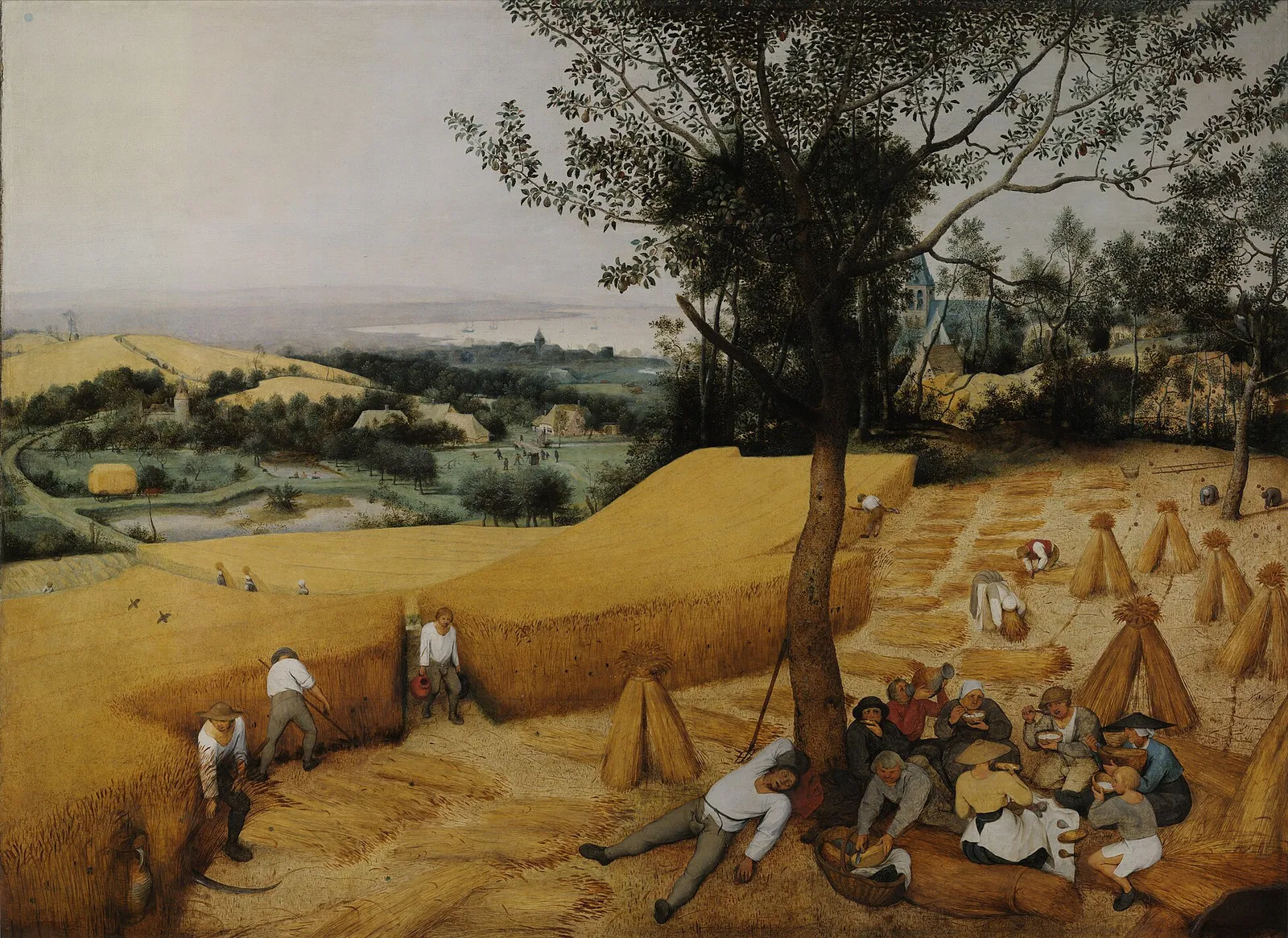
The Harvesters, painted by Pieter Bruegel the Elder in 1565, is in the collection of the Metropolitan Museum of Art. It shows a wheat harvest in full swing, with laborers working and resting in front of a wide, open landscape. At 116.5 by 159.5 cm, it rewards viewing both from a few steps back and up close.
Where to see it
The Harvesters is held by the Metropolitan Museum of Art, which is listed as both its collection and its location. Paintings can be moved, rotated off view or lent, so check the Metropolitan Museum of Art's official website for the work's current display status, opening hours and ticket information before you visit. Once there, give yourself time to look from different distances, as the painting combines a broad composition with many small details.
What to look for in person
The midday rest under the tree
In the right foreground, a group of harvesters sits beneath a tree to eat. Look for the bowls, bread and jug being shared, and for the man sprawled asleep at the base of the trunk. Bruegel gives these figures real weight and posture; they look tired rather than posed. Right beside them the work carries on, so the scene reads as a pause in a long working day rather than a holiday. Up close, notice how each small gesture, from cutting bread to drinking, gets its own moment.
The wall of wheat and the work inside it
The left half of the picture is dominated by a tall block of golden wheat. Men swing scythes, women bind and carry sheaves, and a narrow path cut through the grain draws your eye up and into the scene. The contrast between standing stalks and cut stubble creates strong differences of texture and tone. Step back to see how this field of warm yellow anchors the whole composition, then move closer to find the individual figures working within it.
The landscape stretching to the horizon
Beyond the field, the land falls away into a broad valley with a village, a church, trees, water and distant ships. Bruegel uses a high viewpoint so your eye can travel from the foreground figures to the horizon in one sweep. Colors cool and soften as they recede, suggesting haze and distance. Scan the middle ground for tiny figures busy with other activities; these small scenes reward slow looking and show how much of rural life Bruegel fitted into a single panel.
About the painting
Pieter Bruegel the Elder was a painter of the Netherlands who became known for scenes of peasant life and for landscapes that place human activity within a large natural setting. The Harvesters, dated 1565, brings both interests together. Rather than telling a religious or mythological story, it presents ordinary agricultural work as a worthy subject in its own right, observed with attention to how bodies move, rest and gather.
The painting is widely understood to belong to a series Bruegel made depicting different times of the year, each pairing seasonal labor with a matching landscape. Here the season is harvest time: the wheat is ripe, the weather looks warm, and the workers divide their energy between cutting grain and taking a meal. Seen as part of that series, the picture is less about a single event than about the cycle of the agricultural year and the people whose lives followed it.
For visitors, the size of the work, 116.5 by 159.5 cm, matters. It is large enough that the composition reads clearly from across a room, yet many of its most engaging elements are small and only become legible as you approach. A useful approach is to start at a distance to take in the balance between the golden field, the shaded tree and the open valley, then walk closer and follow the path through the wheat, letting it lead you from the resting figures into the far landscape.
Key facts
| Artist | Pieter Bruegel the Elder |
|---|---|
| Date | 1565 |
| Size | 116.5 × 159.5 cm |
| Medium | oil paint, panel |
| Collection | Metropolitan Museum of Art |
| Gallery | Gallery 638 Checked in the museum's open data on 2026-11-12 (galleries can change) Source |
How to visit: Metropolitan Museum of Art
New York City, United States · Museum guide
| Opening hours | Sun, Mon, Tue, Thu 10:00–17:00 Fri, Sat 10:00–21:00 |
|---|---|
| Closed | Wednesdays; Thanksgiving Day, 25 December, 1 January and the first Monday in May |
| Admission | Adults USD 30 Seniors (65 and over) USD 22 Visitors with a disability (in person only) USD 22 Students USD 17 Children (12 and under) free Care partners of visitors with a disability (in person only) free New York State residents; NY, NJ and CT students: pay what you wish (minimum USD 0.01). Online requires a NY State billing address; NJ/CT students in person with student ID |
| Free entry | Free for children 12 and under, Members and Patrons, and care partners of visitors with a disability. Pay what you wish for New York State residents and NY/NJ/CT students. |
| Booking | No reservation is required and there is no timed entry. |
The Cantor Roof Garden, the Modern and Contemporary Galleries, and the Ancient West Asia and Ancient Cyprus Galleries are closed for renovation.
Official ticket page
Official website
View on map
Hours and prices can change. Please check the official website before you go. (Checked on: 2026-11-09)
More by Pieter Bruegel the Elder
 Two Chained Monkeys — Gemäldegalerie Berlin
 The Beggars — Louvre Museum
 The Hunters in the Snow — Kunsthistorisches Museum
 Netherlandish Proverbs — Gemäldegalerie Berlin
 The Land of Cockaigne — Alte Pinakothek
 The Fall of the Rebel Angels
 The Peasant Wedding — Kunsthistorisches Museum
 The Triumph of Death — Museo del Prado
 The Fight Between Carnival and Lent — Kunsthistorisches Museum
 Children's Games — Kunsthistorisches Museum
 Dull Gret
 The Peasant Dance — Kunsthistorisches Museum