Art! Art! Art! › Works
Netherlandish Proverbs
 Pieter Bruegel the Elder, 1551
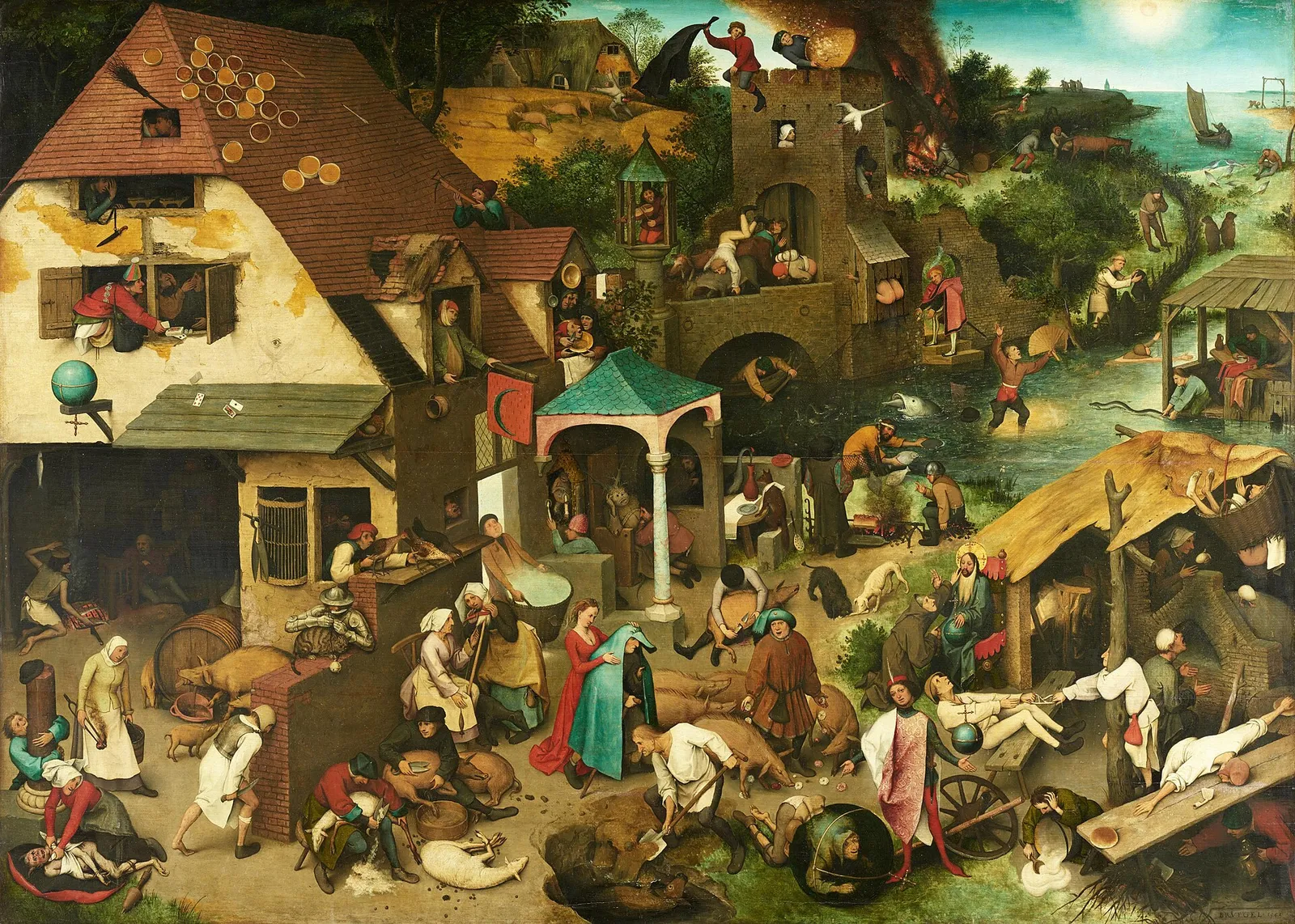
Pieter Bruegel the Elder's Netherlandish Proverbs turns a crowded village into a visual encyclopedia of sayings, each acted out literally by its inhabitants. The panel belongs to the Gemäldegalerie Berlin, where visitors can spend a long time spotting one proverb after another.
Where to see it
Netherlandish Proverbs is in the collection of the Gemäldegalerie Berlin. Our records place it in the Dutch paintings 15th-16th-century room 7. Displays can change because of rehanging, conservation or loans, so check the Gemäldegalerie Berlin's official website for current display status before you visit.
What to look for in person
The blue cloak at the centre
Start near the middle of the composition, where a woman drapes a blue cloak over a man's shoulders. In the Netherlandish idiom of Bruegel's time, this meant she was deceiving her husband. The motif is so central that the painting has long also been known as The Blue Cloak. Notice how calmly the scene is staged: Bruegel presents folly and deceit as everyday events, set among ordinary houses and people rather than as dramatic moral episodes.
A world turned upside down
On the house at the left, look for a globe hung upside down on the façade, an image of a world turned on its head. That idea runs through the whole panel. Nearby, find a man banging his head against a brick wall, another armed to the teeth, and a figure trying to bell the cat. Each saying describes foolish, futile or self-defeating behaviour, and together they form a portrait of human folly rather than a single story.
Reading the whole panel
At 117 by 163 cm, the painting is large enough to hold dozens of small scenes but small enough to reward close looking. Work through it section by section: the roof tiled with tarts, a man casting roses before swine, villagers filling in the well after the calf has drowned. A raised horizon tilts the village toward you, so foreground, middle ground and the distant shoreline all stay readable. Many visitors find that new details keep appearing on a second or third pass.
About the painting
Netherlandish Proverbs is one of Pieter Bruegel the Elder's best-known works, and its appeal lies in a simple but demanding idea: to show a whole repertoire of popular sayings at once by having people perform them literally. The setting is a village by the water, densely packed with figures, houses, animals and objects, and almost every one of them illustrates an expression that would have been familiar to viewers in the Low Countries of the sixteenth century. Scholars have identified around a hundred proverbs in the panel, although the exact count varies depending on how individual details are read. Many of the sayings concern foolishness, wasted effort, deceit and the reversal of sensible order, which is why the inverted globe on the left-hand house is often taken as a key to the whole picture. Rather than preaching, Bruegel observes: his figures are sturdy, ordinary people absorbed in their absurd tasks, and the humour comes from the deadpan way the sayings are made physical. For visitors, the painting works almost like a game. It helps to stand back first to take in the overall structure, with its high viewpoint and receding shoreline, and then to move closer and read individual corners. Some proverbs are still current in English or other languages, while others have faded from use, so part of the pleasure is recognising which ones still make sense today. The work is recorded with an inception date of 1551 and measures 117 by 163 cm. It is held by the Gemäldegalerie Berlin.
Key facts
| Artist | Pieter Bruegel the Elder |
|---|---|
| Date | 1551 |
| Size | 117 × 163 cm |
| Medium | oil paint, oak panel |
| Collection | Gemäldegalerie Berlin |
How to visit: Gemäldegalerie Berlin
Berlin, Germany · Museum guide
| Opening hours | Tue–Sun 10:00–18:00 |
|---|---|
| Closed | Closed Mondays. Closed 24 Dec 2026 and 31 Dec 2026. Open Sunday hours on 25–26 Dec 2026; 1 Jan 2027 12:00–18:00. Most other public holidays: Sunday hours. |
| Admission | Adult (Paintings from the 13th to 18th century) EUR 14 Reduced (schoolchildren, apprentices, students, severely disabled, etc.; ID required) EUR 7 Adult incl. special exhibition “Portraits!” (16 Oct 2026 – 14 Mar 2027) EUR 16 (reduced EUR 8) Kulturforum-Ticket (all Kulturforum museums, one day) EUR 22 (reduced EUR 11) Under 18 free (free ticket required, at the counter or online) |
| Free entry | Free with a free ticket and proof for children and young people up to 18, school groups, ICOM/German Museums Association members, friends' association members, press, recipients of Bürgergeld and similar benefits, required companions of severely disabled persons, and annual-pass holders. |
| Booking | Booking is recommended; there is no timed entry. Tickets can be bought up to four weeks in advance. |
Official ticket page
Official website
View on map
Hours and prices can change. Please check the official website before you go. (Checked on: 2026-11-09)
More by Pieter Bruegel the Elder
 Two Chained Monkeys — Gemäldegalerie Berlin
 The Beggars — Louvre Museum
 The Hunters in the Snow — Kunsthistorisches Museum
 The Land of Cockaigne — Alte Pinakothek
 The Fall of the Rebel Angels
 The Peasant Wedding — Kunsthistorisches Museum
 The Triumph of Death — Museo del Prado
 The Fight Between Carnival and Lent — Kunsthistorisches Museum
 Children's Games — Kunsthistorisches Museum
 The Harvesters — Metropolitan Museum of Art
 Dull Gret
 The Peasant Dance — Kunsthistorisches Museum