Art! Art! Art! › Works
The Peasant Dance
 Pieter Bruegel the Elder, 1568
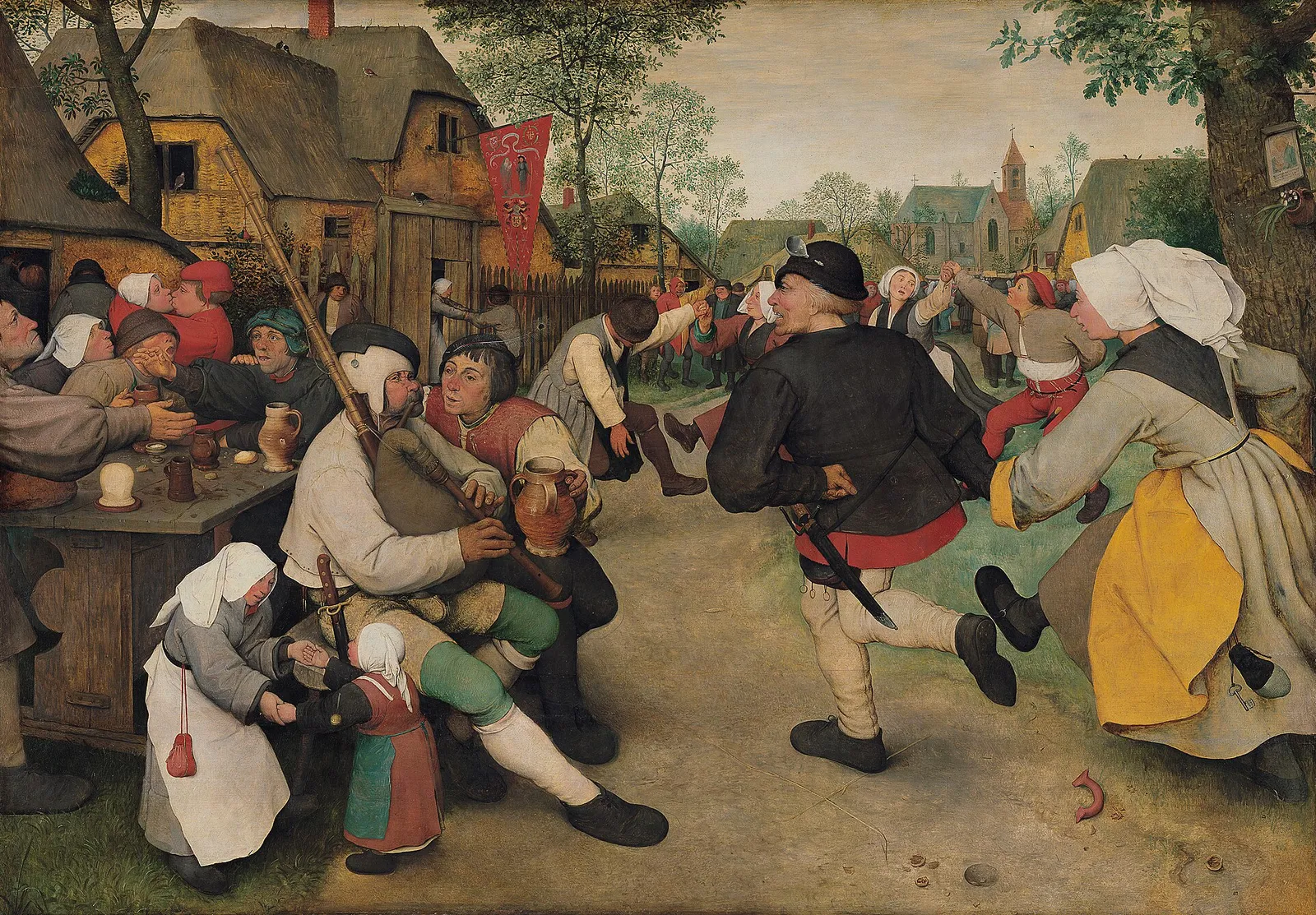
The Peasant Dance is a village celebration painted by Pieter Bruegel the Elder in 1568, now in the collection of the Kunsthistorisches Museum. Measuring 114 by 164 cm, it fills the viewer's field of vision with large, solid figures caught in the middle of a festival day. It rewards slow looking, because much of the story is in the small gestures around the edges.
Where to see it
The Peasant Dance is held by the Kunsthistorisches Museum, which is listed as both its collection and its location. Display arrangements can change because of rehanging, conservation or temporary exhibitions, so check the Kunsthistorisches Museum's official website for current display status, opening hours and ticket information before you visit.
What to look for in person
The couple hurrying into the dance
Start in the lower left foreground, where a peasant man and woman stride toward the open space where others are already dancing. He pulls her along by the hand, and their stride carries your eye across the picture. Bruegel places these figures large and close to the front edge, so in front of the panel you feel as if you are standing at the edge of the crowd rather than watching from far away. Notice how heavy their clothes and shoes look, and how the movement comes from their bodies, not from any drama in their faces.
The bagpiper and the tavern crowd
Look next to the group gathered near the tavern on the left. A bagpiper plays for the dancers, and a man leans in close beside him. Around the table, villagers drink and talk, and some of their exchanges look anything but calm. Nearby, a couple kiss amid the noise. Spend time on the hands and faces here: Bruegel records gesture and expression with care, and these small, ordinary actions carry much of the scene's energy. The music you cannot hear is implied by everything around the piper.
The church and the small details
Lift your eyes to the background, where a church closes the view at the end of the village street. The revellers are turned toward the dance and the tavern, not toward the church. In the foreground, look for children copying the adults, practising steps of their own. Smaller details are scattered through the crowd and along the edges, including a small devotional image near the right side. These details are easy to miss at a glance, so step closer, then step back to see how they fit into the whole composition.
About the painting
Pieter Bruegel the Elder painted The Peasant Dance in 1568, near the end of his career; he died the following year. The work belongs to a group of late paintings in which he moved away from the panoramic, crowded views of his earlier years and brought fewer, much larger figures right up to the front of the picture. At 114 by 164 cm, the panel is big enough for these villagers to feel almost physically present, and that scale is a good reason to see it in person rather than on a screen.
The subject is a village festival of the kind held in the Low Countries on a saint's day or church anniversary, often called a kermis. Bruegel shows the familiar elements of such a day: music, dancing, drinking outside a tavern, couples, children and onlookers. He was known for his close observation of rural life, and here clothing, posture and gesture are rendered with a directness that makes the figures seem individual rather than generic.
What the painting means has long been discussed. Some viewers see an affectionate record of popular celebration; others read it as a moral commentary, pointing to the church that the dancers ignore and to signs of excess and quarrelling. You do not need to settle the question to enjoy the picture, but it is worth keeping both readings in mind as you look.
When you visit, give yourself time to look at the painting from two distances: close up for faces, hands and small objects, and farther back to see how Bruegel arranges the movement of the crowd from the foreground couple toward the distant church.
Key facts
| Artist | Pieter Bruegel the Elder |
|---|---|
| Date | 1568 |
| Size | 114 × 164 cm |
| Medium | oil paint, panel |
| Collection | Kunsthistorisches Museum |
How to visit: Kunsthistorisches Museum
Vienna, Austria · Museum guide
| Opening hours | Mon–Wed, Fri–Sun 10:00–18:00 Thu 10:00–21:00 (late opening) 24 December 10:00–15:00 31 December 10:00–21:00 |
|---|---|
| Closed | Open daily with no regular closing day. Rooms 24, VIII, 14 and IX are currently closed. |
| Admission | Adult (online) EUR 22 (EUR 24 on site) Reduced (online) EUR 19 (EUR 20 on site; EUR 23 with Vienna City Card) Under 19 free (registered at the entrance, no online booking needed) Combined Ticket “Habsburg Treasures” EUR 32 Masterticket EUR 37 |
| Free entry | Free for under-19s and accredited media (register 2 working days ahead). |
| Booking | Reservation is required, with timed entry. |
Official ticket page
Official website
View on map
Hours and prices can change. Please check the official website before you go. (Checked on: 2026-11-09)
More by Pieter Bruegel the Elder
 Two Chained Monkeys — Gemäldegalerie Berlin
 The Beggars — Louvre Museum
 The Hunters in the Snow — Kunsthistorisches Museum
 Netherlandish Proverbs — Gemäldegalerie Berlin
 The Land of Cockaigne — Alte Pinakothek
 The Fall of the Rebel Angels
 The Peasant Wedding — Kunsthistorisches Museum
 The Triumph of Death — Museo del Prado
 The Fight Between Carnival and Lent — Kunsthistorisches Museum
 Children's Games — Kunsthistorisches Museum
 The Harvesters — Metropolitan Museum of Art
 Dull Gret