Art! Art! Art! › Works
The Triumph of Death
 Pieter Bruegel the Elder, 1560s
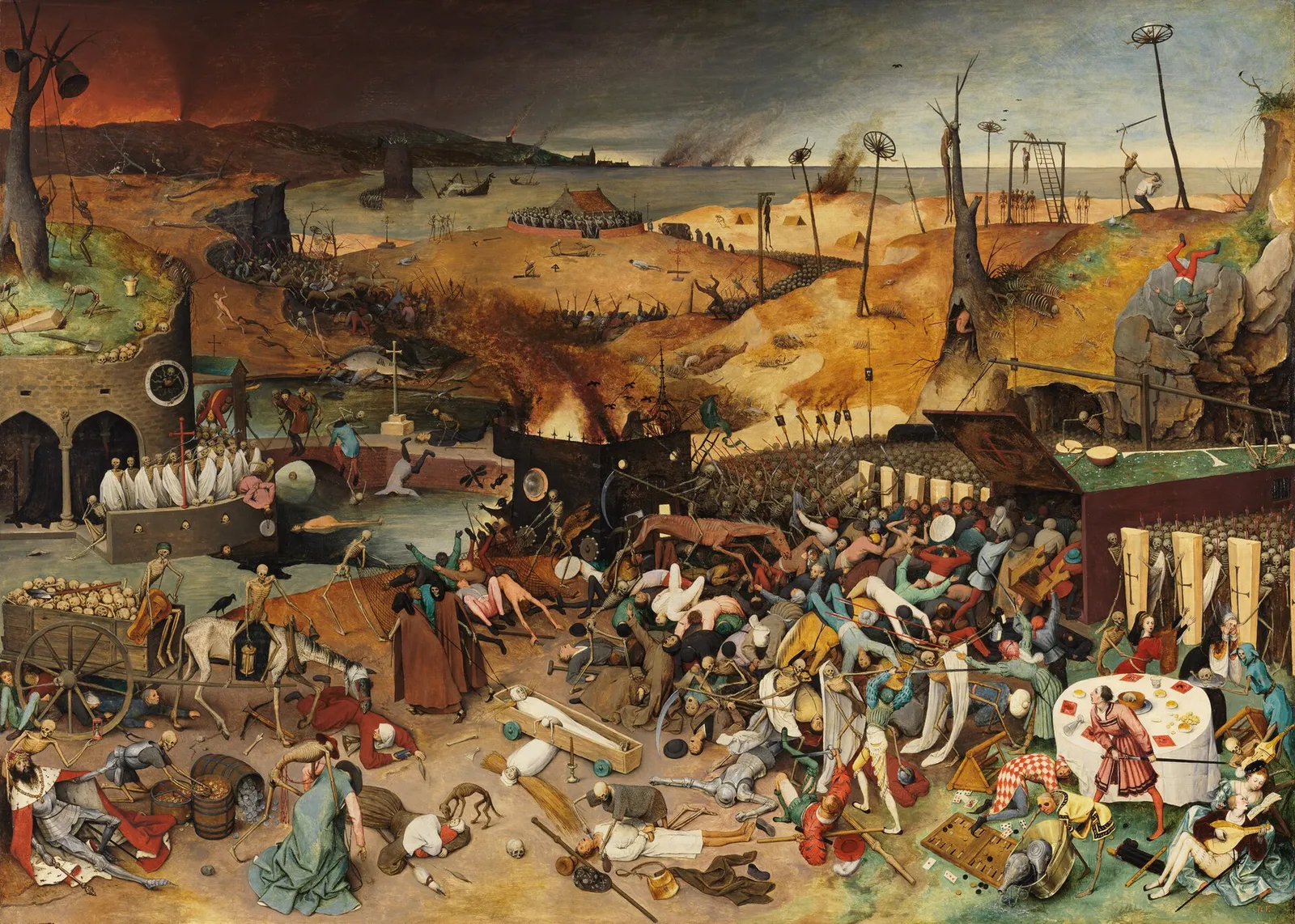
Pieter Bruegel the Elder's The Triumph of Death belongs to the Museo del Prado, which holds it in its collection. Painted in the 1560s, it shows a vast landscape overrun by armies of skeletons, and it rewards slow, close looking at its many small scenes.
Where to see it
The Triumph of Death is in the collection of the Museo del Prado. Display arrangements can change, so check the Museo del Prado's official website for current display status and visiting information before you go.
What to look for in person
An army of the dead
Step back first and take in the whole panel. Death does not come for one person here; it arrives as an organized army. Ranks of skeletons advance from the left, some carrying shields like soldiers in formation. Near the center, a skeleton on a gaunt horse swings a scythe and drives a crowd of panicked people toward a huge box-like trap marked with crosses. Follow the movement across the picture from left to right and notice how every path for escape seems to be blocked.
Every rank of society
Look closely at the lower left corner. A king lies collapsing while a skeleton holds up an hourglass to him, and another skeleton helps itself to his coins. Nearby, a churchman is also seized. Elsewhere you can find ordinary people: travelers, a mother, figures caught at a meal. Bruegel draws on the long medieval tradition of the Dance of Death, in which death treats the powerful and the poor alike. Searching out these individual figures is one of the best ways to spend time in front of the painting.
The lovers in the corner
Before you leave, look at the lower right corner. A young couple sits absorbed in music: the man plays a lute and the woman looks at a sheet of music, apparently unaware of what is happening around them. Behind them, a skeleton joins in with its own instrument. Close by, a feast has been overturned and a figure tries to hide under a table. This quiet corner sets human distraction and pleasure against the chaos filling the rest of the scene.
About the painting
The Triumph of Death is a work by Pieter Bruegel the Elder, the Netherlandish painter known for crowded, highly detailed scenes of human life and landscape. The Museo del Prado dates it to the 1560s, and the panel measures 117 by 162 cm. At that size the picture is large enough to read from a distance, yet much of its meaning lies in small details that need to be viewed up close. The setting is a wide, barren landscape seen from a high viewpoint. Trees are bare, fires burn on the horizon, ships founder at sea, and the hills hold gallows and wheels raised on poles, the instruments of execution familiar to Bruegel's viewers. Across this ruined world, skeletons attack the living, ring bells, dig and drag, and herd people toward their end. The painting draws on themes that were well established in European art before Bruegel, especially the Dance of Death, which reminded viewers that no one, whatever their wealth or position, could avoid mortality. Art historians also commonly connect its imaginative, nightmarish quality to the earlier work of Hieronymus Bosch. Bruegel's own contribution is the way he turns these ideas into a single panoramic scene filled with many separate episodes. For visitors, the best approach is to look in stages: first the overall sweep of the landscape and the movement of the skeleton army, then the lower corners, where the most carefully characterized figures appear. The painting is grim, but it is also inventive and closely observed.
Key facts
| Artist | Pieter Bruegel the Elder |
|---|---|
| Date | 1560s |
| Size | 117 × 162 cm |
| Medium | oil paint, panel |
| Collection | Museo del Prado |
How to visit: Museo del Prado
Madrid, Spain · Museum guide
| Opening hours | Mon–Sat 10:00–20:00 Sun and public holidays 10:00–19:00 6 Jan, 24 Dec, 31 Dec 10:00–14:00 (limited opening) |
|---|---|
| Closed | Closed on 1 January, 1 May and 25 December. |
| Last entry | Last entry 30 minutes before closing; visitors are asked to leave the galleries 10 minutes before closing. |
| Admission | General EUR 15 (includes the Collection and temporary exhibitions) Reduced (over 65, youth card holders, members of large families) EUR 7.5 Under 18, students aged 18–25, people with a disability of 33% or more, and other listed groups: free (official proof required at the ticket office on the day) Audio guide EUR 5 (added to the ticket; over 250 works in 15 languages) |
| Free entry | The Collection is free during the last two hours before closing (tickets at the ticket office, subject to capacity; 50% off temporary exhibitions). Always free for under-18s, students aged 18–25 and other listed groups with official proof at the ticket office. |
| Booking | Entry is by timed ticket. |
Official ticket page
Official website
View on map
Hours and prices can change. Please check the official website before you go. (Checked on: 2026-11-11)
More by Pieter Bruegel the Elder
 Two Chained Monkeys — Gemäldegalerie Berlin
 The Beggars — Louvre Museum
 The Hunters in the Snow — Kunsthistorisches Museum
 Netherlandish Proverbs — Gemäldegalerie Berlin
 The Land of Cockaigne — Alte Pinakothek
 The Fall of the Rebel Angels
 The Peasant Wedding — Kunsthistorisches Museum
 The Fight Between Carnival and Lent — Kunsthistorisches Museum
 Children's Games — Kunsthistorisches Museum
 The Harvesters — Metropolitan Museum of Art
 Dull Gret
 The Peasant Dance — Kunsthistorisches Museum