Art! Art! Art! › Works
The Beggars
 Pieter Bruegel the Elder, 1568
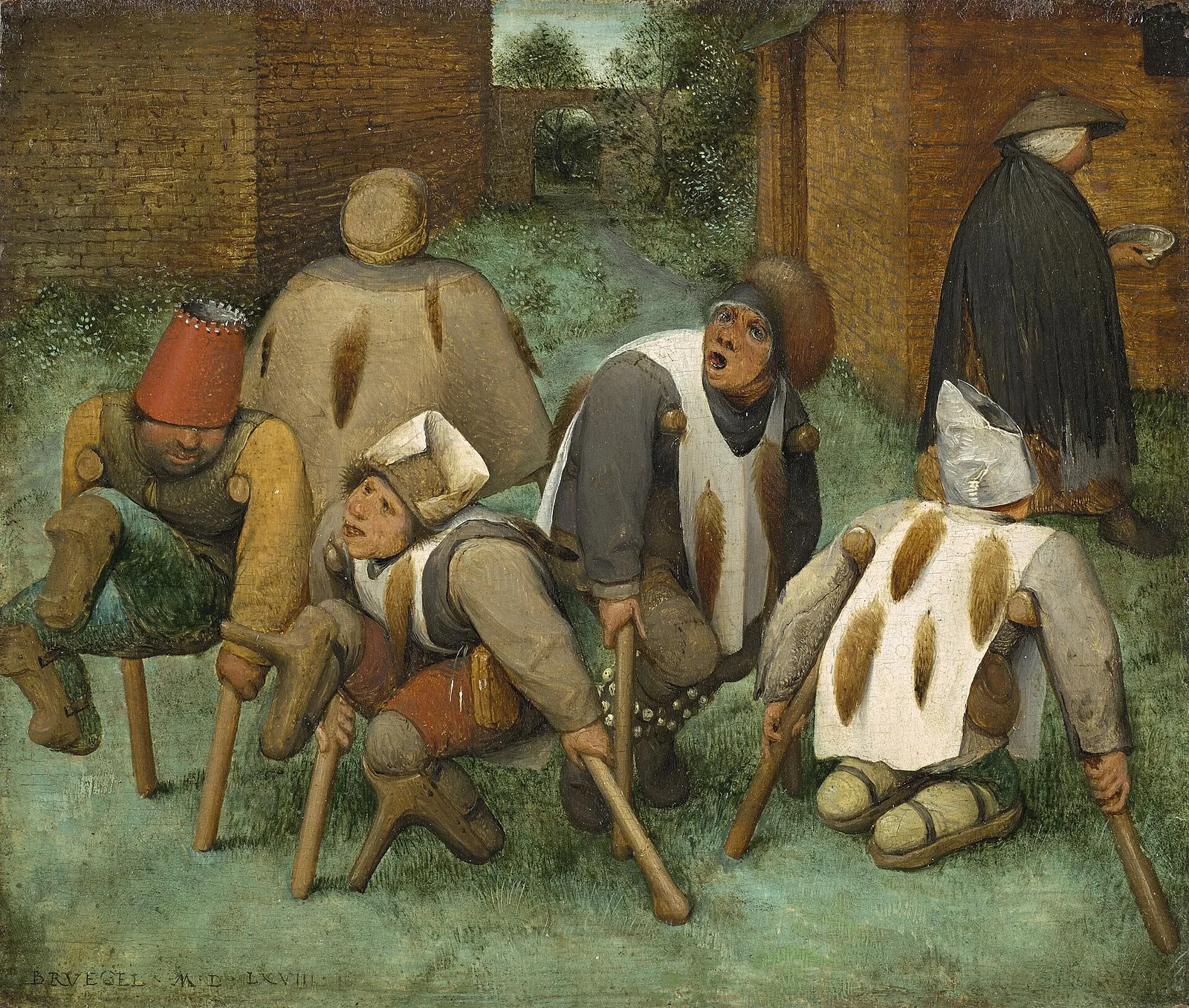
The Beggars is a small, late work by Pieter Bruegel the Elder, dated 1568 and held in the Department of Paintings of the Louvre. Measuring just 18.5 by 21.5 cm, it shows a group of disabled beggars crowded into a courtyard, and it rewards a slow, close look.
Where to see it
The Beggars belongs to the Department of Paintings of the Louvre, and its recorded location is Room 812. Because works can be moved, rehung or temporarily taken off view, check the Louvre's official website for current display status and opening information before you visit. The painting is very small, so allow time to find it and to stand close enough to see its details.
What to look for in person
Read the hats
Start with the headgear. Each figure wears a different kind of hat, and the variety is deliberate: one resembles a crown, another a bishop's mitre, another a soldier's helmet, and others look like the caps of townspeople or peasants. Many viewers read this as a pointed joke about the ranks of society, with every level of the social order reduced to the same crippled state. Whatever the exact intention, comparing the hats one by one is the quickest way into the picture's sense of satire.
Crutches, stumps and fox tails
Look closely at how the men move. Bruegel paints their wooden crutches and leg supports with careful attention, so you can see how each body is propped up and balanced. Then search their clothing for small fox tails hanging from it. These tails are one of the most discussed details in the painting, and scholars disagree about what they signal. Noticing them for yourself is part of the pleasure, even if their meaning remains open.
The courtyard and the woman behind
Step back slightly and take in the setting. The beggars are packed into an enclosed space with a reddish wall, while an opening lets in a glimpse of green beyond. Behind the group a woman holding a bowl seems to walk away, apparently paying them little attention. Her turned back adds a quiet note of distance to the scene. Given the panel's small size, these background elements are easy to miss, so give your eyes a moment to adjust.
About the painting
Pieter Bruegel the Elder is best known for crowded scenes of Netherlandish life: peasants at work and play, village festivals, proverbs acted out, and the follies of ordinary people. The Beggars, dated 1568, comes from the very end of his career, as he died the following year. It is sometimes also called The Cripples, and it is one of his most compact pictures, measuring only 18.5 by 21.5 cm.
Unlike his panoramic compositions, this painting concentrates on a single tight cluster of figures. Five men with crutches and leg supports fill most of the space, their bodies twisted at different angles so that the group seems to jostle and turn in several directions at once. Bruegel had already included beggars and disabled people in larger scenes, and here he brings such figures to the foreground and makes them the whole subject.
The picture is often understood as a satire rather than a simple record of poverty. The mix of hats suggesting kings, clergy, soldiers and commoners invites the viewer to see the group as a comment on society as a whole. At the same time, the precise rendering of crutches, clothing and gestures shows the close observation that runs through Bruegel's work.
For visitors, the key is scale. This is not a painting to glance at from across a room. Its interest lies in small details, from the expressions and gestures of the men to the figure in the background, and it is best appreciated up close and without hurry. Seeing it in the Louvre's Department of Paintings also allows comparison with other Netherlandish works in the collection.
Key facts
| Artist | Pieter Bruegel the Elder |
|---|---|
| Date | 1568 |
| Size | 18.5 × 21.5 cm |
| Medium | oil paint, panel |
| Collection | Department of Paintings of the Louvre |
How to visit: Louvre Museum
Paris, France · Museum guide
| Opening hours | Mon, Thu, Sat, Sun 09:00–18:00 Wed, Fri 09:00–21:00 (evening opening) Rooms are cleared 30 minutes before closing |
|---|---|
| Closed | Every Tuesday; 1 January, 1 May and 25 December. Other public holidays are open unless they fall on a Tuesday. |
| Last entry | 1 hour before closing |
| Admission | Adult (non-EEA visitors) EUR 32 Adult (EEA citizens and residents) EUR 22 Under 18 free (ID required) EEA citizens/residents under 26 free (photo ID; residents also need a residence permit of over 90 days) Audio guide rental EUR 6 (can be booked in advance online) Rates apply from 14 January 2026 |
| Free entry | Free for under-18s, EEA citizens/residents under 26, all visitors on the first Friday of the month after 18:00 (except July and August) and on 14 July, and disabled visitors plus one carer. Also free with proof for EEA art and art-history teachers, ICOM members, journalists, EEA job seekers and EEA residents on income support. |
| Booking | Entry is by timed slot, and booking in advance is recommended. |
The Cour Carrée entrance is currently closed. On Thursday 12 November 2026 the museum may open later and some exhibition rooms may remain closed.
Official ticket page
Official website
View on map
Hours and prices can change. Please check the official website before you go. (Checked on: 2026-11-11)
More by Pieter Bruegel the Elder
 Two Chained Monkeys — Gemäldegalerie Berlin
 The Hunters in the Snow — Kunsthistorisches Museum
 Netherlandish Proverbs — Gemäldegalerie Berlin
 The Land of Cockaigne — Alte Pinakothek
 The Fall of the Rebel Angels
 The Peasant Wedding — Kunsthistorisches Museum
 The Triumph of Death — Museo del Prado
 The Fight Between Carnival and Lent — Kunsthistorisches Museum
 Children's Games — Kunsthistorisches Museum
 The Harvesters — Metropolitan Museum of Art
 Dull Gret
 The Peasant Dance — Kunsthistorisches Museum