Art! Art! Art! › Works
The Peasant Wedding
 Pieter Bruegel the Elder, 1560s
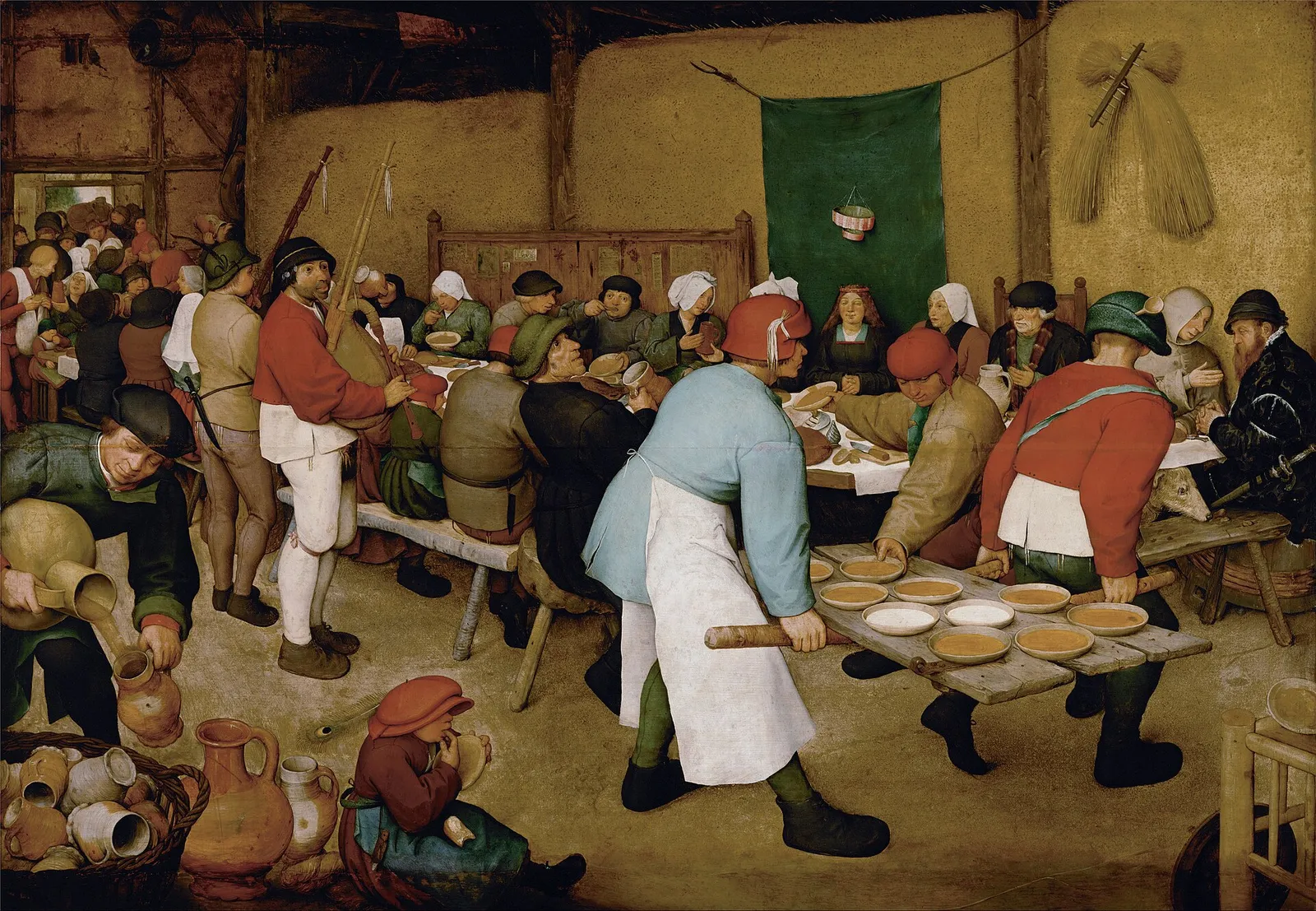
The Peasant Wedding by Pieter Bruegel the Elder is in the collection of the Kunsthistorisches Museum. Painted in the 1560s and measuring 113 by 164 cm, it shows a crowded rural wedding feast in which small, closely observed details reward a slow look.
Where to see it
The Peasant Wedding is held by the Kunsthistorisches Museum. Works can be moved, lent or taken off view for conservation, so check the museum's official website for the painting's current display status before you plan your visit.
What to look for in person
Finding the bride
Look toward the back of the table, where a woman sits in front of a green cloth hung on the wall, with a small paper crown suspended above her head. She is generally identified as the bride. Her hands are folded and her face is calm, making her a still point in an otherwise busy room. Notice how the cloth behind her frames her and draws your eye back to her, however far it wanders across the guests and servers in the foreground.
Serving and pouring
In the lower right, two men carry bowls of food on a long board, often described as a door taken off its hinges and used as a tray. A seated guest reaches to pass the bowls along the table. At the lower left, a man fills a jug, with a basket of empty jugs at his feet. Follow these actions with your eye and you will see how the table runs diagonally back into the room, giving the whole scene its sense of movement and depth.
The child and the musicians
In the foreground, a small child sits on the floor wearing a cap far too large for him, absorbed in licking food from a plate or his fingers. Just behind, near the left, stand musicians with bagpipes; one of them seems to glance toward the passing food rather than his playing. Along the back wall, stacked grain suggests the feast is taking place in a barn. Toward the right edge, look for figures dressed differently from the villagers, who appear to be guests of another standing.
About the painting
Pieter Bruegel the Elder painted The Peasant Wedding in the 1560s, during the final decade of his career. The panel measures 113 by 164 cm, large enough that the main figures in the foreground appear close to life-size when viewed from a short distance, which makes the scene feel as though you are standing at the edge of the room. Bruegel is widely known for his scenes of village life, and this painting is among the best-known examples. Rather than presenting a single dramatic moment, he arranges dozens of people doing ordinary things at once: eating, serving, pouring, talking and playing music. The long table set at an angle organises this crowd, leading the eye from the foreground servers back toward the bride and the far wall. For visitors, the most rewarding approach is to look in stages. First take in the whole composition from a few steps back, noting how the colours, especially the reds and whites of clothing, are distributed across the scene to keep the eye moving. Then step closer and read the picture one group at a time: the servers with their improvised tray, the man filling jugs, the child on the floor, the musicians, and the figures at the far right. Art historians have long debated how to read the painting, whether as affectionate observation, gentle satire, or moral commentary, and who some of the figures are meant to be. The painting does not settle these questions for you, which is part of why it holds attention. Allow time: many details only become visible on a second or third look.
Key facts
| Artist | Pieter Bruegel the Elder |
|---|---|
| Date | 1560s |
| Size | 113 × 164 cm |
| Medium | oil paint, oak panel |
| Collection | Kunsthistorisches Museum |
How to visit: Kunsthistorisches Museum
Vienna, Austria · Museum guide
| Opening hours | Mon–Wed, Fri–Sun 10:00–18:00 Thu 10:00–21:00 (late opening) 24 December 10:00–15:00 31 December 10:00–21:00 |
|---|---|
| Closed | Open daily with no regular closing day. Rooms 24, VIII, 14 and IX are currently closed. |
| Admission | Adult (online) EUR 22 (EUR 24 on site) Reduced (online) EUR 19 (EUR 20 on site; EUR 23 with Vienna City Card) Under 19 free (registered at the entrance, no online booking needed) Combined Ticket “Habsburg Treasures” EUR 32 Masterticket EUR 37 |
| Free entry | Free for under-19s and accredited media (register 2 working days ahead). |
| Booking | Reservation is required, with timed entry. |
Official ticket page
Official website
View on map
Hours and prices can change. Please check the official website before you go. (Checked on: 2026-11-09)
More by Pieter Bruegel the Elder
 Two Chained Monkeys — Gemäldegalerie Berlin
 The Beggars — Louvre Museum
 The Hunters in the Snow — Kunsthistorisches Museum
 Netherlandish Proverbs — Gemäldegalerie Berlin
 The Land of Cockaigne — Alte Pinakothek
 The Fall of the Rebel Angels
 The Triumph of Death — Museo del Prado
 The Fight Between Carnival and Lent — Kunsthistorisches Museum
 Children's Games — Kunsthistorisches Museum
 The Harvesters — Metropolitan Museum of Art
 Dull Gret
 The Peasant Dance — Kunsthistorisches Museum