Art! Art! Art! › Works
The Starry Night
 Vincent van Gogh, 1889
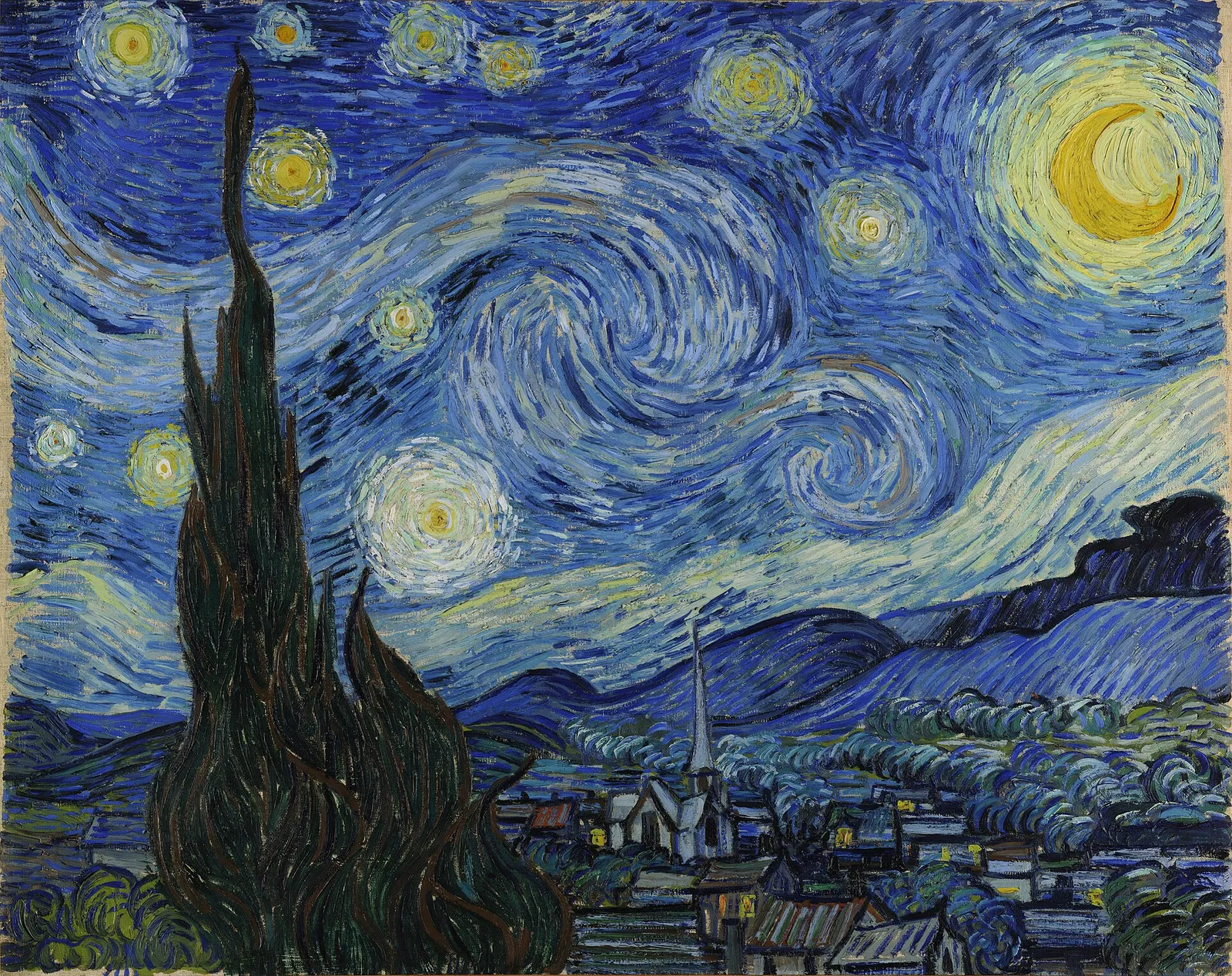
Vincent van Gogh painted The Starry Night in 1889, and today it belongs to the Museum of Modern Art. Seen in person, the painting reveals thick, directional brushwork, a swirling night sky, a dark cypress and a quiet village that reproductions only partly convey.
Where to see it
The Starry Night is in the collection of the Museum of Modern Art, which is also its listed location. Paintings can be moved, lent or temporarily taken off view, so check the Museum of Modern Art's official website for current display status, opening hours and ticket information before you visit. Because this is one of the most widely recognised works in the collection, the area in front of it can be busy. Allow time to wait for a clear view and to look closely at the paint surface.
What to look for in person
The moving sky
Most of the canvas is given over to the sky. Notice how the brushstrokes run in long, curving bands, with a large spiral form near the centre that seems to roll across the night. The stars and the crescent moon are surrounded by halos built from concentric dabs of yellow and white. Step close and you can see the thick, directional strokes typical of Van Gogh's late work. Step back and the separate marks merge into a sense of constant motion. Compare this restless sky with the calmer village below.
The cypress in the foreground
On the left, a dark cypress rises from the bottom edge almost to the top of the canvas and cuts across the sky. Its flame-like outline is built from vertical, twisting strokes of deep green and brown. It is the largest single form in the picture, and it links the earth to the sky. Cypresses appear in several paintings Van Gogh made in the south of France. Here the tree serves as a strong, dark foreground that makes the bright sky behind it look even more vivid.
The village, the colour and the surface
Below the rolling hills lies a small village with lit windows and a church with a slender spire. The houses are drawn with short, straight strokes and firm outlines, in clear contrast to the swirling sky. Look at the palette: deep blues and blue-greens dominate, set against yellows and whites in the moon, the stars and the windows. The canvas measures 73.7 by 92.1 cm, a moderate size. Its textured paint surface rewards close, unhurried viewing.
About the painting
Van Gogh painted The Starry Night in 1889, during the period he spent at the asylum of Saint-Paul-de-Mausole near Saint-Remy-de-Provence in southern France. He had entered the asylum voluntarily that spring, after a period of serious illness, and he continued to work steadily while he was there. From his room he had a view across walled fields toward the hills, and he painted this landscape many times in different seasons and at different times of day. The Starry Night grew out of that view, but it is not a literal record of what he saw. He painted it in the studio, combining observation with memory and invention, and he freely rearranged and exaggerated elements of the scene. In his letters to his brother Theo, Van Gogh described looking out over the countryside before sunrise and seeing the morning star, and night skies interested him as a subject. For visitors, the painting is best understood as a work of construction. The sky, the cypress and the village are each handled with a different kind of brushstroke, and the contrast between them gives the picture its tension. The painting dates from the last full year of Van Gogh's life, as he died in 1890. It shows the energetic, rhythmic handling of paint that marks his work from this period. Give yourself time to look both closely and from a distance, because the experience of the surface changes with your position.
Key facts
| Artist | Vincent van Gogh |
|---|---|
| Date | 1889 |
| Size | 73.7 × 92.1 cm |
| Medium | oil paint, canvas |
| Collection | Museum of Modern Art |
| Gallery | Floor 5, Gallery 501 Checked in the museum's open data on 2026-11-12 (galleries can change) Source |
How to visit: Museum of Modern Art
New York City, United States · Museum guide
| Opening hours | Mon–Thu, Sat–Sun 10:30–17:30 Fri 10:30–20:30 |
|---|---|
| Closed | Open every day except Thanksgiving and Christmas. |
| Admission | Adults USD 30 Seniors (65 and over, with ID) USD 22 Visitors with disabilities USD 22 (accompanying care partner free) Students (full-time, with ID, incl. international students) USD 17 Children 16 and under free (ticket still required) Members free |
| Free entry | Free for children 16 and under and members. New York State residents enter free on Friday evenings 17:30–20:30 (UNIQLO Friday Nights); free tickets must be reserved in advance and proof of residency is required. Tickets include all galleries and special exhibitions. |
| Booking | Booking in advance is strongly recommended. |
Official ticket page
Official website
View on map
Hours and prices can change. Please check the official website before you go. (Checked on: 2026-11-11)
More by Vincent van Gogh
 Café Terrace at Night — Kröller-Müller Museum
 White House at Night
 The siesta (after Millet) — Musée d'Orsay
 The Church at Auvers — Musée d'Orsay
 Portrait of Père Tanguy
 Starry Night Over the Rhône — Musée d'Orsay
 The Potato Eaters — Van Gogh Museum
 The Red Vineyard
 The Yellow House — Van Gogh Museum
 Agostina Segatori Sitting in the Café du Tambourin — Van Gogh Museum
 Irises — J. Paul Getty Museum
 Langlois Bridge at Arles with Women Washing, The — Kröller-Müller Museum