Art! Art! Art! › Works
The Parsonage Garden at Nuenen
 Vincent van Gogh, 1884
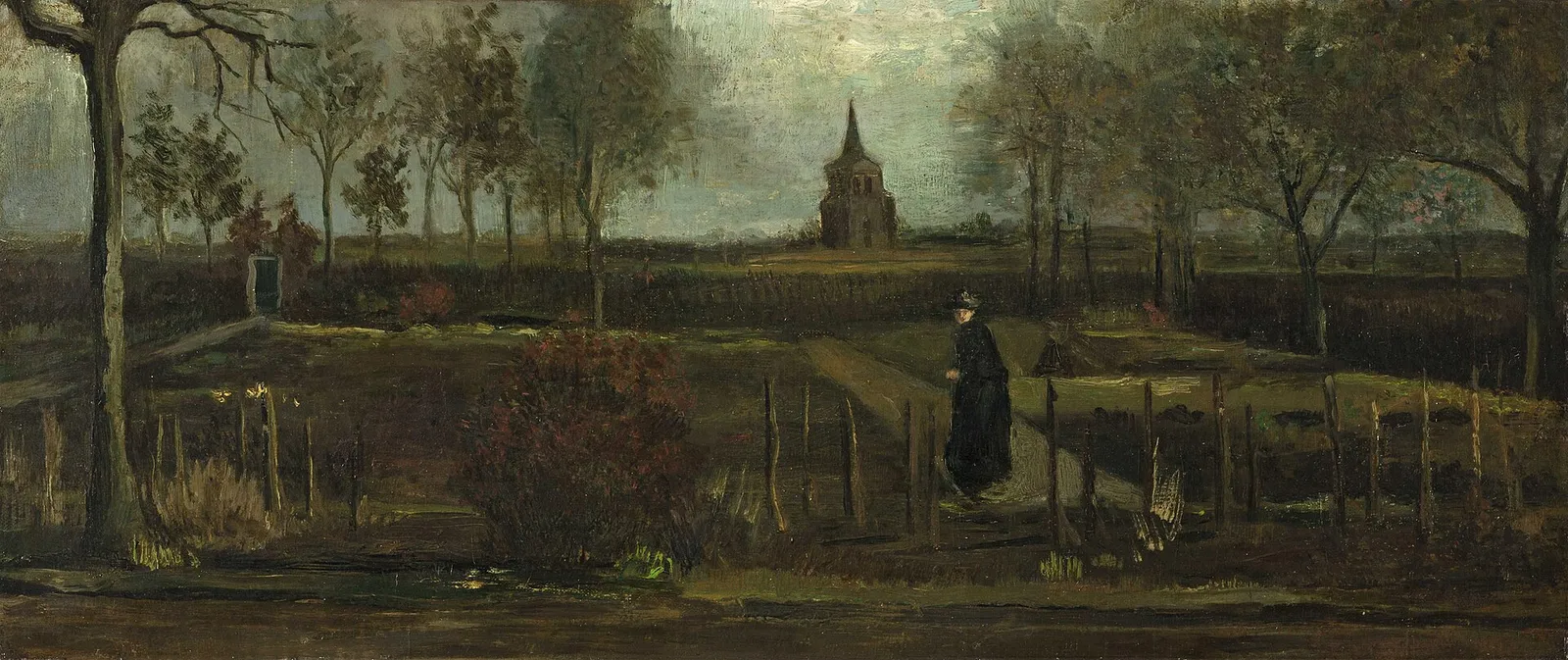
The Parsonage Garden at Nuenen is a small 1884 painting by Vincent van Gogh in the collection of the Groninger Museum. It comes from the years he spent in the Dutch village of Nuenen, before his move to France and the brighter style most visitors know him for. Seeing it in person is a chance to meet an earlier, quieter Van Gogh at close range.
Where to see it
The Parsonage Garden at Nuenen belongs to the collection of the Groninger Museum, which is also listed as its location. Works on paper, panel or canvas may be rotated, lent or temporarily taken off view, so check the Groninger Museum's official website for current display status, opening hours and ticket information before you plan your visit.
What to look for in person
A wide, intimate format
At 25 cm high and 57 cm wide, the picture is more than twice as wide as it is tall. Stand close and notice how this stretched, horizontal shape works almost like a strip of view, encouraging your eye to travel from one side of the garden to the other rather than settle on a single central point. Its modest size also rewards a near look: this is a painting meant to be read up close, not taken in from across the room.
The Nuenen-period palette
Van Gogh's work from his Nuenen years is widely recognised for its restrained, earthy tones, a world away from the vivid yellows and blues of his later paintings in the south of France. In front of the work, take time to look at how much he achieves within a limited range of colour, and how light and shade are built up through tone. It helps to keep his better-known later pictures in mind as a point of comparison.
A familiar, personal subject
During his time in Nuenen, Van Gogh lived at his parents' home, where his father served as the village pastor, and he returned several times to the garden of the parsonage as a subject. Rather than a grand or exotic scene, this is a place he knew day to day. Look for the way he treats ordinary features of a garden as worthy of careful attention, an approach that runs through much of his early work.
About the painting
Vincent van Gogh painted The Parsonage Garden at Nuenen in 1884, during the period he lived in Nuenen, a village in the southern Netherlands. He had moved there to stay with his parents, and his father was the pastor of the local Protestant congregation. These Dutch years are often seen as Van Gogh's formative period as a painter: he worked intensively, drawing and painting rural life, peasants, weavers, cottages and the surroundings of his family home.
The garden behind the parsonage was one of the subjects close at hand, and he depicted it more than once. For visitors, this painting offers a useful counterweight to the image of Van Gogh formed by his later work. Here there are no swirling skies or blazing sunflowers. Instead you find the darker, more sober manner associated with his time in the Netherlands, a style shaped by his admiration for Dutch painting traditions and for artists who depicted rural life.
The work is small, measuring 25 by 57 centimetres, and its wide horizontal shape gives it a panoramic quality despite its size. That scale makes it a picture to approach slowly. Spend a few minutes looking at how the composition is organised across its width, how tones are balanced, and how the brushwork describes the garden without heavy detail.
The painting is held by the Groninger Museum. Because display arrangements can change, confirm on the museum's official website that the work is on view before travelling specifically to see it.
Key facts
| Artist | Vincent van Gogh |
|---|---|
| Date | 1884 |
| Size | 25 × 57 cm |
| Medium | paper, oil paint, panel |
| Collection | Groninger Museum |
How to visit: Groninger Museum
Groningen, Netherlands
Hours and prices can change. Please check the official website before you go.
More by Vincent van Gogh
 Café Terrace at Night — Kröller-Müller Museum
 White House at Night
 The siesta (after Millet) — Musée d'Orsay
 The Church at Auvers — Musée d'Orsay
 Portrait of Père Tanguy
 Starry Night Over the Rhône — Musée d'Orsay
 The Potato Eaters — Van Gogh Museum
 The Red Vineyard
 The Yellow House — Van Gogh Museum
 Agostina Segatori Sitting in the Café du Tambourin — Van Gogh Museum
 Irises — J. Paul Getty Museum
 Langlois Bridge at Arles with Women Washing, The — Kröller-Müller Museum