Art! Art! Art! › Works
The Night Café
 Vincent van Gogh, 1888
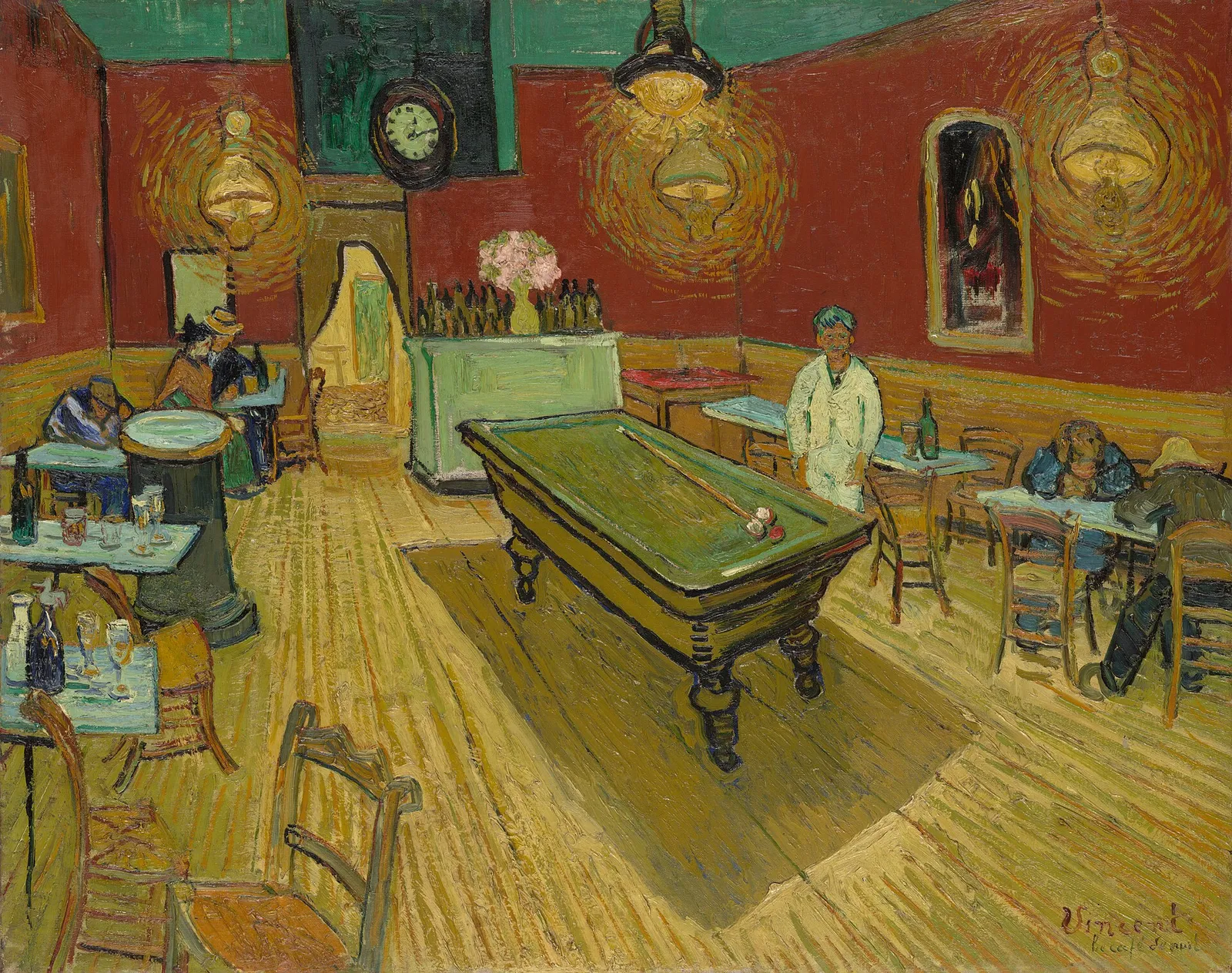
Vincent van Gogh's The Night Café, painted in 1888, shows the interior of an all-night café under harsh artificial light. The painting is in the collection of the Yale University Art Gallery, where visitors can study its clashing colours and tilted space up close.
Where to see it
The Night Café belongs to the collection of the Yale University Art Gallery. Works can be moved, rotated off view or lent to other institutions, so check the Yale University Art Gallery's official website for current display status, opening hours and visitor information before you plan your trip.
What to look for in person
Red walls against green ceiling
The first thing to register is the colour. Blood-red walls meet a green ceiling, and the two complementary colours seem to vibrate where they touch. Van Gogh wrote that he used red and green to express the terrible passions of humanity, so the clash is deliberate rather than descriptive. Stand back to feel the overall tension, then move closer and notice how the greens also reappear in the billiard table and the bar, tying the room together uneasily.
Gaslight halos
Look up at the hanging lamps. Each is surrounded by rings of yellow and orange brushstrokes, radiating outward like ripples. Rather than painting light as a soft glow, Van Gogh built it from concentric strokes of thick paint, which makes the illumination feel glaring and restless. Compare these halos with the flatter areas of the walls and floor, and you will see how varied his handling of paint is across a single canvas, from dense impasto to broader, smoother passages.
A steep floor and isolated figures
The floor tilts sharply upward, pulling your eye toward the doorway at the back. The billiard table sits in the middle and casts a dark shadow, while the floorboards rush away in exaggerated perspective. Around the edges, a few customers slump at tables, some apparently asleep or alone. A figure in a light coat stands beside the table, facing the viewer. Notice how far apart everyone seems; the empty space between the figures contributes strongly to the painting's mood of loneliness.
About the painting
The Night Café dates from 1888, the year Van Gogh was living in Arles in the south of France. It depicts an interior of the kind he frequented there: a café that stayed open through the night, offering shelter to drinkers, travellers and people with nowhere else to go. The establishment is generally identified as the Café de la Gare, run by Joseph and Marie Ginoux, whom Van Gogh knew personally. Unlike many of his sunlit landscapes from the same period, this painting turns inward to a closed room lit by gas lamps. Van Gogh described his intentions in letters to his brother Theo, explaining that he wanted to suggest a place where a person could ruin themselves, go mad or commit a crime. To achieve this, he relied on colour more than on literal description, setting intense reds against acid greens and yellows. The result is an image that feels emotionally charged rather than simply observed. For visitors, the painting rewards slow looking. Notice how the perspective is pushed to an extreme, how the furniture seems to slide toward you, and how the lamps dominate the upper half of the composition. The canvas measures 72.4 by 92.1 centimetres, a moderate size that lets you take in the whole scene from a few steps back before moving closer to examine the brushwork. The work is often discussed alongside Van Gogh's other paintings of Arles, and it remains an important example of how he used colour to convey feeling. It is held by the Yale University Art Gallery.
Key facts
| Artist | Vincent van Gogh |
|---|---|
| Date | 1888 |
| Size | 72.4 × 92.1 cm |
| Medium | oil paint, canvas |
| Collection | Yale University Art Gallery |
How to visit: Yale University Art Gallery
New Haven, United States
Hours and prices can change. Please check the official website before you go.
More by Vincent van Gogh
 Café Terrace at Night — Kröller-Müller Museum
 White House at Night
 The siesta (after Millet) — Musée d'Orsay
 The Church at Auvers — Musée d'Orsay
 Portrait of Père Tanguy
 Starry Night Over the Rhône — Musée d'Orsay
 The Potato Eaters — Van Gogh Museum
 The Red Vineyard
 The Yellow House — Van Gogh Museum
 Agostina Segatori Sitting in the Café du Tambourin — Van Gogh Museum
 Irises — J. Paul Getty Museum
 Langlois Bridge at Arles with Women Washing, The — Kröller-Müller Museum