Art! Art! Art! › Works
Still Life with Bible
 Vincent van Gogh, 1885
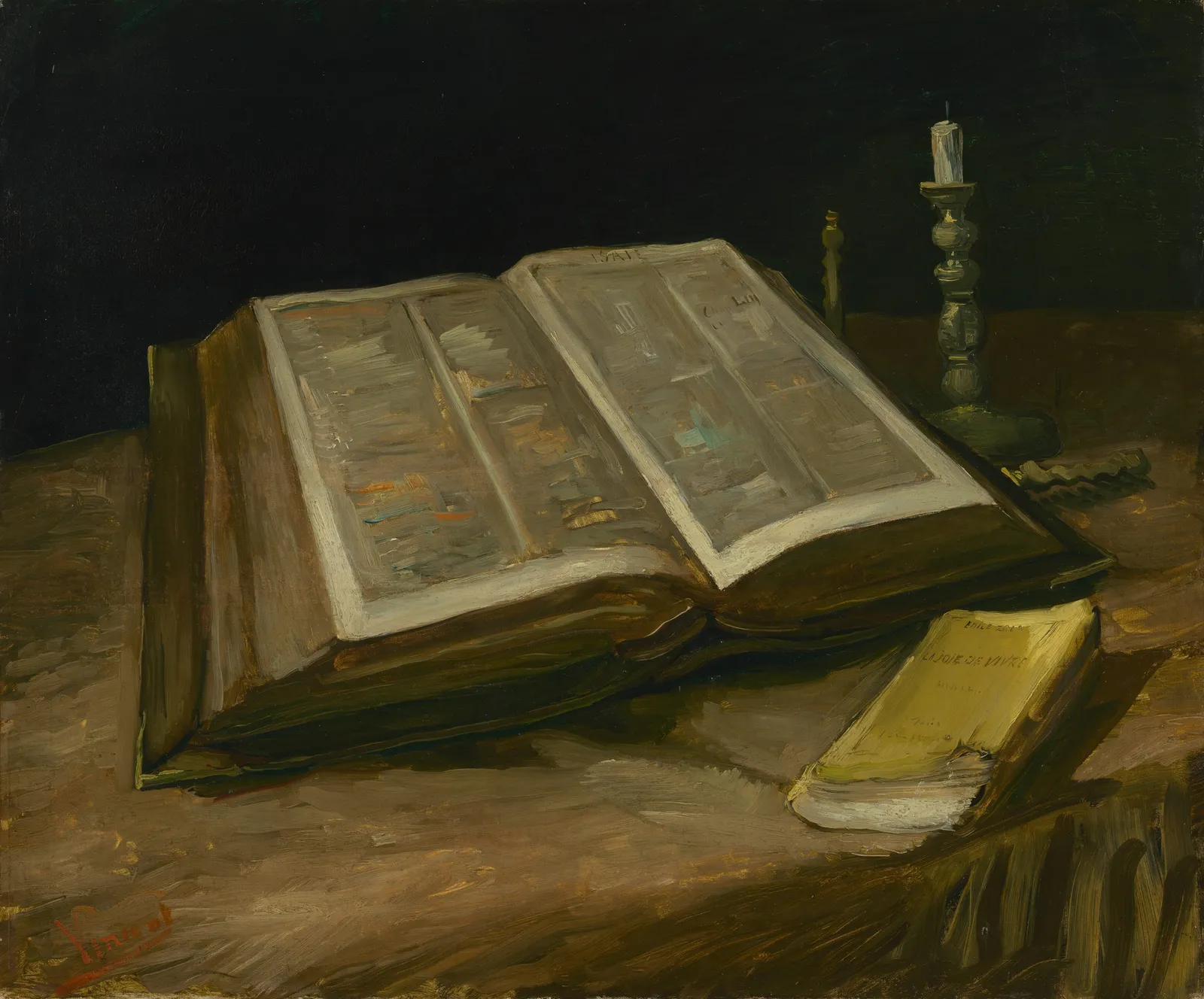
Still Life with Bible is an 1885 painting by Vincent van Gogh in the collection of the Van Gogh Museum. It sets a large open Bible beside a small yellow novel and a snuffed-out candle, painted in the dark, earthy palette of his Dutch years. It is a quiet, compact picture that rewards close looking.
Where to see it
Still Life with Bible is held by the Van Gogh Museum, which is also listed as its location. Works in museum collections can be moved, rotated or lent, so check the Van Gogh Museum's official website for the painting's current display status, opening hours and ticketing before you visit.
What to look for in person
The open Bible
The large book fills much of the canvas, lying open on a table draped in a dark cloth. Look at the pages: the lines of text are suggested with quick, dark marks rather than written out, but a chapter heading stands out, generally identified as Isaiah 53. Notice how the heavy volume, with its thick edges and clasps, is built up in broad strokes of brown, grey and cream. Against the shadowy background it takes on a solid, almost sculptural weight, and it clearly anchors the whole composition.
The small yellow novel
In the foreground sits a small, worn paperback with a bright lemon-yellow cover. Its title is lettered on the front: La Joie de vivre, a novel by the French writer Emile Zola. Step back and see how this patch of yellow is the brightest note in an otherwise sombre picture, and how its modest size contrasts with the massive Bible behind it. The pairing of an old religious text with a contemporary novel is central to how this painting is usually discussed, so it is worth noticing exactly how Van Gogh places the two books in relation to each other.
The candle and the dark palette
Beside the Bible stands a candlestick holding a candle that has been put out. Extinguished candles appear often in earlier European still-life painting as reminders of mortality, and this one is commonly read in that tradition. Look also at the overall colour: deep blacks, browns and ochres, typical of Van Gogh's work before his palette brightened in later years. The confident, broad handling of black is one of the painting's strengths. If you know his later, brighter canvases, comparing them with this one shows how far his colour would change.
About the painting
Vincent van Gogh painted Still Life with Bible in 1885, during the period he spent in Nuenen in the Netherlands, where his parents lived and his father served as a Protestant pastor. His father died earlier that year, and the painting is widely understood as connected to that loss and to the relationship between father and son. The Bible is generally described as his father's. Van Gogh himself had once pursued a religious vocation before turning to art. Many writers have read the picture as setting the faith of his father's generation, represented by the imposing Bible, against the modern world of contemporary fiction that Van Gogh admired, represented by Zola's novel. That reading is an interpretation rather than a stated programme, but it helps explain why the two books are so deliberately contrasted in size, colour and position. Technically, the work shows the skill Van Gogh had developed in his Dutch years: a restrained, dark palette, a strong sense of weight and volume, and assured brushwork. The canvas measures 65.7 cm high by 78.5 cm wide, a moderate size that lets you take in the whole arrangement at once while still seeing the texture of the paint up close. For visitors, the painting offers a useful counterpoint to the bright, colourful works most people associate with Van Gogh. It shows a painter still rooted in Dutch traditions, using a familiar still-life format to say something personal. Before planning a visit specifically to see it, check the Van Gogh Museum's official website to confirm that it is currently on view.
Key facts
| Artist | Vincent van Gogh |
|---|---|
| Date | 1885 |
| Size | 65.7 × 78.5 cm |
| Medium | oil paint, canvas |
| Collection | Van Gogh Museum |
How to visit: Van Gogh Museum
Amsterdam, Netherlands · Museum guide
| Opening hours | 2–30 Nov 2026, daily 09:00–17:00 (Fri until 21:00, except 27 Nov) 1–18 Dec 2026, daily 09:00–17:00 (Fri until 21:00) 19–23 and 27–30 Dec 2026: 09:00–18:00 24, 25, 26 and 31 Dec 2026: 09:00–17:00 1 Jan 2027: 11:00–18:00 2–10 Jan 2027: 09:00–18:00 (Fri until 21:00) 11 Jan – 12 Feb 2027: 09:00–17:00 (Fri until 21:00) 13–28 Feb 2027: 09:00–18:00 (Fri until 21:00, except 26 Feb) March–September 2027: 09:00–18:00 (Fri until 21:00, except 26 Mar, 28 May, 30 Jul, 24 Sep) 1–3 and 11–31 Oct 2027: 09:00–18:00 (Fri until 21:00) 4–10 Oct 2027: from 09:00 (Mon–Thu until 17:00, Fri until 21:00, Sat–Sun until 18:00) 1–7 Nov 2027: 09:00–18:00 (Fri until 21:00) 8–30 Nov and 1–23 Dec 2027: 09:00–17:00 (Fri until 21:00, except 26 Nov) 24–26 and 31 Dec 2027: 09:00–17:00 27–30 Dec 2027: 09:00–18:00 |
|---|---|
| Closed | Open daily with no regular closing day (25 December 09:00–17:00, 1 January 11:00–18:00). |
| Admission | Adult EUR 25 (from 1 January 2027: EUR 26) Adult with multimedia guide EUR 28.75 (from 1 January 2027: EUR 30) Under 18 free (timed ticket still required) Student (EU/EEA institution) EUR 16 (valid until 31 December 2026; proof of enrolment required) Museumkaart, Vincent's Friends, VriendenLoterij VIP-KAART, ICOM, Rembrandt card, Stadspas holders free (reserve a free timed ticket online) |
| Free entry | Free for under-18s and holders of the Museumkaart, Vincent's Friends, VriendenLoterij VIP-KAART, ICOM card, Rembrandt card or Stadspas (a timed ticket must still be booked online). A companion of a visitor needing assistance is also free. The I amsterdam City Card has not been valid since 1 June 2022. |
| Booking | Booking is required, with timed-entry tickets. |
Official ticket page
Official website
View on map
Hours and prices can change. Please check the official website before you go. (Checked on: 2026-11-09)
More by Vincent van Gogh
 Café Terrace at Night — Kröller-Müller Museum
 White House at Night
 The siesta (after Millet) — Musée d'Orsay
 The Church at Auvers — Musée d'Orsay
 Portrait of Père Tanguy
 Starry Night Over the Rhône — Musée d'Orsay
 The Potato Eaters — Van Gogh Museum
 The Red Vineyard
 The Yellow House — Van Gogh Museum
 Agostina Segatori Sitting in the Café du Tambourin — Van Gogh Museum
 Irises — J. Paul Getty Museum
 Langlois Bridge at Arles with Women Washing, The — Kröller-Müller Museum