Art! Art! Art! › Works
Self-portrait
 Vincent van Gogh, 1889
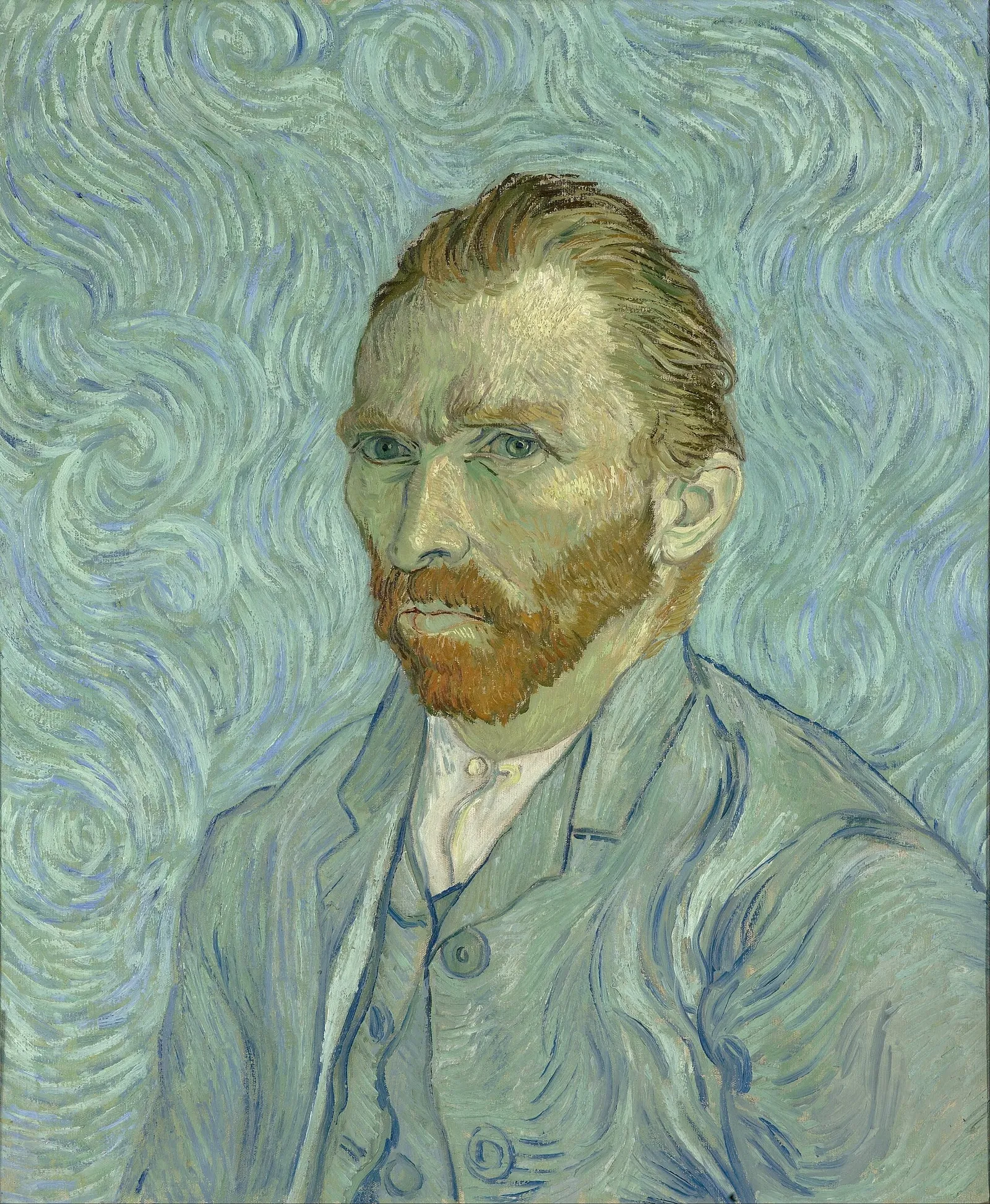
Vincent van Gogh's Self-portrait of 1889 belongs to the Musée d'Orsay. It shows the artist in a steady, unsmiling pose against a background of rippling blue strokes, and it is one of the best-known images he made of himself.
Where to see it
The painting is in the collection of the Musée d'Orsay, which is also its recorded location. It measures 65 cm high by 54.2 cm wide, close to life size for a head-and-shoulders portrait, so it rewards a close look at the brushwork. Works can be moved, lent or taken off view for conservation, so check the Musée d'Orsay's official website for current display status before you plan your visit.
What to look for in person
A background that refuses to sit still
Start with the space around the figure. Instead of a plain backdrop, Van Gogh filled it with curling, wave-like strokes in cool blues and pale blue-greens. Step back and the background reads as one shimmering field. Step closer and you can follow individual loops of paint as they twist around the head and shoulders. Notice how the strokes seem to press in toward the sitter. This churning surface helps give the portrait its uneasy energy, even though the man himself is held completely still.
The face and the fixed gaze
Look next at the head, turned slightly to one side while the eyes stay alert and watchful. The cheeks look hollow and the features are drawn tight, which gives the face a strained, serious mood. The orange and reddish tones of the hair and beard stand out sharply against the surrounding blues, a pairing of opposite colors that Van Gogh used often to make each hue look stronger. Find the small touches of green and other cool colors in the skin, which keep the flesh from looking flat.
Clothing built from the same strokes
Lower your eyes to the jacket. Here he is dressed in a jacket rather than a painter's smock, and the cloth is made from the same kind of directional, ribbon-like marks that fill the background. In places the blues of the clothing almost merge with the space behind, so the figure and its surroundings feel woven together. Look at the edges of the shoulders and lapels, where heavier outlines and thick paint separate the body from the moving background. It is a useful spot to see how he built form with visible strokes.
About the painting
Van Gogh painted himself many times over a short career, using his own face as a subject he could always study. This Self-portrait dates from 1889, a difficult year in his life. After a series of mental health crises in Arles, he entered the asylum of Saint-Paul-de-Mausole at Saint-Rémy-de-Provence in May 1889, where he continued to paint steadily between periods of illness. During that time he produced a small group of self-portraits, and this canvas is among them.
What makes the painting distinctive is how it brings together two sides of his late style. The figure is carefully observed and soberly presented, with no props, no setting and no hint of his trade. Around it, the brushwork becomes rhythmic and almost decorative, turning the background into a pattern of swirling marks. The same restless handling appears in his landscapes from Saint-Rémy, where skies, hills and trees are built from looping strokes.
For visitors, the painting offers a chance to see Van Gogh's technique up close. The paint is applied in distinct strokes that follow the forms they describe, and the contrast between cool blues and warm orange tones is easy to pick out in front of the canvas. Because the work is a modest 65 by 54.2 cm, it can be taken in at a single glance from a few steps back, then studied in detail at closer range.
Van Gogh died in July 1890, the year after this portrait was painted. Seen in that light, the work has become one of the most recognizable images of the artist, though its quiet intensity speaks well enough on its own.
Key facts
| Artist | Vincent van Gogh |
|---|---|
| Date | 1889 |
| Size | 65 × 54.2 cm |
| Medium | oil paint, canvas |
| Collection | Musée d'Orsay |
How to visit: Musée d'Orsay
Paris, France · Museum guide
| Opening hours | Tue–Wed, Fri–Sun 09:30–18:00 (galleries close at 17:30) Thu 09:30–21:45 (late opening; galleries close at 21:15) |
|---|---|
| Closed | Every Monday, 1 May and 25 December. |
| Last entry | 17:00 (exhibitions 17:15); Thursdays 21:00 |
| Admission | Full rate, online EUR 16 Full rate, at the museum EUR 14 Reduced rate (on site only) EUR 11 Enfant & Cie, online EUR 13 Enfant & Cie, at the museum EUR 11 Night rate (Thursday), online EUR 12 Night rate (Thursday), at the museum EUR 10 Under 18s; EEA residents under 26 free |
| Free entry | Free for under 18s and residents of the European Economic Area under 26. Free on the first Sunday of the month, with booking required. |
| Booking | Booking is strongly recommended. Entry is by timed slot. |
The museum stays open and all collections and exhibitions remain accessible, but entrances have changed: timed-ticket holders use Entrance 1 (Quay); priority visitors, reseller voucher holders, visitors without tickets and groups use Entrance 2 (Forecourt). Arrive at least 15 minutes before your time slot.
Official ticket page
Official website
View on map
Hours and prices can change. Please check the official website before you go. (Checked on: 2026-11-11)
More by Vincent van Gogh
 Café Terrace at Night — Kröller-Müller Museum
 Van Gogh's Chair — National Gallery
 Prisoners Exercising
 White House at Night
 The siesta (after Millet) — Musée d'Orsay
 The Church at Auvers — Musée d'Orsay
 Portrait of Père Tanguy
 Almond Blossom — Van Gogh Museum
 Starry Night Over the Rhône — Musée d'Orsay
 The Potato Eaters — Van Gogh Museum
 The Red Vineyard
 The Yellow House — Van Gogh Museum