Art! Art! Art! › Works
Langlois Bridge at Arles
 Vincent van Gogh, 1888
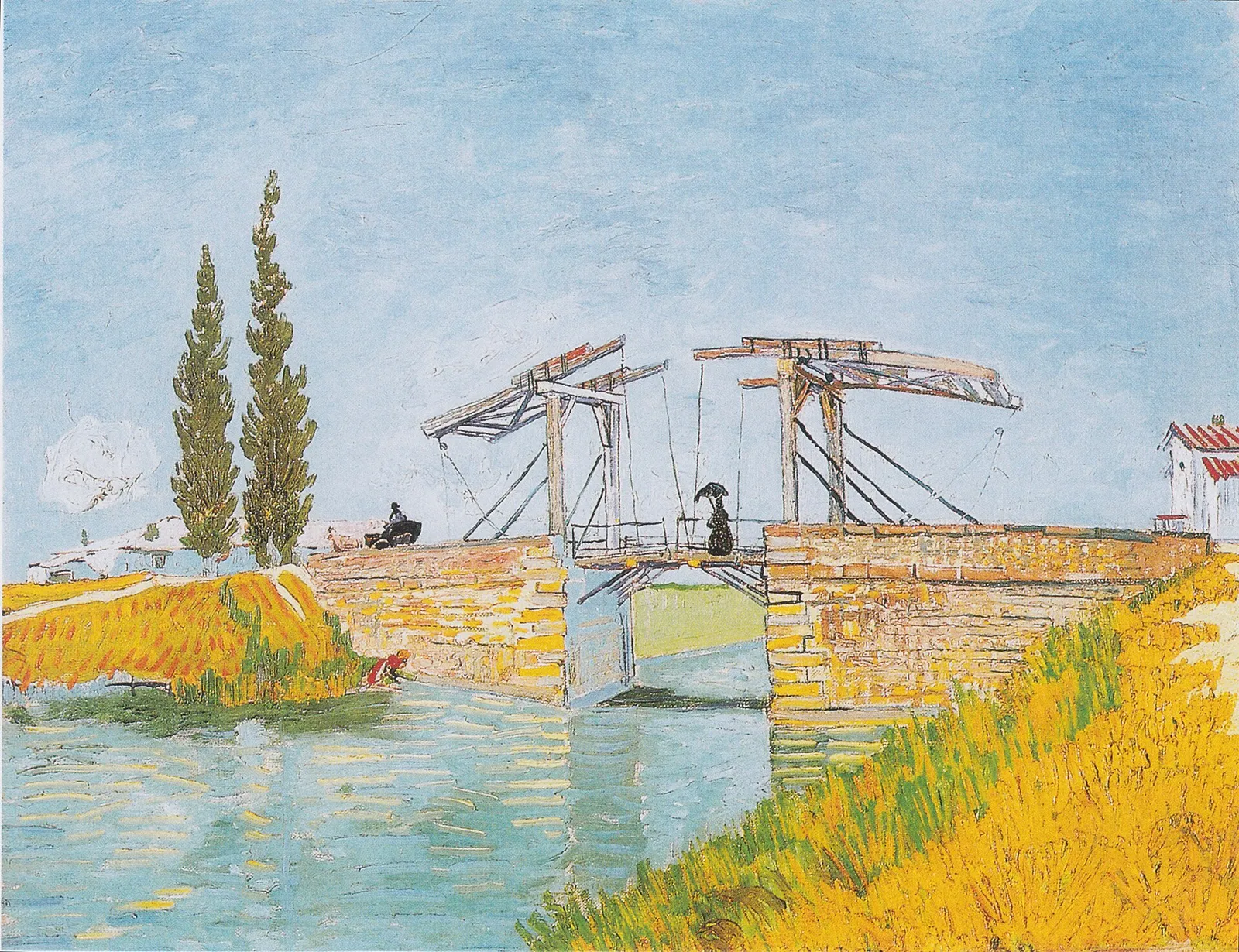
Langlois Bridge at Arles is an 1888 oil painting by Vincent van Gogh in the collection of the Wallraf–Richartz Museum. It belongs to a group of works in which Van Gogh returned again and again to a small drawbridge over a canal near Arles, a motif he made his own during his first months in the south of France.
Where to see it
Langlois Bridge at Arles is held by the Wallraf–Richartz Museum. Works on canvas are sometimes taken off view for conservation, rehanging or loans, so check the museum's official website for current display status, opening hours and ticketing before you plan your visit.
What to look for in person
A working bridge as the main subject
Start with the bridge itself. Van Gogh chose an ordinary piece of local infrastructure, a wooden drawbridge over a canal outside Arles, rather than a famous monument. Look at how its structure is built up from straight, firm lines against the softer forms of water, banks and sky. The geometry of the bridge gives the composition a clear backbone, and it is worth stepping back to see how the eye is led from the foreground towards it and across the canal.
An echo of Japanese prints
Van Gogh admired Japanese woodblock prints, and during his time in Arles he often described the south of France in terms of the Japan he imagined from them. The Langlois Bridge series is widely seen in this light: a simple bridge, flat areas of strong colour and clean outlines recall the bridges that appear in prints he collected and copied. In front of the canvas, notice how parts of the scene read almost as flat shapes rather than deep, modelled space.
Colour and brushwork up close
At 49.5 by 64 centimetres, this is a modest canvas that rewards a close look. In Arles, Van Gogh's palette grew brighter and his touch more direct, and you can follow individual strokes across the surface. Look at how different marks are used for water, sky and ground, and how the paint sits on the canvas. Then move back a few steps to see those separate strokes merge into light and atmosphere.
About the painting
Vincent van Gogh painted Langlois Bridge at Arles in 1888, the year he left Paris for Provence. He arrived in Arles hoping to find strong southern light and a simpler way of life, and the months that followed were among the most productive of his career. Ordinary places around the town, such as fields, orchards, cafes and canals, became the subjects of paintings in which he pushed colour and line further than he had before.
The drawbridge over the canal near Arles was one of the motifs he returned to repeatedly. He made several painted versions and drawings of it, varying the viewpoint, the weather and the figures around it. Seen together, the series shows him testing how much a single, unremarkable structure could carry: a sense of place, a study of colour relationships, and his ongoing dialogue with Japanese prints, which he admired for their bold outlines and flat, bright colour.
For a visitor, the value of this canvas lies in seeing that experiment at close range. The picture is not large, so it invites slow looking rather than a quick glance across a gallery. Notice how the bridge anchors the composition, how the water and sky are handled with different kinds of brushstroke, and how strongly colour defines the scene. If you know other versions of the subject from reproductions or other museums, it is interesting to compare how this one treats the same bridge.
The Wallraf–Richartz Museum holds the work. Check the museum's official website for current display information before you go.
Key facts
| Artist | Vincent van Gogh |
|---|---|
| Date | 1888 |
| Size | 49.5 × 64 cm |
| Medium | oil paint, canvas |
| Collection | Wallraf–Richartz Museum |
How to visit: Wallraf–Richartz Museum
Cologne, Germany
Hours and prices can change. Please check the official website before you go.
More by Vincent van Gogh
 Café Terrace at Night — Kröller-Müller Museum
 White House at Night
 The siesta (after Millet) — Musée d'Orsay
 The Church at Auvers — Musée d'Orsay
 Portrait of Père Tanguy
 Starry Night Over the Rhône — Musée d'Orsay
 The Potato Eaters — Van Gogh Museum
 The Red Vineyard
 The Yellow House — Van Gogh Museum
 Agostina Segatori Sitting in the Café du Tambourin — Van Gogh Museum
 Irises — J. Paul Getty Museum
 Langlois Bridge at Arles with Women Washing, The — Kröller-Müller Museum