Art! Art! Art! › Works
Harvest at La Crau, with Montmajour in the Background
 Vincent van Gogh, 1888
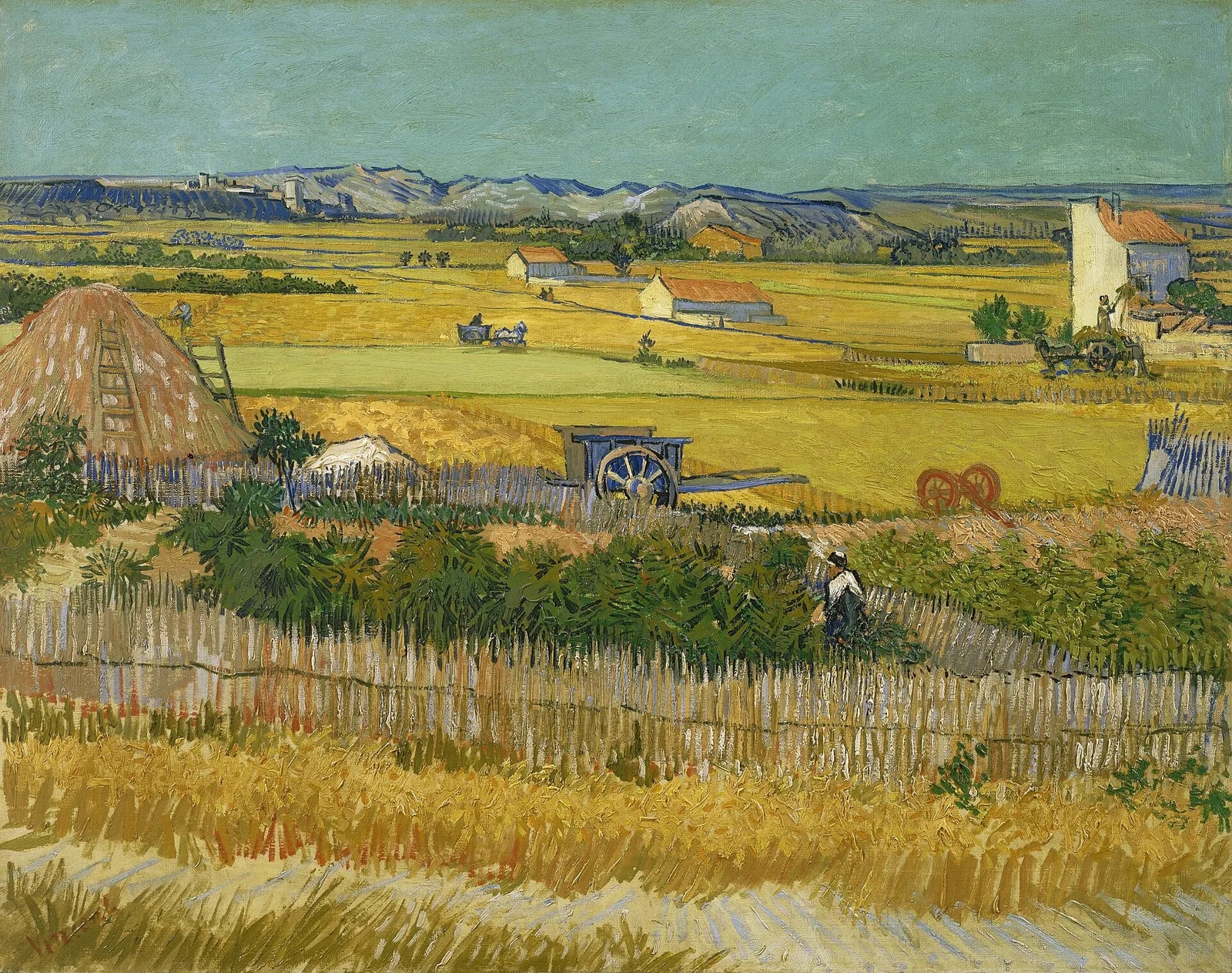
Vincent van Gogh's Harvest at La Crau, with Montmajour in the Background (1888) shows a wide farming plain in Provence during harvest time, with a low ridge and a ruined abbey on the horizon. The painting is in the collection of the Van Gogh Museum. It rewards slow looking, because small figures, carts and haystacks are scattered across a field of yellows and greens.
Where to see it
Harvest at La Crau, with Montmajour in the Background is held by the Van Gogh Museum, which is also its listed location. Works in any collection can be moved, rehung or lent, so check the Van Gogh Museum's official website for current display status, opening hours and ticketing before you plan your visit.
What to look for in person
A landscape built in bands
Stand back first and notice how the picture is organised in horizontal layers. The foreground fields give way to a busy middle zone of farm activity, then to a distant line of hills and a narrow strip of sky set high in the composition. This high horizon lets the plain fill most of the canvas, so your eye travels across the land rather than up into the sky. The 73 by 92 centimetre format suits this wide, panoramic reading of the scene.
Small signs of the harvest
Move closer and look for the details of work in progress. Van Gogh placed a cart near the centre, along with haystacks, farm buildings, fences and small figures who appear busy with the harvest. None of these elements dominates; instead they are spread across the fields, giving a sense of a whole community at work across the plain. Try tracing a path from the foreground into the distance and counting the different activities you can find along the way.
Colour and brushwork
The painting is dominated by warm yellows and ochres for the ripening fields, set against greens, touches of blue and the cool tones of the distant hills and sky. Look at how the brushstrokes change from area to area: short marks, longer strokes and flatter patches each describe a different kind of field or surface. Seen up close, these marks become a patchwork of colour; from a few steps back, they resolve into a coherent, sunlit landscape.
About the painting
Vincent van Gogh painted Harvest at La Crau, with Montmajour in the Background in 1888, the year he settled in Arles in the south of France. Soon after arriving, he became absorbed by the flat, open countryside around the town, known as La Crau, and by the bright light of Provence, which he felt was very different from the northern landscapes he knew. The title points to two places: the plain of La Crau, where the harvest is taking place, and Montmajour, a hill topped by the ruins of an old abbey, which can be found along the horizon. Van Gogh walked in this area and made a number of drawings and paintings of the surrounding landscape during this period. In front of the painting, it helps to think of it as a portrait of a place rather than of people. The farm workers are small and anonymous, while the land itself, divided into fields of different colours and textures, is the real subject. The composition invites you to scan the scene from side to side and from front to back, picking out carts, stacks and buildings as you go. For visitors who know Van Gogh mainly through his sunflowers or night skies, this work offers a quieter view of his time in Arles: careful observation of an ordinary working landscape, translated into strong colour and varied brushwork. Allow time to view it both from a distance, to take in the overall structure, and up close, to see how individual strokes of paint build the fields, the hills and the sky.
Key facts
| Artist | Vincent van Gogh |
|---|---|
| Date | 1888 |
| Size | 73 × 92 cm |
| Medium | oil paint, canvas |
| Collection | Van Gogh Museum |
How to visit: Van Gogh Museum
Amsterdam, Netherlands · Museum guide
| Opening hours | 2–30 Nov 2026, daily 09:00–17:00 (Fri until 21:00, except 27 Nov) 1–18 Dec 2026, daily 09:00–17:00 (Fri until 21:00) 19–23 and 27–30 Dec 2026: 09:00–18:00 24, 25, 26 and 31 Dec 2026: 09:00–17:00 1 Jan 2027: 11:00–18:00 2–10 Jan 2027: 09:00–18:00 (Fri until 21:00) 11 Jan – 12 Feb 2027: 09:00–17:00 (Fri until 21:00) 13–28 Feb 2027: 09:00–18:00 (Fri until 21:00, except 26 Feb) March–September 2027: 09:00–18:00 (Fri until 21:00, except 26 Mar, 28 May, 30 Jul, 24 Sep) 1–3 and 11–31 Oct 2027: 09:00–18:00 (Fri until 21:00) 4–10 Oct 2027: from 09:00 (Mon–Thu until 17:00, Fri until 21:00, Sat–Sun until 18:00) 1–7 Nov 2027: 09:00–18:00 (Fri until 21:00) 8–30 Nov and 1–23 Dec 2027: 09:00–17:00 (Fri until 21:00, except 26 Nov) 24–26 and 31 Dec 2027: 09:00–17:00 27–30 Dec 2027: 09:00–18:00 |
|---|---|
| Closed | Open daily with no regular closing day (25 December 09:00–17:00, 1 January 11:00–18:00). |
| Admission | Adult EUR 25 (from 1 January 2027: EUR 26) Adult with multimedia guide EUR 28.75 (from 1 January 2027: EUR 30) Under 18 free (timed ticket still required) Student (EU/EEA institution) EUR 16 (valid until 31 December 2026; proof of enrolment required) Museumkaart, Vincent's Friends, VriendenLoterij VIP-KAART, ICOM, Rembrandt card, Stadspas holders free (reserve a free timed ticket online) |
| Free entry | Free for under-18s and holders of the Museumkaart, Vincent's Friends, VriendenLoterij VIP-KAART, ICOM card, Rembrandt card or Stadspas (a timed ticket must still be booked online). A companion of a visitor needing assistance is also free. The I amsterdam City Card has not been valid since 1 June 2022. |
| Booking | Booking is required, with timed-entry tickets. |
Official ticket page
Official website
View on map
Hours and prices can change. Please check the official website before you go. (Checked on: 2026-11-09)
More by Vincent van Gogh
 Café Terrace at Night — Kröller-Müller Museum
 White House at Night
 The siesta (after Millet) — Musée d'Orsay
 The Church at Auvers — Musée d'Orsay
 Portrait of Père Tanguy
 Starry Night Over the Rhône — Musée d'Orsay
 The Potato Eaters — Van Gogh Museum
 The Red Vineyard
 The Yellow House — Van Gogh Museum
 Agostina Segatori Sitting in the Café du Tambourin — Van Gogh Museum
 Irises — J. Paul Getty Museum
 Langlois Bridge at Arles with Women Washing, The — Kröller-Müller Museum