Art! Art! Art! › Works
At Eternity's Gate
 Vincent van Gogh, 1890
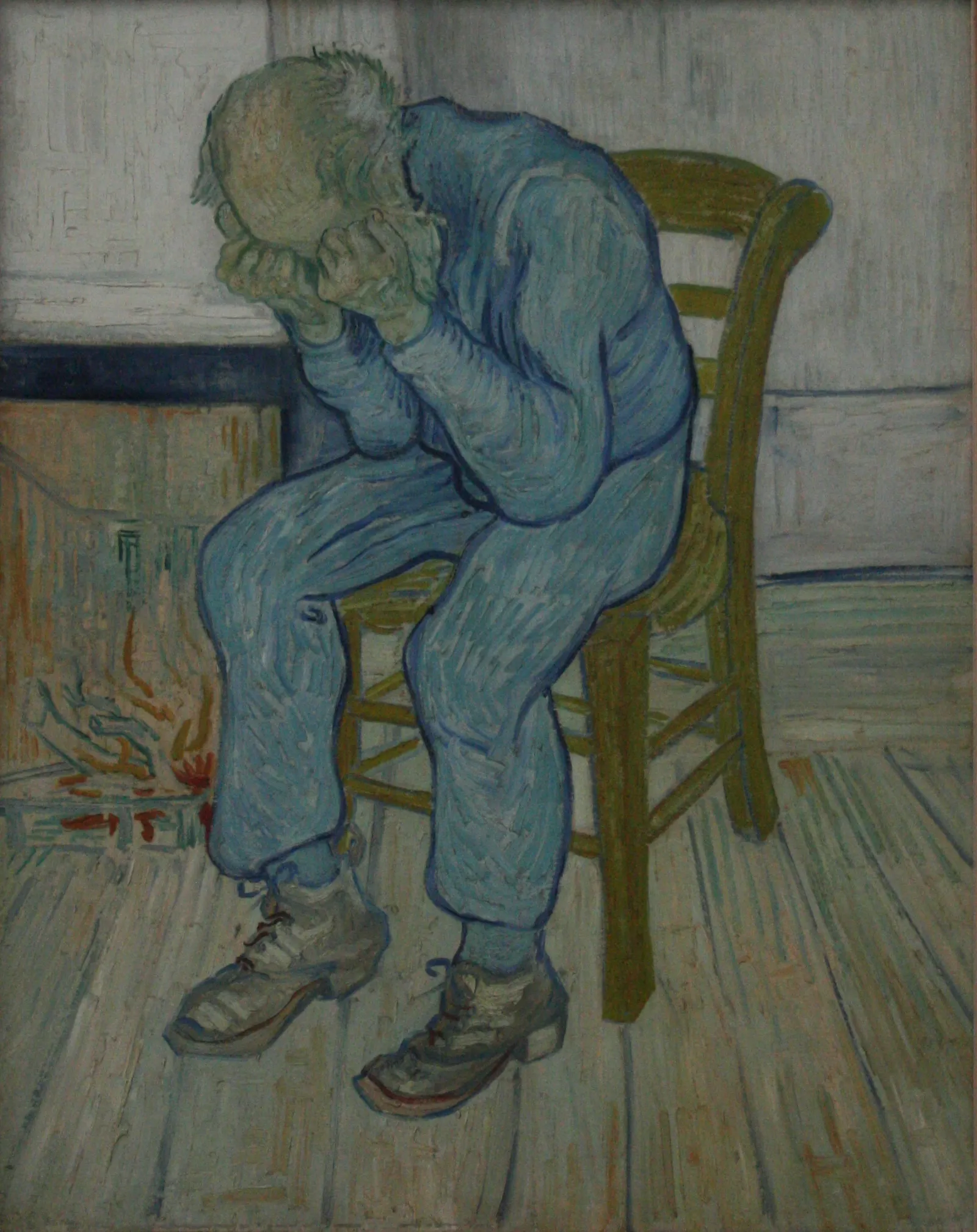
At Eternity's Gate is an oil painting by Vincent van Gogh, dated 1890, showing an old man seated by a stove with his head bowed into his hands. It belongs to the Kröller-Müller Museum, and it revisits a subject Van Gogh had first drawn and printed in The Hague eight years earlier.
Where to see it
At Eternity's Gate is in the collection of the Kröller-Müller Museum, where it is recorded under inventory number KM 111.041. The canvas measures 81.8 cm high by 65.5 cm wide. Display arrangements can change, so check the Kröller-Müller Museum's official website for current display status and visiting information before you travel.
What to look for in person
A figure with no visible face
Start with the pose. An elderly man sits on a plain chair near the stove, his body folded forward and his head pressed into his fists. His face is hidden completely, so the mood of the picture depends on the hunched back, the raised shoulders and the tight grip of the hands. Step back and notice how the figure takes up much of the upright canvas, which measures 81.8 by 65.5 cm, with little else in the room to draw your eye away. The effect is of a private moment of exhaustion or grief rather than a conventional portrait.
Blue against yellow
Move closer and the colour does as much work as the pose. The man's clothing is built from blues, paler blues and touches of white, set against the yellow of the chair and the floor beneath him, while his hair is painted grey. Look at how the cool tones of the figure sit directly against the warm surroundings, so that he stands out sharply from the room. Because this is oil on canvas, you can also follow the direction of the brushstrokes as they describe the folds of the clothes and the surface of the floor.
An old image, reworked
The subject began eight years earlier. In 1882 in The Hague, Van Gogh made a series of studies of a pensioner and war veteran, Adrianus Jacobus Zuyderland, at an almshouse. One pencil drawing, Worn Out, became the basis for a lithograph; seven impressions of it are known, and one bears the words At Eternity's Gate. The museum stresses that the 1890 canvas is not simply the print turned into colour: Van Gogh changed the composition, and the chair and stove may be those of the asylum. If you know the print, compare the settings.
About the painting
Van Gogh painted At Eternity's Gate in May 1890 at Saint-Rémy-de-Provence, where he was a patient at the asylum of Saint-Paul-de-Mausole. He completed it early that month while recovering from a serious relapse of his illness, roughly two months before his death. Both the 1970 catalogue raisonné and the scholar Jan Hulsker place the work in May 1890 at Saint-Rémy, and the catalogue raisonné listed it under the fuller title Worn Out: At Eternity's Gate. The composition looks back to Van Gogh's years in The Hague. In 1882 he drew a series of studies of Adrianus Jacobus Zuyderland, an elderly pensioner and former soldier living in an almshouse, and turned one drawing, Worn Out, into a lithograph. One of the seven known impressions of that print carries the annotation At Eternity's Gate, the phrase by which the painting is now known. Returning to the image in Saint-Rémy, Van Gogh did not reproduce the print mechanically. The Kröller-Müller Museum, which holds the painting as inventory number KM 111.041, points out that he adjusted the composition and may have drawn on the asylum's own chair and stove for the setting. The museum also considers it likely that a fellow patient sat for the figure of the old man. Seen this way, the canvas joins an earlier memory of The Hague with the surroundings Van Gogh was living in at the time. For visitors, it offers a chance to see how he took a black-and-white image from his early career and rebuilt it in strong, contrasting colour late in his life.
Key facts
| Artist | Vincent van Gogh |
|---|---|
| Date | 1890 |
| Size | 81.8 × 65.5 cm |
| Medium | oil paint, canvas |
| Collection | Kröller-Müller Museum |
How to visit: Kröller-Müller Museum
Ede, Netherlands · Museum guide
| Opening hours | Tue–Sun and public holidays 10:00–17:00 (museum and sculpture garden) Mon 21 Dec and Mon 28 Dec 2026 10:00–17:00 (special Christmas openings) |
|---|---|
| Closed | Mondays (except public holidays and announced exceptions); 1 January. Public holidays: Easter, Ascension Day, Pentecost, 25 and 26 December, King's Day 27 April, Liberation Day 5 May. |
| Admission | Adult (combined day ticket, museum + De Hoge Veluwe National Park) EUR 27.75 Youth 13–18 (combined day ticket) EUR 20.8 Child 6–12 (combined day ticket) EUR 6.95 Museumkaart / VriendenLoterij VIP-KAART holders (park only; museum free) EUR 13.85 (bring the card) Students / CJP / Cultuurkaart / EYCA (discounted museum ticket) EUR 6.95 (park ticket bought separately at the park entrance) Car / motorcycle in the park EUR 9.8 (parking at park entrance EUR 4.90) Audio tour (Podcatcher) EUR 2.5 (collection presentation only; max 90 minutes) |
| Free entry | Museum entry is free with a Museumkaart or VriendenLoterij VIP-KAART (park ticket still needed). Free with an ICOM or Vereniging Rembrandt card. One companion of a disabled-parking-permit holder enters the museum free. Park admission is required to reach the museum. |
| Booking | Booking is recommended; there is no timed entry. |
The exhibition “Van Gogh, All Our Paintings” (15 Sep 2026 – 3 Jan 2027) requires an additional free exhibition ticket with a start time. From 4 October the collection tour follows a different route. No closure has been announced.
Official ticket page
Official website
View on map
Hours and prices can change. Please check the official website before you go. (Checked on: 2026-11-09)
More by Vincent van Gogh
 Café Terrace at Night — Kröller-Müller Museum
 White House at Night
 The siesta (after Millet) — Musée d'Orsay
 The Church at Auvers — Musée d'Orsay
 Portrait of Père Tanguy
 Starry Night Over the Rhône — Musée d'Orsay
 The Potato Eaters — Van Gogh Museum
 The Red Vineyard
 The Yellow House — Van Gogh Museum
 Agostina Segatori Sitting in the Café du Tambourin — Van Gogh Museum
 Irises — J. Paul Getty Museum
 Langlois Bridge at Arles with Women Washing, The — Kröller-Müller Museum
Sources
- Wikidata Q500554
- Wikipedia (en) (CC BY-SA 4.0)
- Wikipedia (ja) (CC BY-SA 4.0)
- Wikipedia (it) (CC BY-SA 4.0)
- Museum website (krollermuller.nl)
- www.krollermuller.nl
- krollermuller.nl
- a.krollermuller.nl