Art! Art! Art! › Works
Vampire
 Edvard Munch, 1893
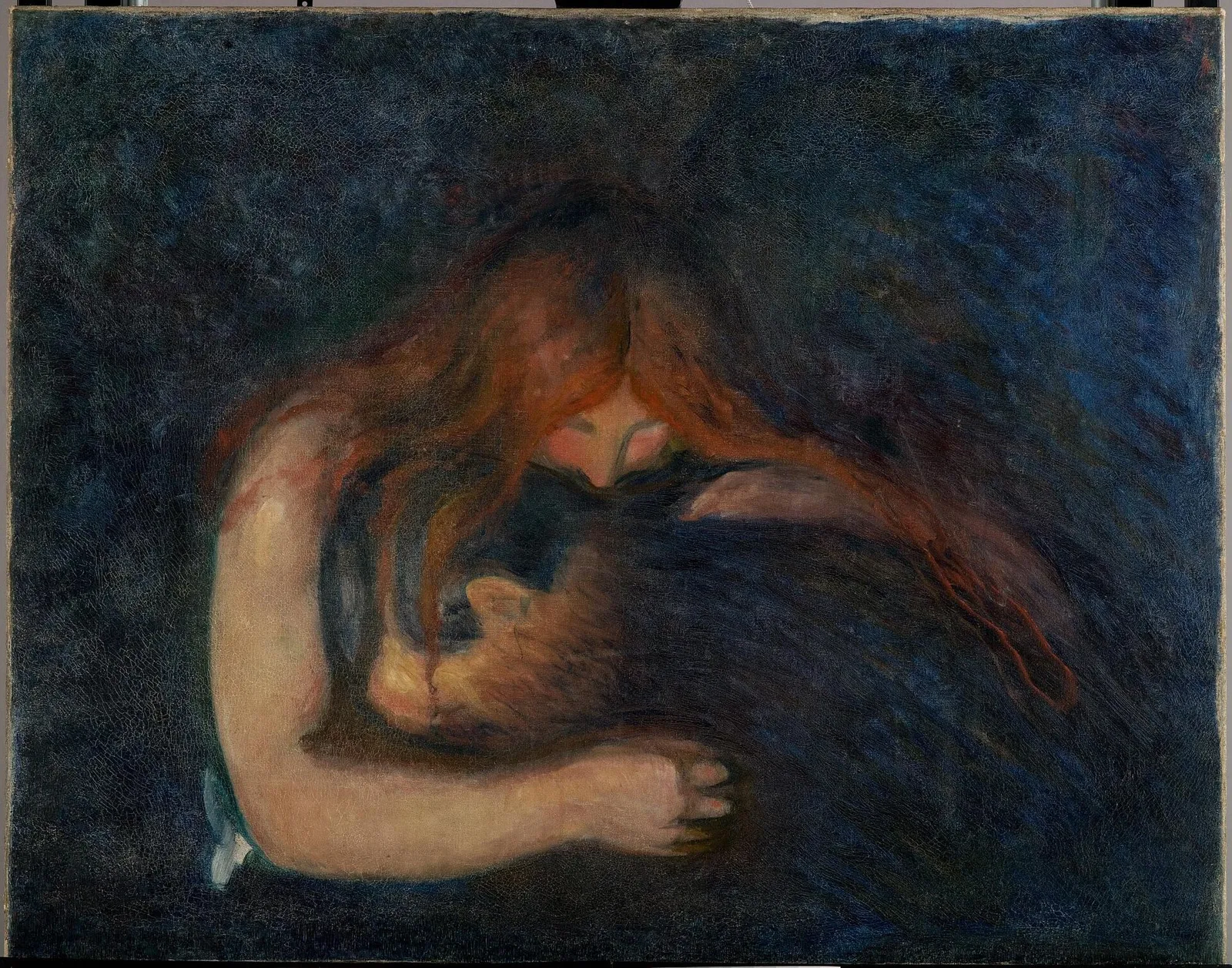
Edvard Munch's Vampire, dated 1893, shows a man and a woman locked in an embrace that can be read as tenderness or as something far darker. The work belongs to the Munch Museum, and it rewards slow looking: the meaning shifts depending on where your eye settles.
Where to see it
Vampire is in the collection of the Munch Museum. The painting measures 77.5 cm high by 98.5 cm wide, a size that lets you take in the whole embrace from a few steps back and then move closer to study the brushwork. Works on display can change because of rotations, conservation or loans, so check the Munch Museum's official website for current display status before you visit.
What to look for in person
The embrace at the centre
Start with the two figures. The man bows his head into the woman's body, and she leans over him with her face pressed to the back of his neck. Neither face is clearly shown, so the emotional reading is left open. Is she comforting him, or feeding on him? Munch offers no clear answer. Notice how the bodies fold into one rounded shape, so that it becomes hard to say where one figure ends and the other begins. That fusion is the heart of the picture.
The red hair
The woman's red hair is the most striking element of colour in the composition. Look at how it spills down over the man's head and shoulders in long strands, almost like tendrils wrapping around him. Against the darker tones of the rest of the painting, the red draws the eye immediately and carries much of the image's tension. Some viewers see warmth and intimacy in it; others see something closer to a trap or a wound. Following the strands across the figures is a good way to read the painting.
Darkness and simplified forms
Step back and look at the surroundings. The setting is dark and loosely defined, with no detailed room or landscape to anchor the scene. A shadow seems to gather around and behind the couple, adding weight to the mood. Munch simplifies the figures into broad shapes rather than describing them in fine detail, which is typical of his work from the 1890s. This reduction keeps attention on feeling rather than story, and it is worth comparing the soft, brushy passages of the background with the more defined contours of the couple.
About the painting
Edvard Munch, the Norwegian painter and printmaker, made Vampire in the 1890s, a decade in which he developed the themes of love, jealousy, anxiety and death that run through much of his best-known work. He grouped many of these images into a loose cycle he called The Frieze of Life, and Vampire is widely regarded as one of its key motifs. The Munch Museum, which holds this painting, dates it to 1893. Munch is generally understood to have first shown the image under a title closer to Love and Pain. The name Vampire is commonly associated with the Polish writer Stanisław Przybyszewski, part of Munch's circle in Berlin, who described the scene in those darker terms. The title stuck, and it has shaped how viewers approach the picture ever since. It is worth keeping both titles in mind while you look, because the painting holds both readings at once. Munch returned to this composition several times, in painted versions and in prints, which was a habit of his with images that mattered to him. If you know the motif from reproductions or from his printed versions, standing in front of this painting lets you see how colour and the texture of the paint change the mood. For visitors, the practical advice is simple: give the work time. First take in the overall shape of the couple, then follow the red hair, then let your eye drift into the dark surroundings. The picture is not about a story with a clear ending, but about an emotional state that stays unresolved, and that ambiguity is what keeps people returning to it.
Key facts
| Artist | Edvard Munch |
|---|---|
| Date | 1893 |
| Size | 77.5 × 98.5 cm |
| Medium | oil paint, canvas |
| Collection | Munch Museum |
How to visit: Munch Museum
Oslo, Norway · Museum guide
| Opening hours | Sun–Tue 10:00–18:00 Wed–Sat 10:00–21:00 (late opening) 24 and 31 Dec 2026 10:00–14:00 25 and 26 Dec 2026 10:00–18:00 |
|---|---|
| Closed | Closed on 1 May 2026. |
| Admission | Adults NOK 220 Under 25 NOK 100 Ages 0–17 free |
| Free entry | Free for ages 0–17, members (plus one guest) and companions with a valid companion certificate. Free drop-in entry on the first Wednesday of each month, 18:00–21:00 (except July, August and September). |
| Booking | Tickets are timed and booking in advance is recommended. |
Official ticket page
Official website
View on map
Hours and prices can change. Please check the official website before you go. (Checked on: 2026-11-09)
More by Edvard Munch
 Jealousy
 Anxiety — Munch Museum
 Starry Night — J. Paul Getty Museum
 Inger on the Beach
 Night in Saint-Cloud — National Museum of Art, Architecture and Design
 Self-Portrait with Cigarette — National Museum of Art, Architecture and Design
 Self-Portrait. Between the Clock and the Bed — Munch Museum
 Vampire — Munch Museum
 Dance of Life — National Museum of Art, Architecture and Design
 Puberty — National Museum of Art, Architecture and Design
 Evening on Karl Johan
 The Scream — National Museum of Art, Architecture and Design