Art! Art! Art! › Works
Self-Portrait with Cigarette
 Edvard Munch, 1895
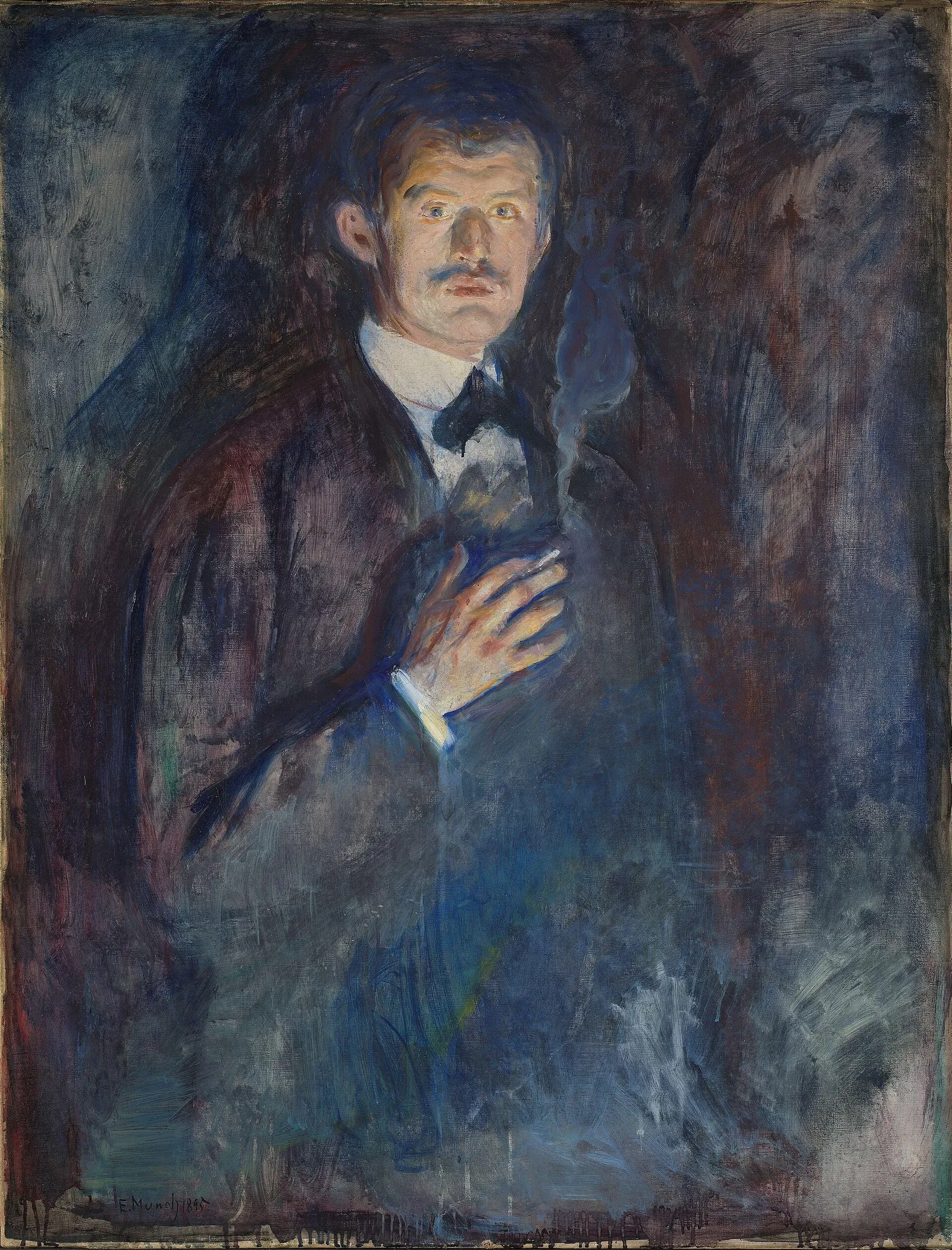
Edvard Munch's Self-Portrait with Cigarette, dated 1895, shows the artist emerging from a haze of smoke and shadow, his face and hand caught in a sharp, unsettling light. The painting belongs to the National Museum of Art, Architecture and Design in Norway, and seeing it in person shows how much of its effect depends on scale, colour and atmosphere.
Where to see it
Self-Portrait with Cigarette is in the collection of the National Museum of Art, Architecture and Design. Its location is recorded as the National Gallery of Norway and the National Museum of Art, Architecture and Design; the National Gallery of Norway is part of the National Museum. Displays can change because of rehangs, conservation or loans, so check the museum's official website for current display status before you visit.
What to look for in person
A face lit from below
Start with the light. Munch's face and the hand holding the cigarette are the brightest parts of the canvas, and the illumination seems to rise from beneath, much like stage footlights. This lighting sharpens the cheekbones and brow while leaving much of the body in shadow. Stand still for a moment and notice how your eye keeps returning to the face and hand, as if the rest of the figure were fading. The effect is less a flattering likeness than a portrait of a mood: watchful, inward and slightly detached.
Smoke that becomes the background
Look at the cool blue and dark tones surrounding the figure. The cigarette smoke does not stay a separate detail; it seems to drift into the background until air, smoke and space are hard to tell apart. The edges of the body are loose and soft in places, so the figure appears to dissolve into its surroundings rather than stand against them. Step closer to see how freely the paint is handled in these areas, then step back to see how the haze holds the composition together.
Scale and the direct gaze
At 110.5 by 85.5 centimetres, this is a substantial canvas, and the figure fills much of it. Seen at a normal viewing distance, the size makes the encounter feel personal, as though the artist were standing in the room with you. Notice the eyes: the gaze is steady and turned toward the viewer, yet the expression gives little away. Compare the stillness of the pose with the restless, shifting background. That contrast between a composed figure and an unstable atmosphere is a good way into the painting's tension.
About the painting
Edvard Munch painted Self-Portrait with Cigarette in 1895, during the years when he was developing the emotionally charged, symbolic style for which he is best known. In this period he was working on paintings about love, anxiety and death, themes he later grouped as the Frieze of Life. This self-portrait belongs to that same climate of ideas: it is less interested in recording exactly how the artist looked than in conveying an inner state.
The cigarette is a telling detail. In the artistic circles Munch moved in during the 1890s, smoking, late nights and café conversation were part of a bohemian way of life that rejected conventional respectability. By presenting himself with a cigarette, wrapped in smoke and shadow, Munch casts himself as a modern artist, self-aware and somewhat apart from ordinary society.
Self-portraiture was a lifelong practice for Munch. Across his career he returned again and again to his own image, using it to explore illness, ageing, solitude and his identity as a painter. This 1895 canvas is one of the most frequently discussed of his early self-portraits, partly because it combines a fairly traditional half-length portrait format with an atmosphere that feels unstable and dreamlike.
For visitors, the painting rewards slow looking. Notice how little detail is given to clothing or setting, and how much attention goes to light, colour and the blurring of edges. The work is a useful starting point for understanding Munch's broader approach, in which feeling shapes form and the boundaries between a person and their surroundings begin to give way.
Key facts
| Artist | Edvard Munch |
|---|---|
| Date | 1895 |
| Size | 110.5 × 85.5 cm |
| Medium | oil paint, canvas |
| Collection | National Museum of Art, Architecture and Design |
How to visit: National Museum of Art, Architecture and Design
Oslo, Norway · Museum guide
| Opening hours | Tue–Wed 10:00–20:00 Thu–Sun 10:00–17:00 |
|---|---|
| Closed | Closed on Mondays. Holiday exceptions 2026–27: 23 Dec open 10:00–17:00; 24–26 Dec closed; Monday 28 Dec open 10:00–17:00; 31 Dec 2026 – 1 Jan 2027 closed. |
| Admission | Adults NOK 220 Under 25 NOK 100 Students (under 30) NOK 120 (student ID required; buy at the ticket counter) Under 18 free |
| Free entry | Free for under-18s, National Museum members (plus one guest), Oslo Pass holders (free ticket at the counter), ICOM/ICAM and listed professional association members, press card holders, and companions or carers of visitors with disabilities (with proof). |
| Booking | Booking is recommended. |
Official ticket page
Official website
View on map
Hours and prices can change. Please check the official website before you go. (Checked on: 2026-11-11)
More by Edvard Munch
 Vampire — Munch Museum
 Jealousy
 Anxiety — Munch Museum
 Starry Night — J. Paul Getty Museum
 Inger on the Beach
 Night in Saint-Cloud — National Museum of Art, Architecture and Design
 Self-Portrait. Between the Clock and the Bed — Munch Museum
 Vampire — Munch Museum
 Dance of Life — National Museum of Art, Architecture and Design
 Puberty — National Museum of Art, Architecture and Design
 Evening on Karl Johan
 The Scream — National Museum of Art, Architecture and Design