Art! Art! Art! › Works
Anxiety
 Edvard Munch, 1894
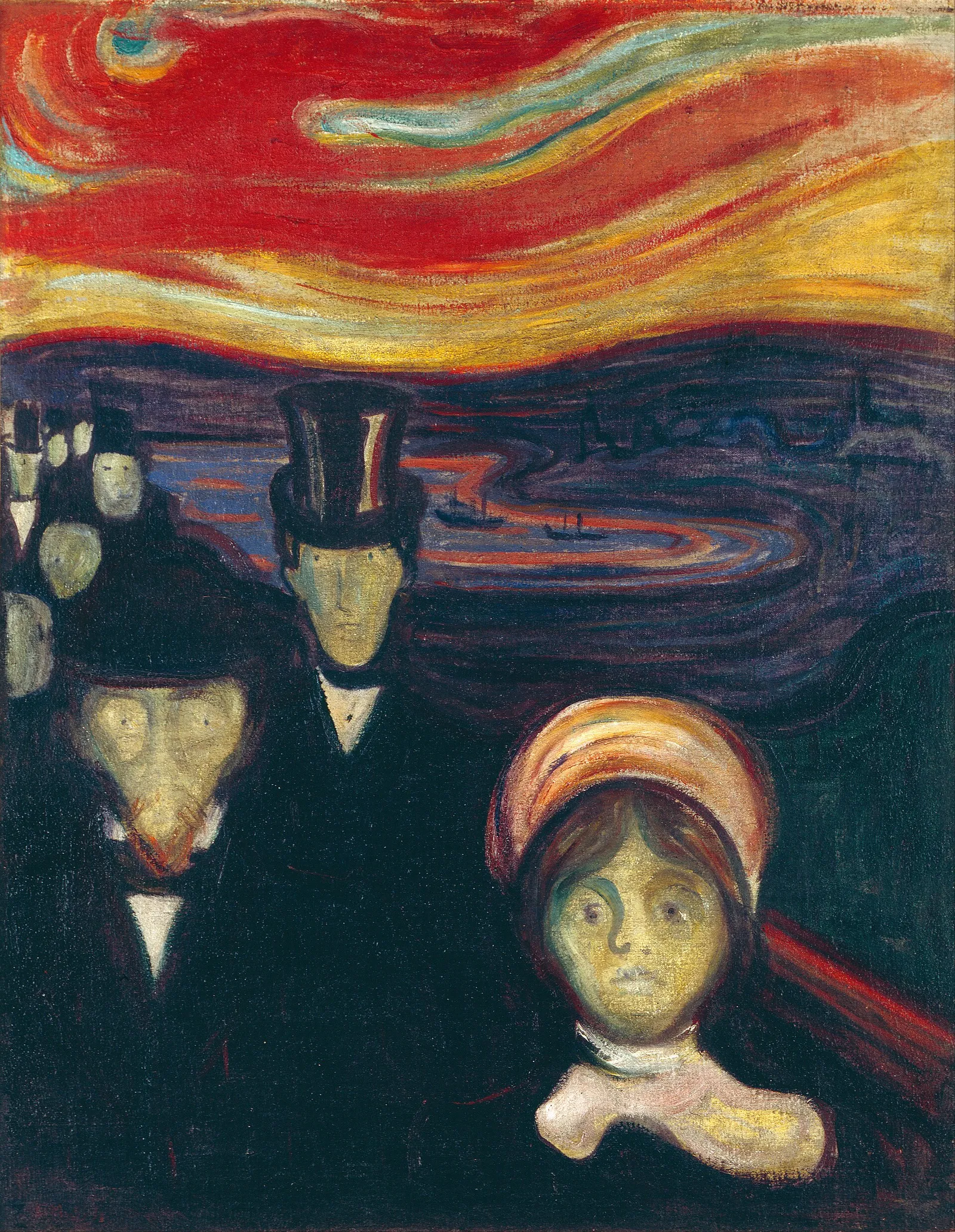
Edvard Munch painted Anxiety in 1894, and the work is held in the collection of the Munch Museum. A crowd of pale, staring figures moves toward the viewer beneath a burning red sky. It is one of the clearest places to see how Munch used colour and faces to make a feeling visible.
Where to see it
Anxiety (1894) by Edvard Munch is in the collection of the Munch Museum. Works on paper and paintings in large single-artist collections are often rotated, rested or lent, so check the Munch Museum's official website for current display status before you visit, especially if this painting is the main reason for your trip. The canvas measures 94 x 74 cm, which makes it a moderate size: close enough to human scale that the figures seem to meet you at eye level.
What to look for in person
The faces that stare back
Start with the people in the foreground. A woman in a hat and a group of men in dark coats and top hats walk straight toward you, their faces pale and mask-like, with hollow, fixed eyes. No one looks at anyone else, and no one seems to be going anywhere in particular. Stand still for a moment and notice how the group feels both crowded and isolated at the same time. Munch gives very little individual detail, so the figures read less as portraits and more as a shared state of mind.
A sky that carries the mood
Look up to the sky, which is painted in swirling bands of red and orange above the blue landscape. The colour does not describe a calm sunset; it presses down on the scene and sets the emotional temperature of the whole picture. Follow the curving strokes and see how they echo the lines of the land and water below. If you know The Scream, you will recognise this kind of sky. Here, though, the unease is spread across a whole crowd rather than focused on a single figure.
Road, fjord and the pull of space
Notice the strong diagonal of the road and railing running back into the picture on one side, while the figures fill the other. This pushes the landscape, with its blue water and dark hills, into the distance and makes the crowd seem to spill toward the edge of the canvas. The setting closely resembles the one Munch used in The Scream, and the procession of blank faces recalls his earlier Evening on Karl Johan. Seeing Anxiety with those works in mind helps show how he repeated and reworked motifs.
About the painting
Anxiety dates from 1894, a period when Edvard Munch was developing the group of paintings he later came to call the Frieze of Life. In this cycle he explored themes such as love, jealousy, anxiety and death, often returning to the same settings, figures and compositions. Anxiety sits close to two other well-known works: The Scream, with which it shares the road, the fjord landscape and the fiery sky, and Evening on Karl Johan, with its procession of pale, staring city dwellers. In Anxiety, Munch combines these ideas, placing a crowd of anonymous figures in the landscape associated with The Scream. For a visitor, the painting is a good example of how Munch worked. He was less interested in recording a particular place or event than in conveying an inner state. Colour is used for emotional effect rather than realism, outlines are simplified, and faces are reduced to a few strokes. The result is a picture that feels direct and unsettling without telling a clear story. Munch also returned to this composition in printmaking, producing versions of Anxiety as prints in the mid-1890s. If you have the chance to see related prints, compare how the image changes when it is translated into black and white or limited colour. At 94 x 74 cm, the painting is easy to take in from a few steps back, but it rewards a closer look at the brushwork in the sky and the treatment of the faces. Give yourself time to move between a distant view of the whole composition and a near view of its surfaces.
Key facts
| Artist | Edvard Munch |
|---|---|
| Date | 1894 |
| Size | 94 × 74 cm |
| Medium | oil paint, canvas |
| Collection | Munch Museum |
How to visit: Munch Museum
Oslo, Norway · Museum guide
| Opening hours | Sun–Tue 10:00–18:00 Wed–Sat 10:00–21:00 (late opening) 24 and 31 Dec 2026 10:00–14:00 25 and 26 Dec 2026 10:00–18:00 |
|---|---|
| Closed | Closed on 1 May 2026. |
| Admission | Adults NOK 220 Under 25 NOK 100 Ages 0–17 free |
| Free entry | Free for ages 0–17, members (plus one guest) and companions with a valid companion certificate. Free drop-in entry on the first Wednesday of each month, 18:00–21:00 (except July, August and September). |
| Booking | Tickets are timed and booking in advance is recommended. |
Official ticket page
Official website
View on map
Hours and prices can change. Please check the official website before you go. (Checked on: 2026-11-09)
More by Edvard Munch
 Vampire — Munch Museum
 Jealousy
 Starry Night — J. Paul Getty Museum
 Inger on the Beach
 Night in Saint-Cloud — National Museum of Art, Architecture and Design
 Self-Portrait with Cigarette — National Museum of Art, Architecture and Design
 Self-Portrait. Between the Clock and the Bed — Munch Museum
 Vampire — Munch Museum
 Dance of Life — National Museum of Art, Architecture and Design
 Puberty — National Museum of Art, Architecture and Design
 Evening on Karl Johan
 The Scream — National Museum of Art, Architecture and Design