Art! Art! Art! › Works
Inger on the Beach
 Edvard Munch, 1889
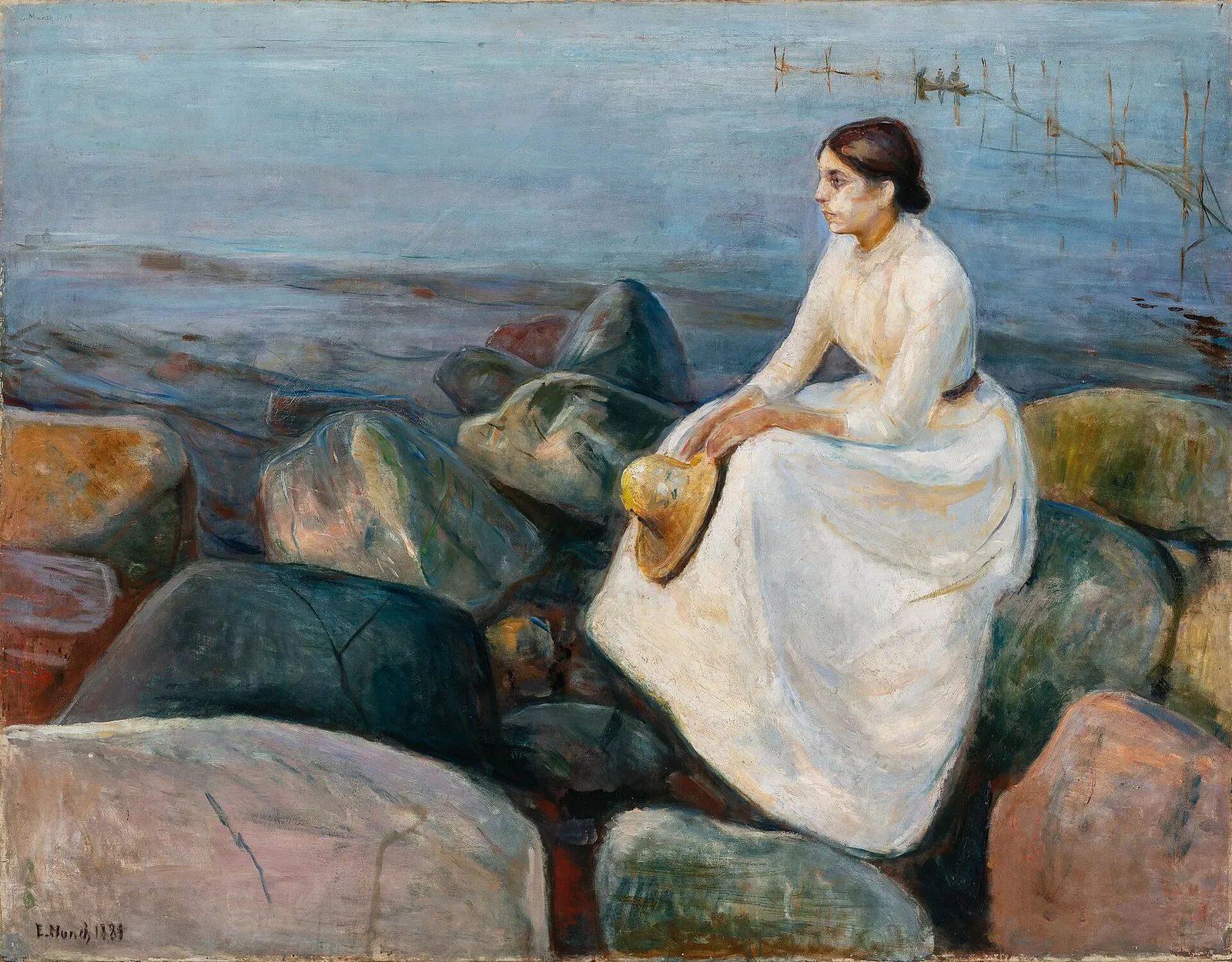
Edvard Munch's Inger on the Beach, dated 1889, belongs to the Art Museums of Bergen, where its listed location is Rasmus Meyer. The painting shows the artist's sister Inger seated alone on a rocky shore in pale northern light. It is a quiet, carefully composed canvas from the years when Munch was moving toward the simplified, mood-driven style of his later work.
Where to see it
Inger on the Beach is in the collection of the Art Museums of Bergen, with its location recorded as Rasmus Meyer. Works in permanent collections are sometimes moved, rehung, lent or taken off view for conservation, so check the Art Museums of Bergen's official website for the painting's current display status, opening hours and ticket information before you visit.
What to look for in person
Inger in white
Start with the seated figure. Munch's sister Inger sits on the rocks in a light-colored dress, turned slightly away and absorbed in her own thoughts rather than engaging the viewer. Notice how her pale clothing stands out against the darker stones and water, making her the clear focus of the scene. Her stillness sets the tone of the whole picture. Instead of telling a story, the painting invites you to share a mood of solitude and reflection, something Munch would return to again and again in later figures placed beside the sea.
Rocks, shoreline and water
Look closely at the large boulders around the figure. Their rounded, solid shapes are built up in broad areas of color, and they almost compete with Inger for attention. Follow the shoreline back into the picture and see how the calm water and distant coast are reduced to simple bands. This flattening of the landscape into clear shapes is one of the features that marks the painting as a step away from strict naturalism. Stepping back from the canvas, which measures 123.6 by 158.9 cm, helps you see how these forms balance across its wide format.
The light of a summer evening
The painting's color is restrained: soft blues, greys, muted violets and pale tones rather than strong contrasts. Many viewers read this as the diffuse light of a Nordic summer night, when the sky never fully darkens. Pay attention to how the light seems evenly spread rather than coming from a single direction, and how this gives the scene a hushed, suspended feeling. This interest in atmosphere and emotional tone, carried by color and simplified form, is a key reason the work is often discussed as an early sign of the direction Munch's art would take.
About the painting
Inger on the Beach is dated 1889, a formative period for Edvard Munch. At this point in his career he was absorbing new ideas about painting and beginning to move beyond the detailed realism that had shaped his early training. In this canvas he takes an ordinary subject, a young woman sitting by the sea, and treats it less as a record of a particular afternoon than as an image of mood. The sitter is his sister Inger, who appears in several of his works. Here she is not presented as a formal portrait subject; she sits among the rocks, quiet and inward, part of the landscape rather than set apart from it. The shore itself is given unusual weight. The boulders are large, simplified masses, and the water and coastline are reduced to calm, broad areas of tone. This emphasis on shape and atmosphere over fine detail is why the painting is often seen as a bridge between Munch's earlier naturalistic work and the more expressive, symbol-laden paintings that followed in the 1890s. For visitors, the work rewards slow looking. At 123.6 by 158.9 cm, it is large enough to fill your field of view if you stand close, yet it is best understood from a few steps back, where the relationship between the pale figure, the dark rocks and the quiet sea becomes clear. It is a good painting to see alongside other works by Munch, since the seaside setting, the solitary figure and the soft summer light are motifs that recur throughout his career.
Key facts
| Artist | Edvard Munch |
|---|---|
| Date | 1889 |
| Size | 123.6 × 158.9 cm |
| Medium | oil paint, canvas |
| Collection | Art Museums of Bergen |
How to visit: Art Museums of Bergen
Bergen Municipality, Norway
Hours and prices can change. Please check the official website before you go.
More by Edvard Munch
 Vampire — Munch Museum
 Jealousy
 Anxiety — Munch Museum
 Starry Night — J. Paul Getty Museum
 Night in Saint-Cloud — National Museum of Art, Architecture and Design
 Self-Portrait with Cigarette — National Museum of Art, Architecture and Design
 Self-Portrait. Between the Clock and the Bed — Munch Museum
 Vampire — Munch Museum
 Dance of Life — National Museum of Art, Architecture and Design
 Puberty — National Museum of Art, Architecture and Design
 Evening on Karl Johan
 The Scream — National Museum of Art, Architecture and Design