Art! Art! Art! › Works
Puberty
 Edvard Munch, 1895
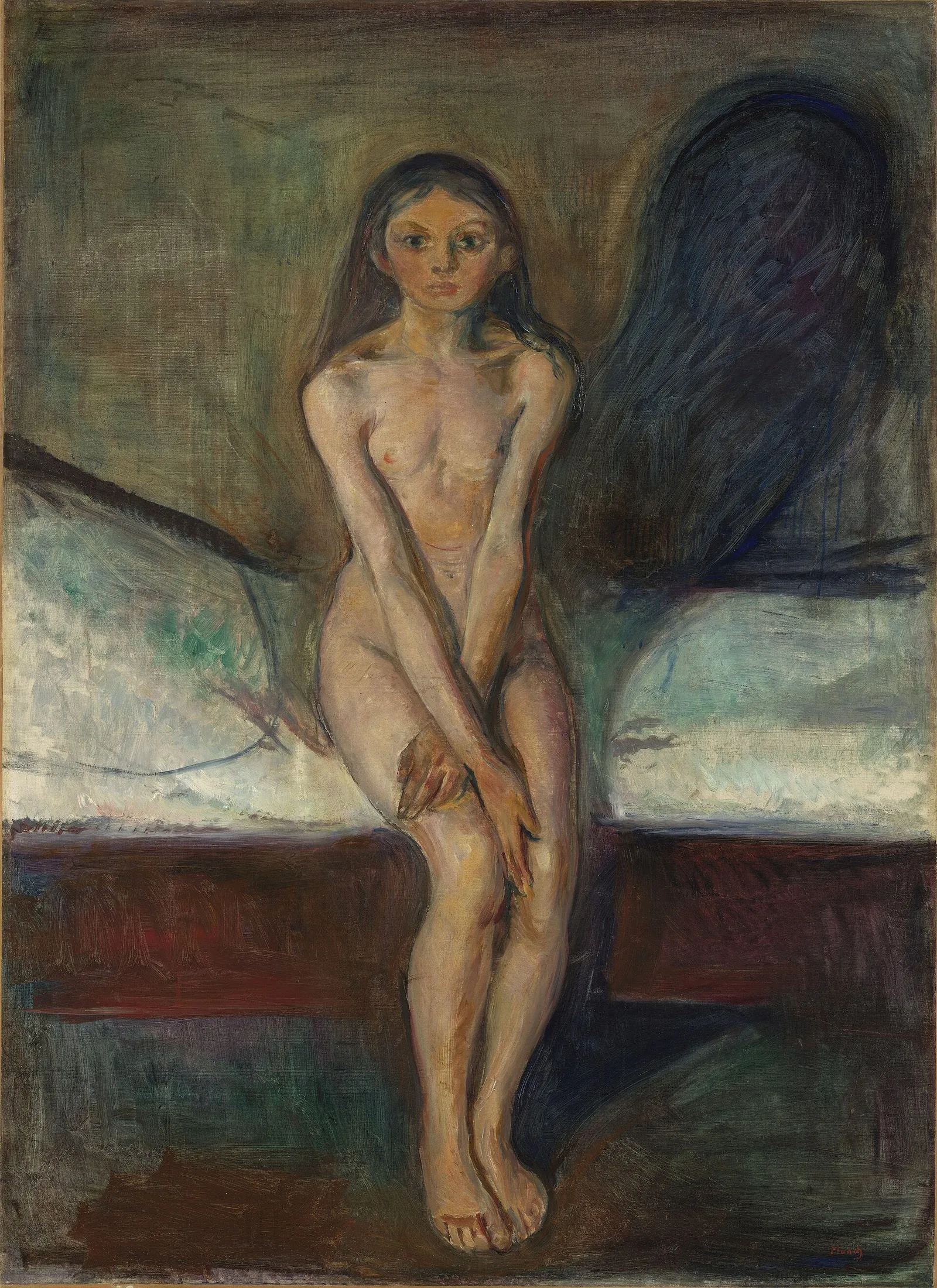
Edvard Munch's Puberty, dated 1895, is in the collection of the National Museum of Art, Architecture and Design. It shows a young girl seated alone on a bed, with a dark shadow rising on the wall behind her. The painting is a quiet, unsettling study of adolescence and one of the key works for understanding Munch's psychological approach to the figure.
Where to see it
Puberty is held by the National Museum of Art, Architecture and Design, which is also listed as its location. Works on display can be rotated, lent or temporarily removed for conservation, so check the museum's official website for current display status, opening hours and ticket information before you plan your visit.
What to look for in person
The direct, frontal pose
Start with the girl herself. She sits upright on the edge of the bed, facing straight out toward the viewer, with her arms crossed in front of her lap. The pose is simple and symmetrical, which makes her look exposed and self-protective at the same time. Notice how little else competes for attention: there is no story, no setting beyond the bed and wall. Standing in front of the canvas, you are placed in the position of the person she is looking at, which is part of why the image feels so uncomfortable and intimate.
The shadow on the wall
Look to the left of the figure, where a large, dark shadow spreads up the wall. It does not behave like a natural cast shadow; it is too big and too heavy for the slight body that seems to produce it. Many viewers read it as a sign of anxiety or of something looming over the girl's future. Munch leaves its meaning open, and that ambiguity is worth spending time with. Compare the soft, pale treatment of the body with the dense mass of the shadow, and see how the contrast creates tension across the picture.
Scale and handling of paint
At 151.5 cm high, the painting presents the figure at a size close to life, so the encounter feels personal rather than distant. Move closer and look at how the surfaces are painted: the bed, the wall and the body are handled with fairly loose, visible strokes rather than polished detail. The restrained colour range, with pale flesh tones set against darker surroundings, keeps the focus on mood rather than description. Step back again afterward to see how these simple shapes and tones combine into a single, concentrated image.
About the painting
Edvard Munch was a Norwegian painter whose work is closely associated with themes of love, illness, death and emotional states. Rather than recording outward appearances in detail, he aimed to make the viewer feel an inner experience, and Puberty is a clear example of this approach. The fact sheet dates the work to 1895, a period when Munch was producing many of the images for which he is best known today.
The subject is a young girl on the threshold between childhood and adulthood. She sits on a bed, nude, arms crossed, looking outward. The painting does not narrate an event; instead it isolates a moment of awareness and vulnerability. The setting is reduced to a bed and a wall, which makes the figure and the dark shadow beside her the only real subjects.
That shadow has drawn much discussion. It is often interpreted as an expression of fear, of emerging sexuality, or of an uncertain future, though Munch did not fix a single meaning. Its exaggerated size is one of the features that separates the painting from conventional studies of the nude: the body is not presented for admiration but as the site of an emotional experience.
When visiting, it helps to give the painting time. Notice first the directness of the gaze, then the defensive gesture of the arms, and finally the way the shadow seems to press in. Together these elements show why Munch is regarded as an important figure in the development of expressive, psychologically driven painting at the end of the nineteenth century.
Key facts
| Artist | Edvard Munch |
|---|---|
| Date | 1895 |
| Medium | oil paint, canvas |
| Collection | National Museum of Art, Architecture and Design |
How to visit: National Museum of Art, Architecture and Design
Oslo, Norway · Museum guide
| Opening hours | Tue–Wed 10:00–20:00 Thu–Sun 10:00–17:00 |
|---|---|
| Closed | Closed on Mondays. Holiday exceptions 2026–27: 23 Dec open 10:00–17:00; 24–26 Dec closed; Monday 28 Dec open 10:00–17:00; 31 Dec 2026 – 1 Jan 2027 closed. |
| Admission | Adults NOK 220 Under 25 NOK 100 Students (under 30) NOK 120 (student ID required; buy at the ticket counter) Under 18 free |
| Free entry | Free for under-18s, National Museum members (plus one guest), Oslo Pass holders (free ticket at the counter), ICOM/ICAM and listed professional association members, press card holders, and companions or carers of visitors with disabilities (with proof). |
| Booking | Booking is recommended. |
Official ticket page
Official website
View on map
Hours and prices can change. Please check the official website before you go. (Checked on: 2026-11-11)
More by Edvard Munch
 Vampire — Munch Museum
 Jealousy
 Anxiety — Munch Museum
 Starry Night — J. Paul Getty Museum
 Inger on the Beach
 Night in Saint-Cloud — National Museum of Art, Architecture and Design
 Self-Portrait with Cigarette — National Museum of Art, Architecture and Design
 Self-Portrait. Between the Clock and the Bed — Munch Museum
 Vampire — Munch Museum
 Dance of Life — National Museum of Art, Architecture and Design
 Evening on Karl Johan
 The Scream — National Museum of Art, Architecture and Design