Art! Art! Art! › Works
Evening on Karl Johan
 Edvard Munch, 1892
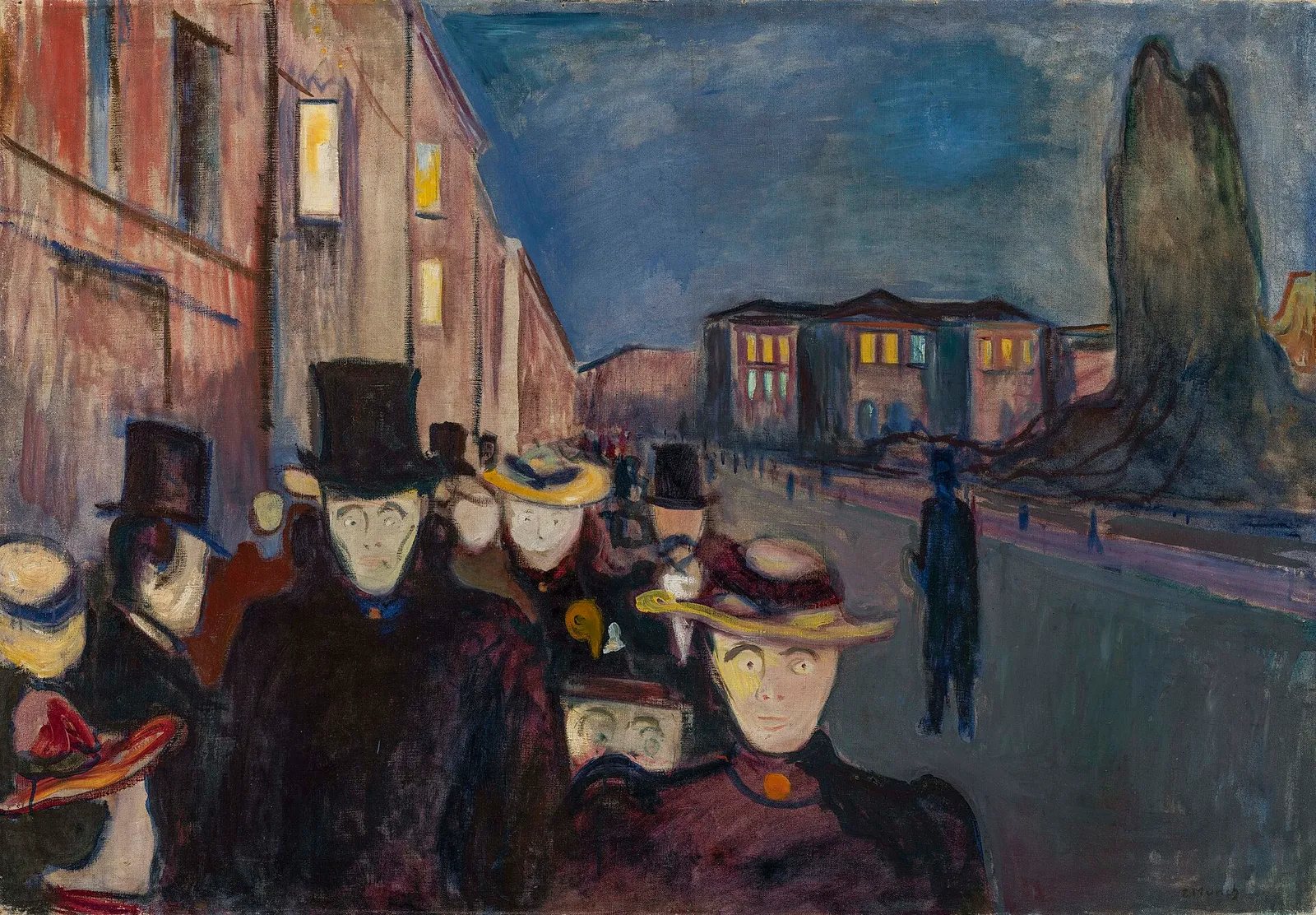
Edvard Munch's Evening on Karl Johan (1892) turns an ordinary evening stroll on a city street into a scene of unease, with a crowd of pale, staring faces advancing toward the viewer. The painting belongs to the Art Museums of Bergen, part of KODE Art museums and composer homes in Norway.
Where to see it
Evening on Karl Johan is held by the Art Museums of Bergen, within KODE Art museums and composer homes, in Bergen, Norway. Works in museum collections are sometimes moved, rehung, lent or placed in storage, so check KODE's official website for current display status, opening hours and ticket information before planning your visit.
What to look for in person
The approaching crowd
Start with the faces coming straight at you. The people on the pavement are rendered as pale, wide-eyed, almost masklike ovals with very little individual detail, set beneath a dark band of hats. From a few steps back, they read as a solid mass pressing forward. Move closer and notice how economically the features are painted: a few marks for eyes and mouths. A familiar social ritual, the evening promenade, becomes impersonal and slightly menacing, and the viewer seems to stand directly in the crowd's path.
The figure going the other way
Now look into the open street on the right. A single dark figure walks away from the crowd, moving in the opposite direction. Its isolation is the counterweight to the packed pavement, and much of the painting's tension comes from the contrast between the dense group and this lone shape. Notice the empty space Munch leaves around the figure and how little detail it carries. The composition invites you to read the scene as a picture of separation, of someone out of step with everyone else.
Twilight colour and glowing windows
Lift your eyes to the upper part of the canvas. A deep blue evening sky hangs over the street, and a building in the background shows windows lit in warm yellow. Dark, rounded tree shapes sit at one side. These colours are not there simply to record the time of day; they set the mood, mixing the calm of dusk with a sense of strangeness. The wide format, about 121.7 cm across, lets the street stretch sideways, giving you room to follow the crowd and the empty roadway.
About the painting
Karl Johan is the main boulevard of Norway's capital, known in Munch's day as Kristiania and now Oslo. In the late nineteenth century it was the place where people of the city walked in the evening to see and be seen. Munch, who knew the street well, painted this view in 1892, at a time when he was moving away from straightforward naturalism toward pictures that express inner states such as anxiety, loneliness and longing.
Instead of describing a lively, pleasant scene, Munch simplifies forms and pushes colour toward mood. The crowd's faces lose their individuality, the space tilts toward the viewer, and a single figure is set apart in the street. These choices make the painting an early example of the psychological intensity that would define his best-known work of the 1890s; The Scream followed in 1893. Evening on Karl Johan is often discussed alongside the group of paintings on love, anxiety and death that Munch later gathered under the idea of a Frieze of Life.
The canvas measures 84.5 by 121.7 cm, a moderate size that works well when viewed from both a distance and close up. From farther away, the composition reads as a broad contrast between dense crowd and empty street; up close, you can see how loosely and directly the faces and figures are painted.
The work is in the collection of the Art Museums of Bergen, part of KODE Art museums and composer homes. For visitors to Bergen, it offers a chance to see a key Munch painting outside Oslo.
Key facts
| Artist | Edvard Munch |
|---|---|
| Date | 1892 |
| Size | 84.5 × 121.7 cm |
| Medium | oil paint, canvas |
| Collection | Art Museums of Bergen / KODE Art museums and composer homes |
How to visit: Art Museums of Bergen
Bergen Municipality, Norway
Hours and prices can change. Please check the official website before you go.
More by Edvard Munch
 Vampire — Munch Museum
 Jealousy
 Anxiety — Munch Museum
 Starry Night — J. Paul Getty Museum
 Inger on the Beach
 Night in Saint-Cloud — National Museum of Art, Architecture and Design
 Self-Portrait with Cigarette — National Museum of Art, Architecture and Design
 Self-Portrait. Between the Clock and the Bed — Munch Museum
 Vampire — Munch Museum
 Dance of Life — National Museum of Art, Architecture and Design
 Puberty — National Museum of Art, Architecture and Design
 The Scream — National Museum of Art, Architecture and Design