Art! Art! Art! › Works
Jealousy
 Edvard Munch, 1895
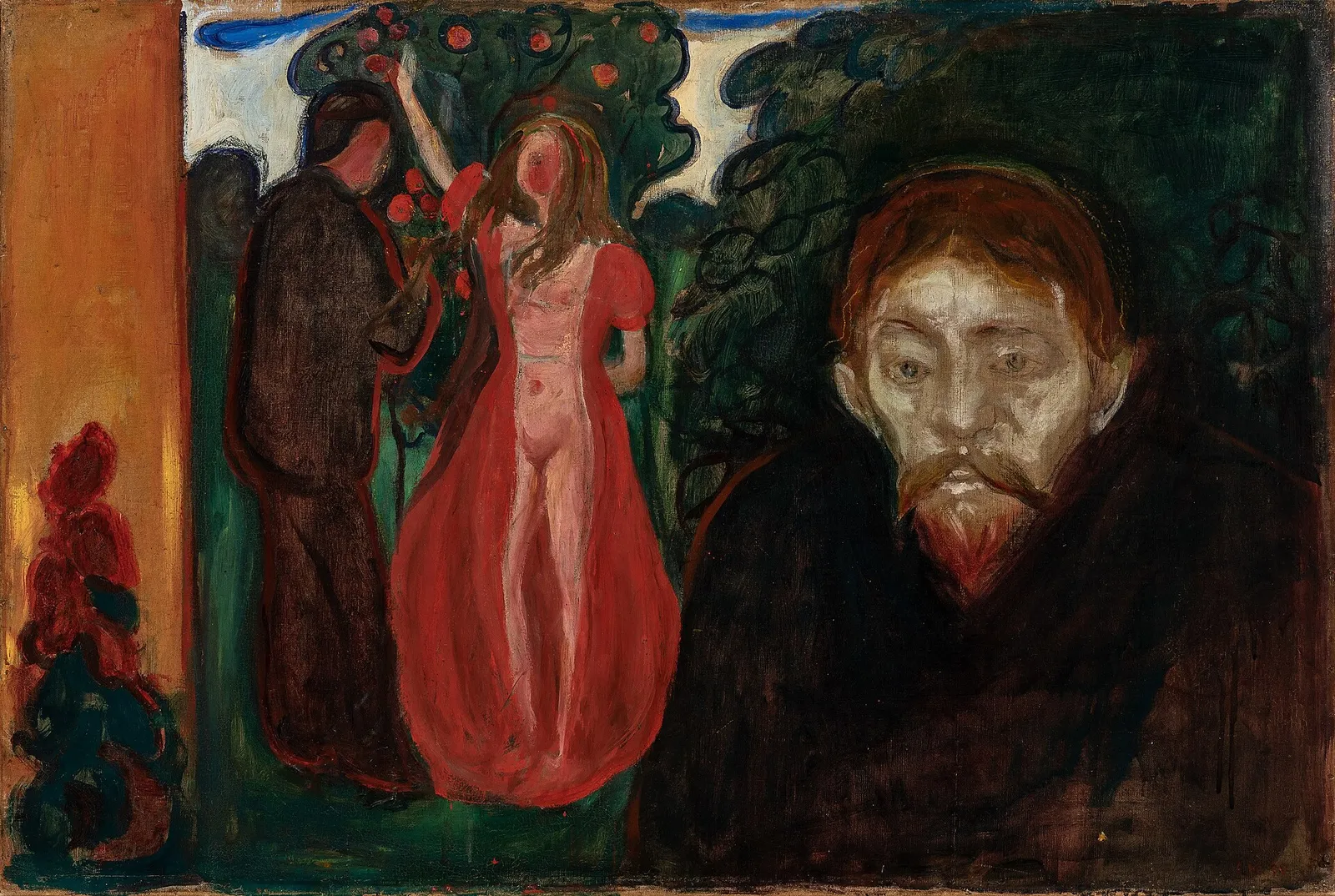
Edvard Munch painted Jealousy in 1895, turning a private, gnawing emotion into a staged scene of one man watching another couple. The painting belongs to the Art Museums of Bergen, where visitors can see how Munch places the viewer almost face to face with a jealous mind.
Where to see it
Jealousy is in the collection of the Art Museums of Bergen. Works are sometimes moved, rehung, lent or taken off view for conservation, so check the Art Museums of Bergen's official website for current display status, opening hours and ticket information before you visit.
What to look for in person
The face in the foreground
Start with the man at the front edge of the picture. His pale, mask-like face is pushed close to us and turned outward, as if he were looking past the scene rather than at it. Munch makes him the largest and nearest figure, so we meet his stare before anything else. Notice how little of his body is shown: the head and dark clothing seem to float against the background, which gives the impression that what lies behind him may be playing out in his thoughts.
The couple behind
Look over his shoulder to the pair in the middle distance. A woman in a red garment that hangs open faces a man in dark clothes, and she reaches toward a tree. Art historians widely read this as an allusion to Adam and Eve and the fruit of temptation, recasting a biblical moment as a modern drama of desire. The couple is smaller and less detailed than the watcher, which keeps them at an emotional as well as a physical distance from him.
Color and a wide format
At 67 by 100.5 centimeters, the canvas is wider than it is tall, and Munch uses that breadth to separate the watcher from the couple, as though a gap runs between them. Pay attention to how the red of the woman's clothing stands out against cooler, darker areas around it, drawing the eye back to her again and again. The simplified shapes and flattened space are typical of Munch's work in the 1890s, when he favored mood over precise description.
About the painting
Jealousy dates from 1895, a period when Edvard Munch was developing a group of paintings on love, desire, anxiety and death that he later gathered under the idea of The Frieze of Life. Rather than illustrating a single story, these works try to give visible form to inner states. Jealousy is one of the clearest examples: the subject is not an event but a feeling, and the composition is built around the person who feels it.
The foreground figure is commonly identified as the Polish writer Stanislaw Przybyszewski, a member of the bohemian circle Munch moved in while living in Berlin in the 1890s. That circle's tangled personal relationships are often cited as background to the painting, though Munch was less interested in portraiture than in the emotion itself. The watcher's detached gaze, the half-dreamlike couple and the hint of a fall from innocence combine into an image that feels both specific and universal.
Munch returned to the theme more than once, including in printmaking, so visitors who know other images titled Jealousy may notice differences in arrangement and color. Standing in front of this 1895 painting, it helps to read it in layers: first the face that confronts you, then the scene behind it, and finally the way the space between them carries the painting's meaning. The work rewards a slow look, especially at how Munch uses scale, distance and a single strong color to suggest what cannot be seen directly.
Key facts
| Artist | Edvard Munch |
|---|---|
| Date | 1895 |
| Size | 67 × 100.5 cm |
| Medium | oil paint, canvas |
| Collection | Art Museums of Bergen |
How to visit: Art Museums of Bergen
Bergen Municipality, Norway
Hours and prices can change. Please check the official website before you go.
More by Edvard Munch
 Vampire — Munch Museum
 Anxiety — Munch Museum
 Starry Night — J. Paul Getty Museum
 Inger on the Beach
 Night in Saint-Cloud — National Museum of Art, Architecture and Design
 Self-Portrait with Cigarette — National Museum of Art, Architecture and Design
 Self-Portrait. Between the Clock and the Bed — Munch Museum
 Vampire — Munch Museum
 Dance of Life — National Museum of Art, Architecture and Design
 Puberty — National Museum of Art, Architecture and Design
 Evening on Karl Johan
 The Scream — National Museum of Art, Architecture and Design