Art! Art! Art! › Works
Starry Night
 Edvard Munch, 1893
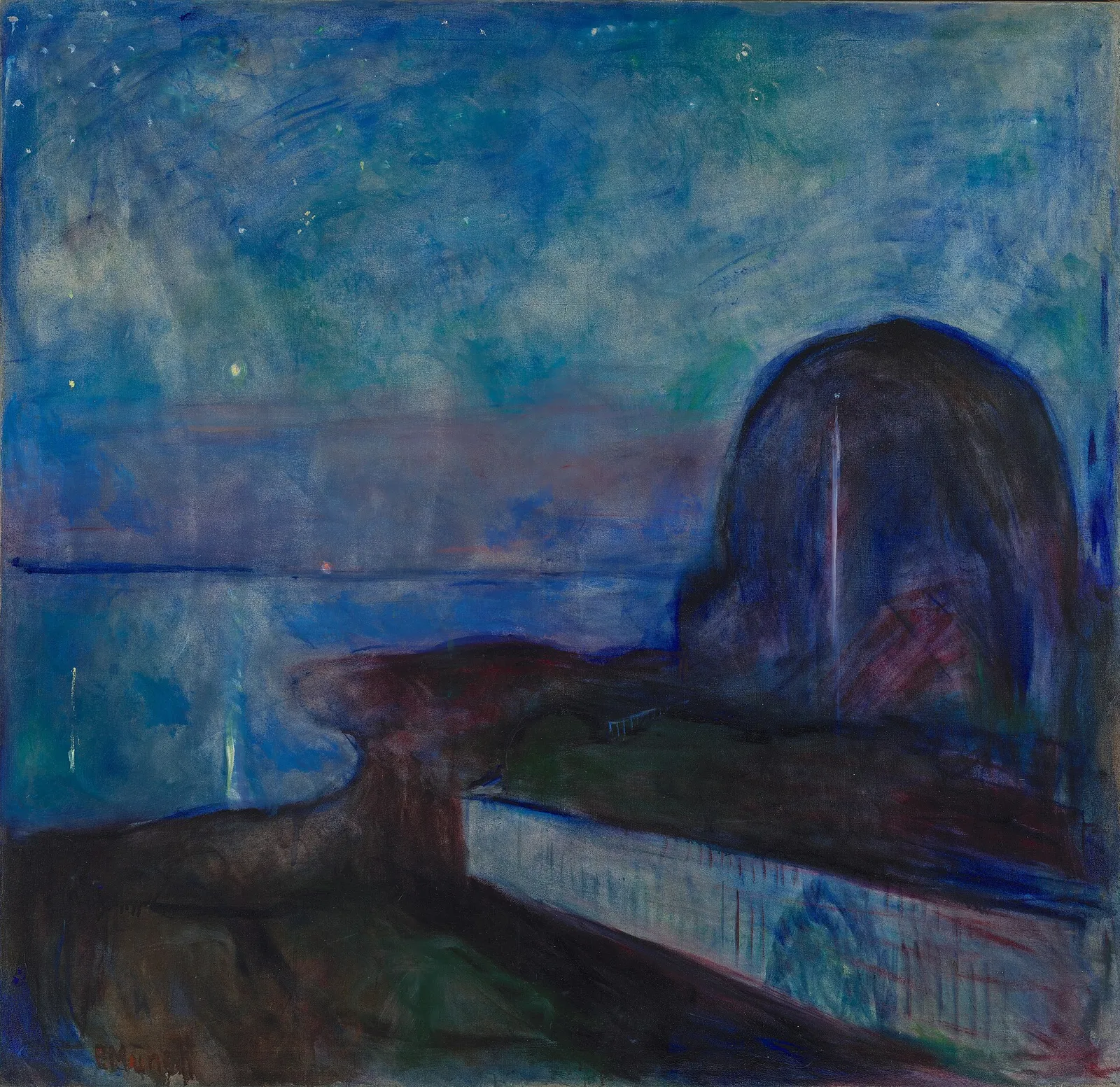
Edvard Munch's Starry Night, painted in 1893, belongs to the J. Paul Getty Museum and is associated with its Getty Center site. This is a quiet, brooding nocturne, a coastal night scene built from dark blues, heavy shapes and a few points of light. It is a different painting from Vincent van Gogh's better-known work of the same name, and it rewards slow, patient looking.
Where to see it
Starry Night is in the collection of the J. Paul Getty Museum, at the Getty Center. Paintings can be moved, rotated off view or lent to other institutions, so check the J. Paul Getty Museum's official website for current display status before you visit. The website also lists opening hours, ticketing and directions to the Getty Center.
What to look for in person
A sky built from deep blue
Start with the sky. Munch fills much of the canvas with layered, shifting blues rather than flat darkness, and the stars appear as small, scattered points instead of dramatic bursts. Notice how restrained the light is: the painting is about the stillness of a northern summer night, not spectacle. Step close to see how the blues vary in tone and density across the surface, then step back to see how they merge into one enveloping atmosphere that seems to press gently down on the land below.
Shoreline and trees as simplified shapes
Look at how the landscape is drawn. The coastline curves and swells rather than following a strict line, and the trees read as dark, rounded masses instead of individually described trunks and leaves. This simplification is typical of Munch in the 1890s, when he moved away from detailed observation toward forms that carry feeling. Follow the edge where land meets water and you will see how the curving line leads the eye through the picture, giving a calm scene an undercurrent of unease.
Mood over description
Starry Night is a substantial canvas, 135.6 cm tall, large enough that the dark scene can fill your field of vision if you stand at a moderate distance. Give yourself time with it. Night pictures often reveal themselves slowly: shapes that first look like a single shadow gradually separate into trees, shore and water. Pay attention to how you feel as your eyes adjust. Munch was less interested in recording a particular view than in conveying the emotional charge of a place, and that charge is the real subject here.
About the painting
Edvard Munch, the Norwegian painter best known today for The Scream, made Starry Night in 1893, the same period in which he was developing his most influential imagery. In these years Munch was closely connected with the Symbolist currents of European art, which valued inner experience, memory and mood over faithful reproduction of the visible world. Starry Night shows that approach applied to landscape. Rather than a panoramic or picturesque view, he offers a compressed, darkened scene in which sky, trees, shore and water are reduced to broad shapes and a narrow range of deep colours. For visitors, the painting is a useful counterpoint to the expressive figure paintings for which Munch is famous. There are no anxious faces or dramatic gestures here; the emotion lives in the curve of a shoreline, the weight of a tree mass and the cool glow of a night sky. Many of Munch's landscapes from this decade draw on the coast of southern Norway, where he spent summers, and the long, pale nights of the northern summer are often seen as part of their atmosphere. The work is also a reminder that the title Starry Night is shared with Van Gogh's well-known 1889 painting. The two are unrelated works by different artists, and Munch's version is calmer and more inward. When you stand in front of it, try comparing your first impression with what you notice after several minutes; the gradual emergence of forms from darkness is one of the painting's quiet pleasures.
Key facts
| Artist | Edvard Munch |
|---|---|
| Date | 1893 |
| Medium | oil paint, canvas |
| Collection | J. Paul Getty Museum |
How to visit: J. Paul Getty Museum
Los Angeles, United States · Museum guide
| Opening hours | Tue, Wed, Thu, Fri, Sun 10:00–18:30 Sat 10:00–21:00 (late opening) |
|---|---|
| Closed | Closed on Mondays, and on New Year's Day, Independence Day, Thanksgiving Day and Christmas Day. Closes early on Christmas Eve and New Year's Eve. |
| Admission | Museum admission (everyone) free (timed-entry reservation required) Parking per car or motorcycle USD 25 (cashless; includes LA parking tax) Parking after 15:00 USD 15 Parking after 18:00 USD 10 |
| Free entry | Admission is always free (reservation required). Parking is free on Saturdays after 18:00. Bicycles park free. |
| Booking | A timed-entry reservation is required. |
The South Pavilion, the East Pavilion plaza-level galleries and the North Pavilion galleries are closed for renovation as part of the Getty Center modernisation. The Getty Villa Museum (a separate site in Pacific Palisades) is open daily 10:00–17:00, closed Tuesdays.
Official ticket page
Official website
View on map
Hours and prices can change. Please check the official website before you go. (Checked on: 2026-11-09)
More by Edvard Munch
 Vampire — Munch Museum
 Jealousy
 Anxiety — Munch Museum
 Inger on the Beach
 Night in Saint-Cloud — National Museum of Art, Architecture and Design
 Self-Portrait with Cigarette — National Museum of Art, Architecture and Design
 Self-Portrait. Between the Clock and the Bed — Munch Museum
 Vampire — Munch Museum
 Dance of Life — National Museum of Art, Architecture and Design
 Puberty — National Museum of Art, Architecture and Design
 Evening on Karl Johan
 The Scream — National Museum of Art, Architecture and Design