Art! Art! Art! › Works
The Scream
 Edvard Munch, 1893
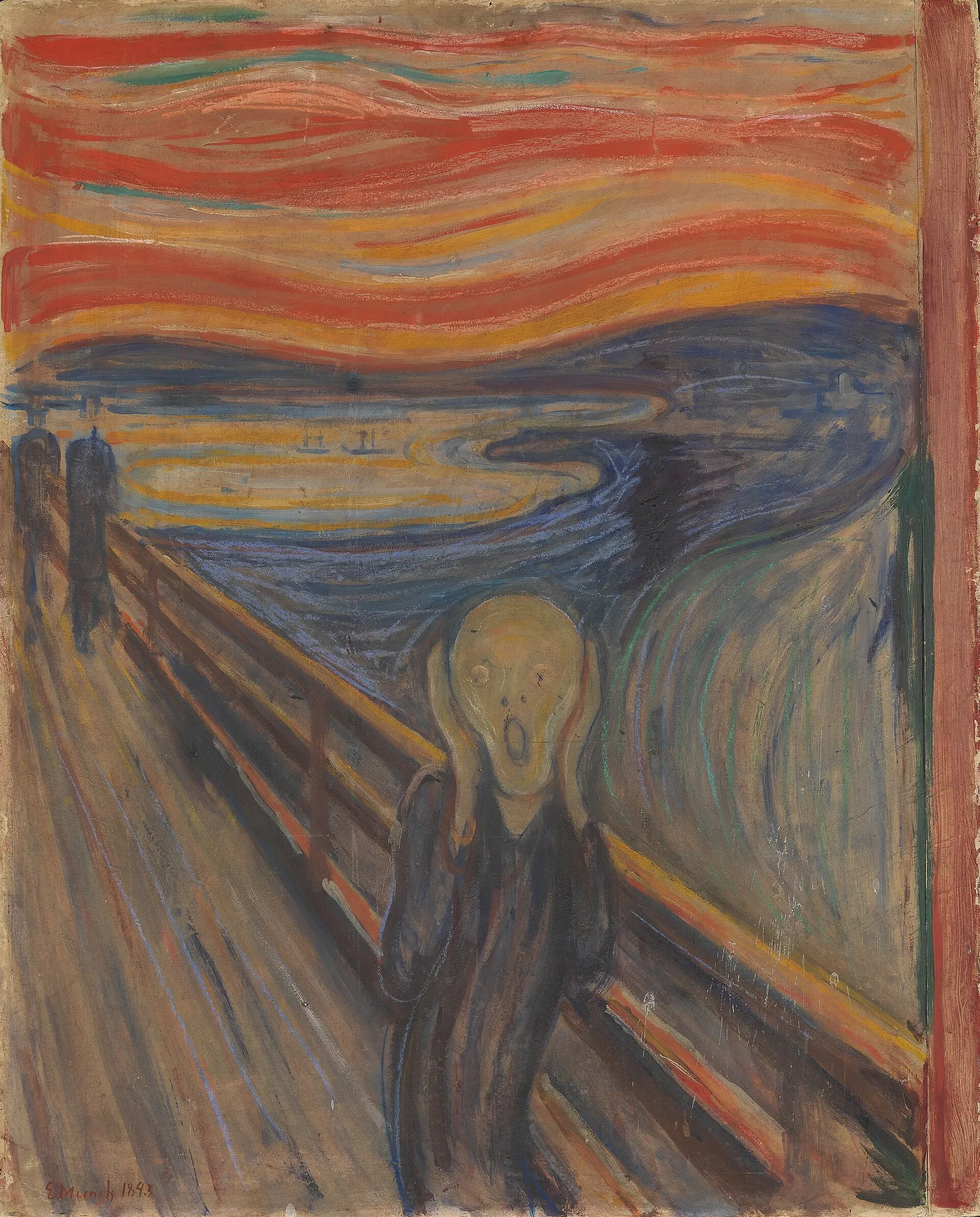
Edvard Munch's The Scream, dated 1893, is held by the National Museum of Art, Architecture and Design in Norway. Its swirling sky, hard diagonal railing and lone figure with hands raised to its face have made it one of the most recognised images in modern art. This page explains where to find it and what to notice when you stand in front of it.
Where to see it
The Scream (1893) is in the collection of the National Museum of Art, Architecture and Design, with its location recorded as the National Gallery of Norway. Display arrangements can change, and the painting may be rotated, moved or temporarily off view, so check the museum's official website for current display status, opening hours and ticketing before you plan your visit.
What to look for in person
The figure and its gesture
The central figure, reduced to a skull-like head with hands pressed to its face, is the point the whole composition pulls toward. Look at how little anatomical detail Munch gives it: the body bends and sways like the lines around it, so it reads less as a portrait of a particular person than as a shape for an emotion. Notice the open mouth, the hollow eyes and the way the hands frame the face. Standing close, compare how this figure is drawn with the looser handling elsewhere in the picture.
The sky and the landscape
Behind the figure, bands of red, orange and yellow sweep across the sky, while darker blue curves suggest water and shoreline below. These lines do not sit still; they ripple and echo one another, so sky and landscape seem to share the same restless movement as the figure. Munch wrote about experiences of this kind as a sense of a scream passing through nature, and the painting turns that sensation into colour and line rather than any literal depiction of sound.
The railing and the two walkers
A straight diagonal railing runs sharply from the lower left toward the back of the picture, the one rigid element in a world of curves. Follow it with your eye and you reach two dark figures walking away, apparently unaware of what is happening in the foreground. That contrast matters: the upright companions and the hard geometry of the road heighten the isolation of the central figure. Step back as well as forward; at 91 by 73.5 cm, the work is modest in size, and its effect shifts with viewing distance.
About the painting
Edvard Munch made The Scream in 1893, at a time when he was turning away from straightforward depiction of the visible world toward images of inner experience: anxiety, love, jealousy and death. The picture is widely understood as part of the larger cycle of themes Munch later grouped under the title The Frieze of Life, in which individual works explore stages and states of human feeling. Rather than telling a story, The Scream presents a single moment of overwhelming sensation, and it does so almost entirely through form and colour. For visitors, the most rewarding approach is to look at how the painting is built. The landscape, sky and figure are drawn with the same flowing, wave-like lines, which binds the person and the surroundings into one rhythm. Against this, the straight railing and the receding road create depth and a feeling of being pulled away from safety. The colours are not naturalistic in any strict sense; the blazing sky works emotionally rather than descriptively. Munch returned to this motif more than once, producing other versions in different media, and the composition became widely reproduced in prints. That familiarity can make it hard to see the original freshly. Try spending a few quiet minutes with it: follow the curves from sky to water to figure, then trace the railing back to the two walkers, and notice how your attention keeps being drawn back to the face at the centre. Seeing the physical surface in person, with its visible handling and its 91 by 73.5 cm scale, gives a sense of the work that reproductions rarely capture.
Key facts
| Artist | Edvard Munch |
|---|---|
| Date | 1893 |
| Size | 91 × 73.5 cm |
| Collection | National Museum of Art, Architecture and Design |
How to visit: National Museum of Art, Architecture and Design
Oslo, Norway · Museum guide
| Opening hours | Tue–Wed 10:00–20:00 Thu–Sun 10:00–17:00 |
|---|---|
| Closed | Closed on Mondays. Holiday exceptions 2026–27: 23 Dec open 10:00–17:00; 24–26 Dec closed; Monday 28 Dec open 10:00–17:00; 31 Dec 2026 – 1 Jan 2027 closed. |
| Admission | Adults NOK 220 Under 25 NOK 100 Students (under 30) NOK 120 (student ID required; buy at the ticket counter) Under 18 free |
| Free entry | Free for under-18s, National Museum members (plus one guest), Oslo Pass holders (free ticket at the counter), ICOM/ICAM and listed professional association members, press card holders, and companions or carers of visitors with disabilities (with proof). |
| Booking | Booking is recommended. |
Official ticket page
Official website
View on map
Hours and prices can change. Please check the official website before you go. (Checked on: 2026-11-11)
More by Edvard Munch
 Vampire — Munch Museum
 Jealousy
 Anxiety — Munch Museum
 Starry Night — J. Paul Getty Museum
 Inger on the Beach
 Night in Saint-Cloud — National Museum of Art, Architecture and Design
 Self-Portrait with Cigarette — National Museum of Art, Architecture and Design
 Self-Portrait. Between the Clock and the Bed — Munch Museum
 Vampire — Munch Museum
 Dance of Life — National Museum of Art, Architecture and Design
 Puberty — National Museum of Art, Architecture and Design
 Evening on Karl Johan