Art! Art! Art! › Works
Dance of Life

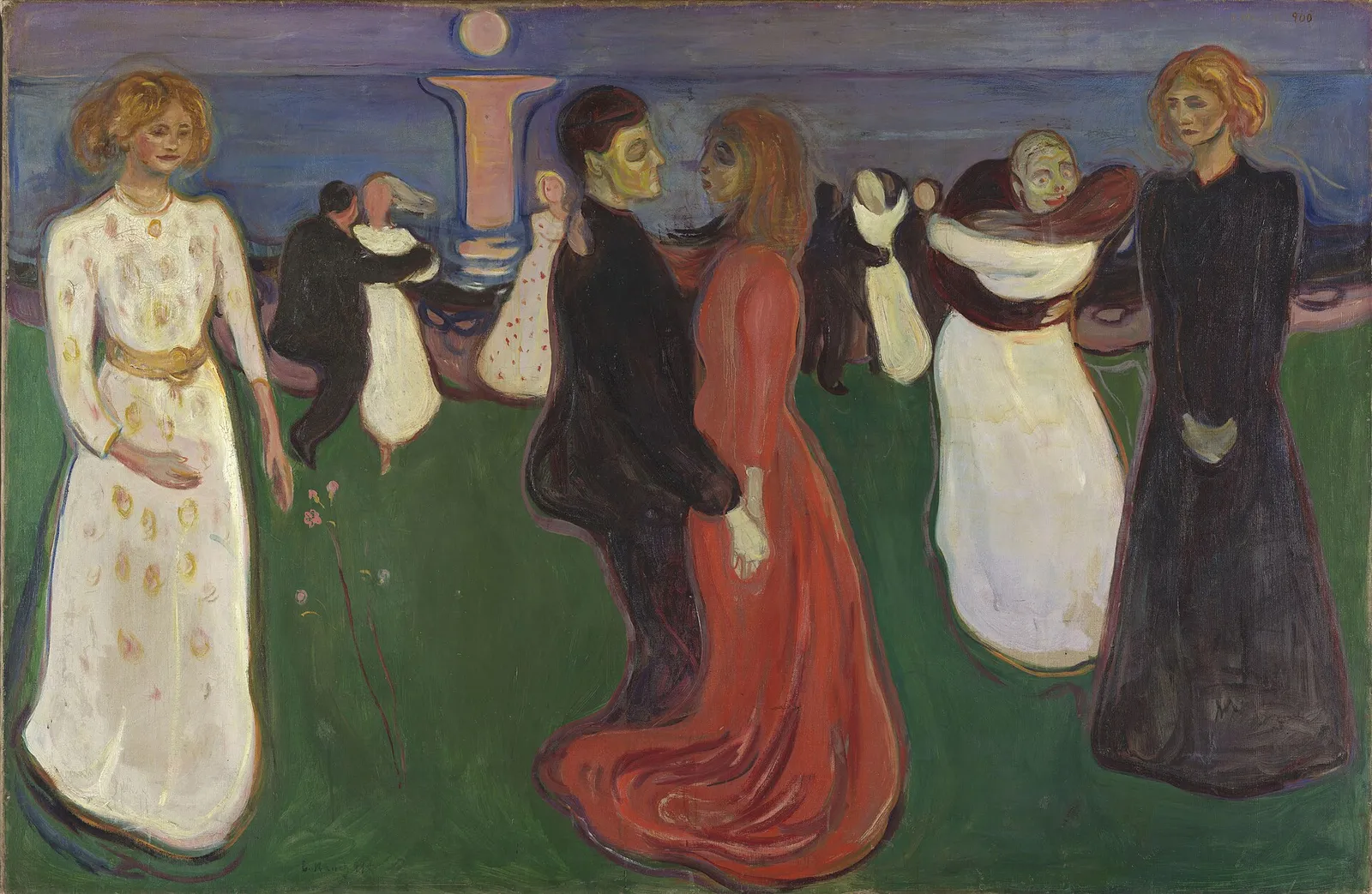
Edvard Munch's Dance of Life, painted in 1899–1900, is held by the National Museum of Art, Architecture and Design. The wide canvas sets dancing couples on a shoreline under a low moon, with three women at the front who are often read as different moods or stages of love.
Where to see it
Dance of Life is in the collection of the National Museum of Art, Architecture and Design, which is also its listed location. Works in large collections can be moved, rotated or temporarily withdrawn from view, so check the museum's official website for current display status, opening hours and ticketing before you visit.
What to look for in person
Three women, three moods
Start by reading the painting from left to right. On the left stands a young woman in a light dress, turned towards the dancers. In the centre a woman in red dances with a man in dark clothes. On the right a woman in black stands apart, still and watchful. Many viewers and writers interpret the trio as phases of love or of a life: expectation, passion and loss. Notice how each figure is set against the open meadow, so the contrast in dress colour carries much of the story.
The moon and its reflection
Look past the dancers to the sea. A low moon hangs above the horizon, and its reflection on the water forms a vertical band of light. This shoreline motif appears in a number of Munch's paintings from the 1890s and helps give the scene its hushed, nocturnal atmosphere. See how the column of light sits behind the central couple, quietly linking the sky, the water and the figures in the foreground, and how the dark line of the shore divides the composition.
The red dress and flowing lines
Step closer to the central couple. The red dress sweeps outward and curls around the man's feet, as if drawing him into the dance. Munch builds the scene with simplified shapes, broad areas of colour and curving outlines rather than fine detail, an approach associated with Symbolism and the art of the 1890s. In the background, other couples move across the grass in looser, more animated forms, offering a contrast to the stillness of the women standing at the edges.
About the painting
Dance of Life dates from 1899–1900 and measures 125 x 191 cm, a wide horizontal format that lets the scene unfold like a frieze. It is generally considered part of Munch's Frieze of Life, a group of works he developed around themes of love, anxiety and death, and which he thought of as belonging together rather than as isolated pictures. Seen in that context, the dance on the shore becomes less a record of a particular evening and more a meditation on how attraction, joy and loneliness sit side by side.
In front of the canvas, it helps to look in two stages. First stand well back to take in the overall structure: the horizon line, the vertical reflection of the moon, and the balance between the solitary figures at either side and the couple at the centre. The symmetry is deliberate, and the eye tends to settle on the red dress. Then move closer to see how the forms are handled. Contours are simplified, colour is applied in large zones, and the dancers in the background are treated more loosely than the women in front.
The painting rewards slow viewing rather than a quick glance. Compare the poses of the women on the left and right, notice where each one is looking, and consider how the open landscape both connects and separates the figures. Before planning a trip specifically to see the work, confirm on the museum's official website that it is currently on display.
Key facts
| Artist | Edvard Munch |
|---|---|
| Size | 125 × 191 cm |
| Medium | oil paint, canvas |
| Collection | National Museum of Art, Architecture and Design |
How to visit: National Museum of Art, Architecture and Design
Oslo, Norway · Museum guide
| Opening hours | Tue–Wed 10:00–20:00 Thu–Sun 10:00–17:00 |
|---|---|
| Closed | Closed on Mondays. Holiday exceptions 2026–27: 23 Dec open 10:00–17:00; 24–26 Dec closed; Monday 28 Dec open 10:00–17:00; 31 Dec 2026 – 1 Jan 2027 closed. |
| Admission | Adults NOK 220 Under 25 NOK 100 Students (under 30) NOK 120 (student ID required; buy at the ticket counter) Under 18 free |
| Free entry | Free for under-18s, National Museum members (plus one guest), Oslo Pass holders (free ticket at the counter), ICOM/ICAM and listed professional association members, press card holders, and companions or carers of visitors with disabilities (with proof). |
| Booking | Booking is recommended. |
Official ticket page
Official website
View on map
Hours and prices can change. Please check the official website before you go. (Checked on: 2026-11-11)
More by Edvard Munch
 Vampire — Munch Museum
 Jealousy
 Anxiety — Munch Museum
 Starry Night — J. Paul Getty Museum
 Inger on the Beach
 Night in Saint-Cloud — National Museum of Art, Architecture and Design
 Self-Portrait with Cigarette — National Museum of Art, Architecture and Design
 Self-Portrait. Between the Clock and the Bed — Munch Museum
 Vampire — Munch Museum
 Puberty — National Museum of Art, Architecture and Design
 Evening on Karl Johan
 The Scream — National Museum of Art, Architecture and Design