Art! Art! Art! › Works
Woman with a Parasol – Madame Monet and Her Son
 Claude Monet, 1875
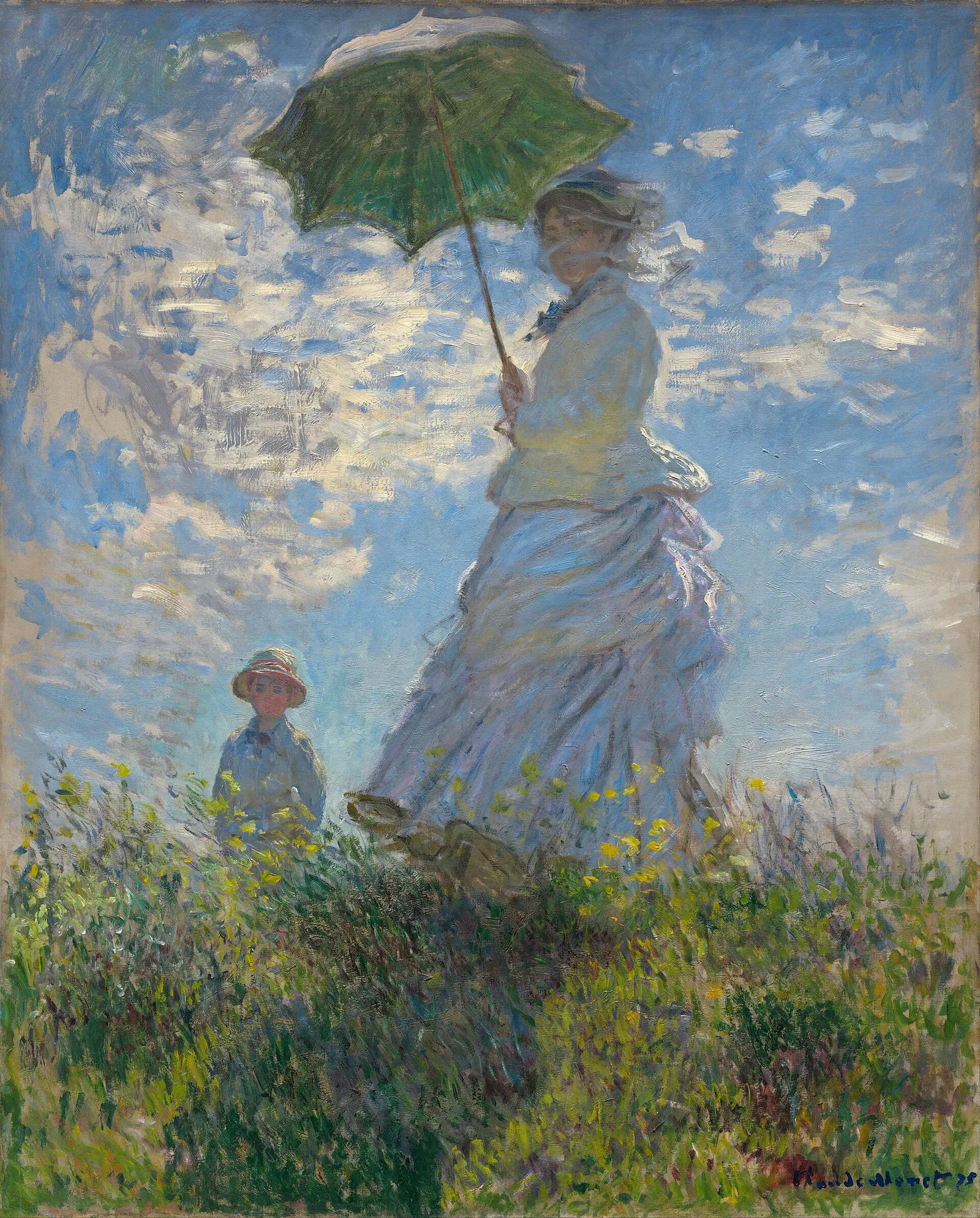
Claude Monet's Woman with a Parasol – Madame Monet and Her Son, dated 1875, shows a woman on a breezy hillside, seen from below against a bright sky, with a child standing farther back in the grass. At 100 × 82 cm, the canvas is large enough for its quick, open brushwork to read clearly from a few steps away.
Where to see it
Our fact sheet identifies the painting's collection and location only by the Wikidata identifier Q214867. We have not confirmed the institution's name from that source, so we do not state it here. To plan a visit, look up Q214867 on Wikidata, or open the artwork's own Wikidata entry (https://www.wikidata.org/wiki/Q2395218), to identify the holding museum. Then check that museum's official website for current display status, opening hours and ticketing before you travel. Paintings can be temporarily off view for conservation, rehanging or loans.
What to look for in person
Looking up at the figure
Stand close and notice how low the viewpoint is. Monet places the horizon near the bottom edge, so the woman rises against the sky as if you were looking up at her from farther down the slope. Clouds fill most of the space around her, and the green parasol frames her head and shoulders. This low angle turns an everyday walk into an open, airy composition. It is one of the first things that sets the picture apart from a conventional portrait of a sitter.
Wind made visible
Look at the edges rather than the centre. The veil, the hem of the white dress and the grass at her feet are painted in fast, directional strokes that seem to move in the same breeze. The clouds behind her are brushed in loose sweeps rather than outlined. Monet barely indicates the features of the face. The sense of a passing moment comes from this handling of paint, a hallmark of Impressionism, rather than from precise drawing.
Colour in the shadows, and the boy
Step back to see how the light works. The dress is not painted plain white. Where the parasol casts shade, you will find blues, greens and yellows reflected from the sky and grass, while the sunlit areas are warmer. The underside of the parasol also carries tinted, reflected light. Then find the small figure of the boy, partly hidden by the rise of the slope. His place in the middle distance creates depth and gives the scene the feel of a family outing seen at a glance.
About the painting
Monet painted this canvas in 1875, during the years he lived at Argenteuil, a town on the Seine west of Paris that provided the setting for many of his pictures of that decade. The models are his wife, Camille, and their son, Jean, both of whom appear often in his work from this period. The painting is generally described as an open-air scene, in keeping with the Impressionists' aim of recording natural light and changing weather from direct observation.
The picture sits between genres. It has the scale of a portrait, at 100 × 82 cm, yet Monet gives the sitters little individual detail. What interests him is the effect of sunlight and wind on figures outdoors. He shows how a white dress takes on the colours around it, how a parasol throws a tinted shadow, and how clouds and grass seem to move. This approach was still unconventional in the mid-1870s, when the artists later known as the Impressionists had only recently begun exhibiting independently.
Camille died in 1879. In 1886 Monet returned to the motif of a figure with a parasol on a hillside, in a pair of paintings with a different model. Comparing them shows how his handling changed over a decade. Viewers often read the 1875 picture as a personal work, though the painting itself concentrates on light and atmosphere rather than on telling a story.
For visitors, the reward lies in moving back and forth. Up close, the brushstrokes look rapid and separate. From a distance, they resolve into a bright, breezy afternoon.
Key facts
| Artist | Claude Monet |
|---|---|
| Date | 1875 |
| Size | 100 × 82 cm |
| Medium | oil paint, canvas |
| Collection | Q214867 |
| Gallery | West Building, Main Floor, Gallery 85 Checked in the museum's open data on 2026-11-12 (galleries can change) Source |
How to visit: National Gallery of Art
Washington, D.C., United States · Museum guide
| Opening hours | Mon–Sun 10:00–17:00 (open daily) |
|---|---|
| Closed | 25 December and 1 January |
| Admission | All visitors: free (including special exhibitions) |
| Free entry | Admission is always free. No passes or tickets are needed for the galleries, exhibitions or guided tours; some events require free registration. |
| Booking | No reservation is required and there is no timed entry. |
Hours and prices can change. Please check the official website before you go. (Checked on: 2026-11-11)
More by Claude Monet
 Madame Monet wearing a kimono — Museum of Fine Arts Boston
 Luncheon on the Grass — Musée d'Orsay
 Hollowed Cliff near Étretat
 Women in the Garden — Musée d'Orsay
 Impression, Sunrise — Musée Marmottan Monet
 Garden at Sainte-Adresse — Metropolitan Museum of Art
 The Magpie — Musée d'Orsay
 Rocks at Belle-Île, Port-Domois — Cincinnati Art Museum
 Boulevard des Capucines
 Woman in the Garden