Art! Art! Art! › Works
Hollowed Cliff near Étretat
 Claude Monet, 1884
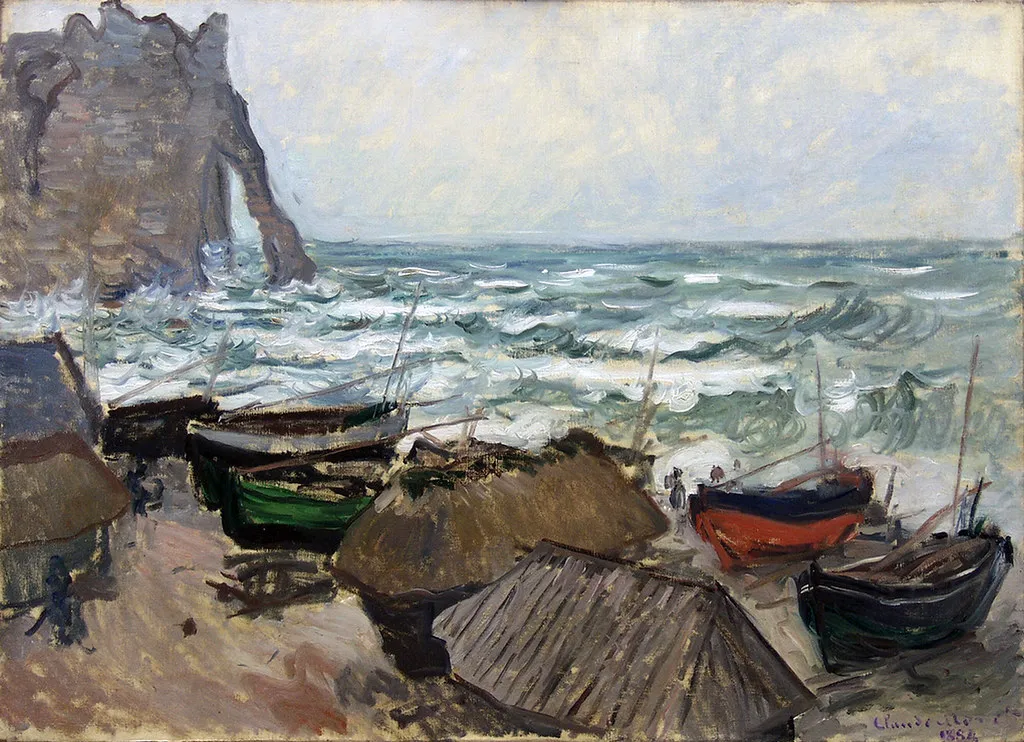
Claude Monet's Hollowed Cliff near Étretat, dated 1884, is in the collection of the Wallraf–Richartz Museum. The canvas measures 73.5 × 100.5 cm. It comes from the decade when Monet returned again and again to the chalk cliffs of the Normandy coast.
Where to see it
The painting belongs to the collection of the Wallraf–Richartz Museum. Works in permanent collections are sometimes moved, lent to other institutions or taken off view for conservation. Before you plan a visit, check the museum's official website for current display status, opening hours and ticket information.
What to look for in person
The cliff as subject
As the title suggests, the motif is a stretch of the Étretat cliffs where the sea has worn a hollow through the rock. Monet does not treat the formation as a geological curiosity. He uses it as a large, solid mass set against the movement of water and sky. In front of the canvas, notice how the shape of the rock organises the whole composition. Its openings and edges are defined less by outline than by shifts of colour and light.
Brushwork up close and from a distance
At 73.5 by 100.5 centimetres, the picture rewards two viewing distances. Step close and you can see the separate, visible strokes typical of Monet's Impressionist method, with paint laid down in touches rather than blended smooth. Step back a few metres and those marks resolve into rock, water and atmosphere. Moving between the two positions is a simple way to see how Monet built a scene out of colour rather than drawn detail.
Part of a larger campaign
During the 1880s Monet painted the Normandy coast, and Étretat in particular, many times. He returned to the same arches and cliffs under different weather and light. This painting, dated 1884, belongs to that sustained engagement with a single stretch of landscape. If you know other Étretat views by Monet from reproductions or other museums, compare the viewpoint and conditions. His habit of painting one motif repeatedly would later become central to his series paintings.
About the painting
Hollowed Cliff near Étretat is a landscape by Claude Monet dated 1884. It measures 73.5 cm high and 100.5 cm wide, and it is held by the Wallraf–Richartz Museum. The horizontal format suits the subject: a sweep of coastline in which a cliff, opened by erosion, meets the sea.
Étretat, on the Channel coast of Normandy, is known for its tall chalk cliffs and natural rock arches. In the nineteenth century these formations drew many painters. Monet made the place one of his most important motifs of the 1880s, working there over several stays and producing numerous canvases of the cliffs, arches and beaches.
For a visitor, the interest of a painting like this lies in how Monet turns a famous landmark into a study of conditions. The rock stays the same, but its appearance depends on the time of day, the weather and the state of the sea. Monet's broken brushwork and attention to light let him record those changes rather than produce a fixed topographical view. When you stand in front of the work, give yourself time to look at the transitions: where the cliff meets the water, where the water meets the sky, and how the hollow in the rock is suggested through tone and colour.
Seeing the painting in person also shows its physical surface, the build-up and direction of the strokes, which reproductions tend to flatten. If the work is on view, it is worth looking at it from both near and far.
Key facts
| Artist | Claude Monet |
|---|---|
| Date | 1884 |
| Size | 73.5 × 100.5 cm |
| Medium | oil paint, canvas |
| Collection | Wallraf–Richartz Museum |
How to visit: Wallraf–Richartz Museum
Cologne, Germany
Hours and prices can change. Please check the official website before you go.
More by Claude Monet
 Madame Monet wearing a kimono — Museum of Fine Arts Boston
 Luncheon on the Grass — Musée d'Orsay
 Woman with a Parasol – Madame Monet and Her Son — National Gallery of Art
 Women in the Garden — Musée d'Orsay
 Impression, Sunrise — Musée Marmottan Monet
 Garden at Sainte-Adresse — Metropolitan Museum of Art
 The Magpie — Musée d'Orsay
 Rocks at Belle-Île, Port-Domois — Cincinnati Art Museum
 Boulevard des Capucines
 Woman in the Garden