Art! Art! Art! › Works
Madame Monet wearing a kimono
 Claude Monet, 1876
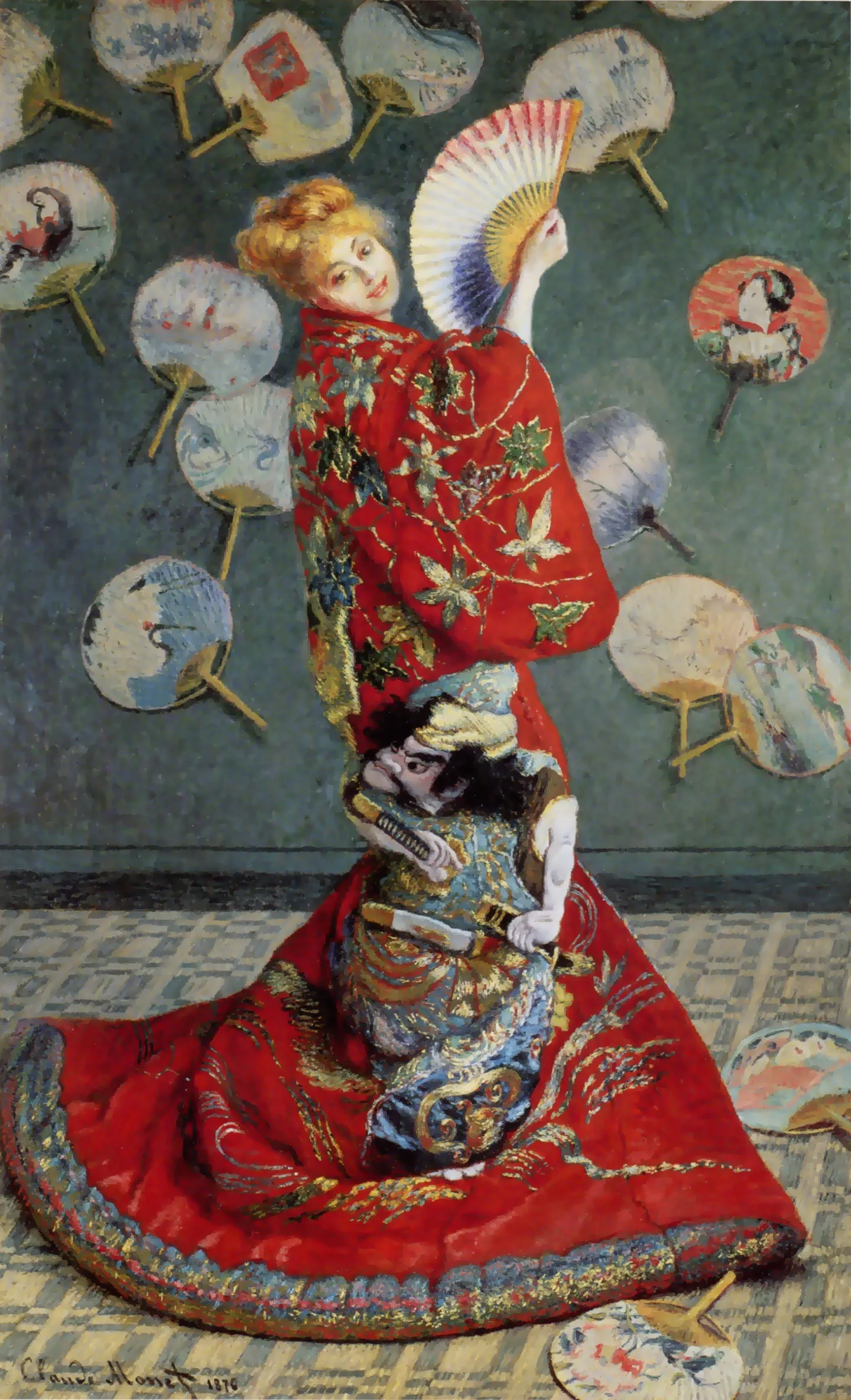
Claude Monet's Madame Monet wearing a kimono, often called La Japonaise, is a life-size oil painting from 1876 in the collection of the Museum of Fine Arts Boston. It shows his first wife, Camille Doncieux, turning in a red kimono against a wall of Japanese fans. At more than two metres tall, it is a picture best seen in person, where the scale and colour can be taken in at full size.
Where to see it
The painting belongs to the Museum of Fine Arts Boston, and that is where it is located. Display arrangements at any museum can change because of rehanging, conservation or loans, so check the Museum of Fine Arts Boston's official website for the painting's current display status before you plan your visit.
What to look for in person
The embroidered warrior on the robe
Look first at the red uchikake kimono, which fills much of the canvas. Woven into its folds is an embroidered samurai who grips the sword at his belt. Monet placed this figure's face close to the centre of the picture, so the eye keeps returning to him rather than only to Camille. Step back to see how the robe's broad sweep of red anchors the composition, then move closer to study how the painted embroidery seems to come alive within the fabric.
A French fan and a blonde wig
In her raised right hand Camille holds a folding fan painted in blue, white and red, the colours of the French flag. This small detail sets a Parisian accent against the Japanese setting around her. Notice too her hair: Camille had dark hair, yet here she wears a blonde wig. Together the fan and the wig remind the viewer that this is a European woman dressed up in Japanese costume, and that the picture plays deliberately with that contrast.
The wall of uchiwa fans
Take time over the round, flat uchiwa fans scattered across the background wall and floor. Each is a small picture of its own. On the left, find the fan showing a red-crowned crane. Just to the right of Camille's lifted hand, another shows a Japanese woman in a kimono set against a rosy red ground, quietly echoing the main figure. Comparing these fans with Camille's pose and costume is one of the most rewarding ways to spend time in front of the canvas.
About the painting
Monet painted this large canvas in 1876, and it is widely known as La Japonaise. The sitter was his first wife, Camille Doncieux, shown full length in a red uchikake kimono before a wall dotted with Japanese fans. The picture reflects the strong enthusiasm for Japanese art and objects in Paris during the 1870s, and its size and staged, costumed subject set it apart from the outdoor scenes more often linked with Monet in that decade.
The work made its public debut at the second Impressionist exhibition in 1876. On 14 April of that year it was offered as lot 37 in a sale of works belonging to Monet and Ernest Hoschedé at the Hôtel Drouot in Paris. In 1877, at an anonymous sale held at the same auction house, it passed to Constantin de Rasty. He kept it until 1918, when he sold it to the dealers Paul Rosenberg and Co. From there it went to the collector Philip Lehman in 1920 and to Duveen Brothers in 1921. Duveen sold the painting to the Museum of Fine Arts, Boston, in 1956 for $45,000.
Monet himself thought little of the picture in later life. In 1918, talking with the dealers Georges Bernheim and René Gimpel, he dismissed it with the French word "saleté", which translates roughly as a piece of junk. Visitors can judge that harsh verdict for themselves. Standing before the canvas, which measures 231.8 by 142.3 cm, it is worth noticing how the bright robe, the tricolour fan and the crowded wall of fans combine into a single, carefully arranged display.
Key facts
| Artist | Claude Monet |
|---|---|
| Date | 1876 |
| Size | 231.8 × 142.3 cm |
| Medium | oil paint, canvas |
| Collection | Museum of Fine Arts Boston |
How to visit: Museum of Fine Arts Boston
Boston, United States · Museum guide
| Opening hours | Sat, Sun, Mon, Wed 10:00–17:00 Thu, Fri 10:00–22:00 (late opening; until 17:00 on Christmas Eve and New Year's Eve) |
|---|---|
| Closed | Closed Tuesdays, and on New Year's Day, Patriots' Day, Fourth of July, Thanksgiving and Christmas. Galleries may close temporarily without notice. |
| Last entry | 30 minutes before closing |
| Admission | Adult USD 30 Ages 7–17 USD 14 Ages 0–6 free (ticket required) Members free Phone order fee USD 6 (per order, phone orders only) |
| Free entry | Pay what you wish (USD 5 minimum) every third Thursday after 17:00 (19 Nov 2026, 17 Dec 2026; in person only). Free for Massachusetts residents on Open House days (18 Jan 2027, 31 May 2027, 18 Jun 2027; in person, no advance tickets). Also free for US active-duty military and veterans plus 5 guests, students and faculty of participating colleges, Bank of America cardholders on the first full weekend of each month, Boston students and families on the first and second Sundays (Boston Family Days), and caregivers of visitors with disabilities. |
| Booking | Booking is recommended; there is no timed entry. General admission tickets are available for dates through January 2027 (as of 9 Nov 2026). |
The Fenway Entrance is closed. Some galleries are closed until further notice: 209/209A/209B (Ancient Egypt, Nubia, Near East), 210/210A/216 (Greece and Rome), 275, 278A–C, 279 and 280 (Asia). The Arts of Japan galleries are closed while three new Japanese art spaces are added.
Official ticket page
Official website
View on map
Hours and prices can change. Please check the official website before you go. (Checked on: 2026-11-12)
More by Claude Monet
 Luncheon on the Grass — Musée d'Orsay
 Hollowed Cliff near Étretat
 Woman with a Parasol – Madame Monet and Her Son — National Gallery of Art
 Women in the Garden — Musée d'Orsay
 Impression, Sunrise — Musée Marmottan Monet
 Garden at Sainte-Adresse — Metropolitan Museum of Art
 The Magpie — Musée d'Orsay
 Rocks at Belle-Île, Port-Domois — Cincinnati Art Museum
 Boulevard des Capucines
 Woman in the Garden
Sources
- Wikidata Q10322900
- Wikipedia (en) (CC BY-SA 4.0)
- Wikipedia (ja) (CC BY-SA 4.0)
- www.mfa.org