Art! Art! Art! › Works
Luncheon on the Grass
 Claude Monet, 1866
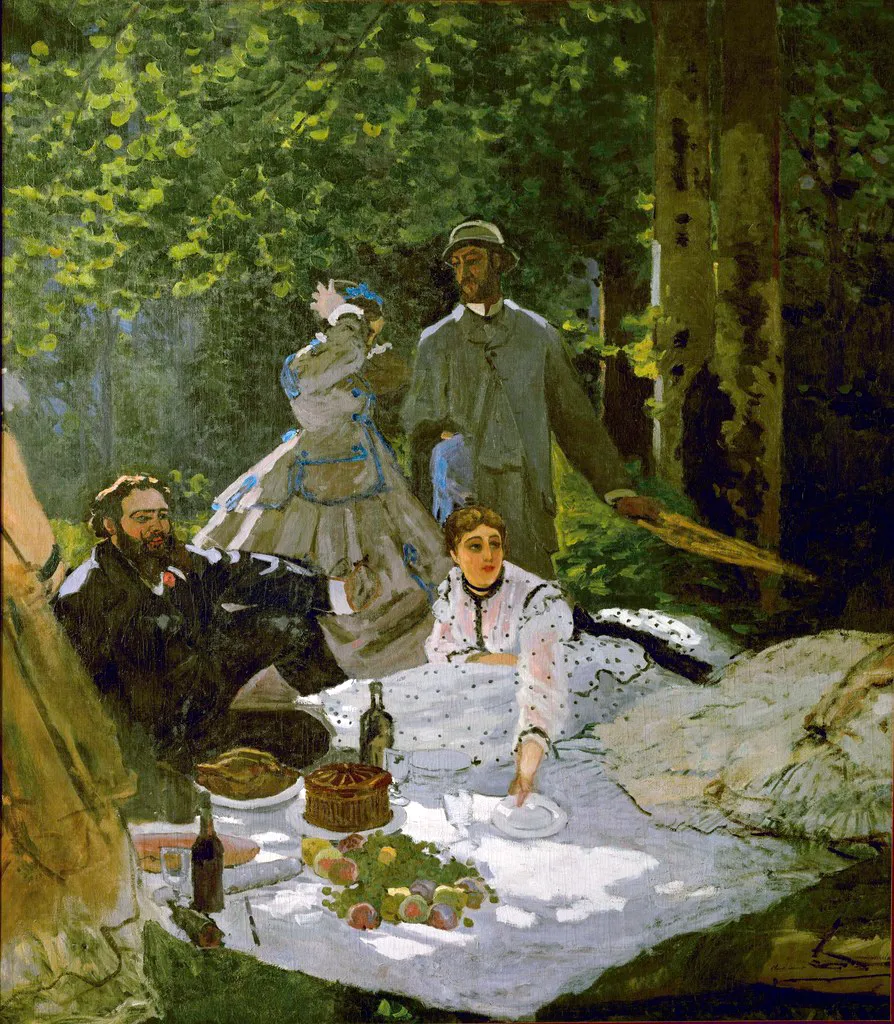
Claude Monet's Luncheon on the Grass, dated 1866, is in the collection of the Musée d'Orsay in Paris. What visitors see today are surviving fragments of an enormous, unfinished picnic scene that the young Monet planned as his answer to Édouard Manet's painting of the same title.
Where to see it
Luncheon on the Grass is held by the Musée d'Orsay in Paris, which owns both surviving large fragments, the central and left sections of the original canvas. Display arrangements can change, so check the Musée d'Orsay's official website for current display status before you visit. If you are also travelling to Moscow, a smaller 1866 version of the whole composition is held by the Pushkin Museum.
What to look for in person
Pieces of a much larger picture
Stand back and remember that you are looking at only part of Monet's plan. The original canvas was more than 4 metres high and more than 6 metres wide, intended to hold its own among the large paintings of the Paris Salon. The museum records this work at 218 by 248.9 cm, and it still feels large on the wall. Look at the edges: the composition stops abruptly because Monet himself cut the damaged canvas into sections, and the right-hand part no longer survives.
Faces from Monet's circle
In the central fragment, look for the seated man at the left, identified as the painter Gustave Courbet, placed near Camille Doncieux, who would later become Monet's wife. Frédéric Bazille, Monet's friend and fellow painter, stands nearby. These are not mythological or historical figures but people in the fashionable Parisian clothing of the 1860s. Notice how Monet treats their dresses, hats and jackets as broad areas of colour and light, giving a modern outing the scale normally reserved for grand subjects.
The picnic and the forest light
The full composition gathered twelve people around a white cloth spread with fruit, cake and wine at the edge of a forest clearing. Let your eye travel from the bright cloth to the shadows under the trees, and watch how patches of sunlight fall through the leaves onto fabric and skin. The setting is Chailly-en-Bière, near the Fontainebleau forest southeast of Paris, where Monet went in spring 1865 to make studies on site. That outdoor observation is what to look for here.
About the painting
Monet began this project in 1865 as a direct response to Édouard Manet's Luncheon on the Grass of 1863. Where Manet had paired clothed men with a nude woman, Monet chose a fully modern scene: a party of fashionably dressed Parisians enjoying a picnic in the woods. In spring 1865 he travelled to Chailly, in the Fontainebleau forest about 60 kilometres southeast of Paris, to make studies directly from the landscape, and his friends posed for the figures.
The canvas was planned on a huge scale, more than 4 metres high and over 6 metres wide, and Monet hoped to show it at the Salon of 1866. He did not finish it in time, and the painting was never completed. Its later history is one of loss. Monet left the canvas with his landlord in lieu of rent, and while it was stored there it suffered damage from damp. He had left it as a pledge in 1878 and got it back in 1884. He then cut out the central and left sections; the right-hand part was lost. The central fragment was trimmed once more on its right side after 1920.
The two surviving fragments came to the Musée d'Orsay by separate routes. Georges Wildenstein gave the left fragment to the French state in 1957, and the central fragment joined it in the same museum through a dation in 1987. A smaller version of the composition, dated 1866, is in the Pushkin Museum in Moscow and offers a sense of how the complete scene was meant to look.
Key facts
| Artist | Claude Monet |
|---|---|
| Date | 1866 |
| Size | 218 × 248.9 cm |
| Medium | oil paint, canvas |
| Collection | Musée d'Orsay |
How to visit: Musée d'Orsay
Paris, France · Museum guide
| Opening hours | Tue–Wed, Fri–Sun 09:30–18:00 (galleries close at 17:30) Thu 09:30–21:45 (late opening; galleries close at 21:15) |
|---|---|
| Closed | Every Monday, 1 May and 25 December. |
| Last entry | 17:00 (exhibitions 17:15); Thursdays 21:00 |
| Admission | Full rate, online EUR 16 Full rate, at the museum EUR 14 Reduced rate (on site only) EUR 11 Enfant & Cie, online EUR 13 Enfant & Cie, at the museum EUR 11 Night rate (Thursday), online EUR 12 Night rate (Thursday), at the museum EUR 10 Under 18s; EEA residents under 26 free |
| Free entry | Free for under 18s and residents of the European Economic Area under 26. Free on the first Sunday of the month, with booking required. |
| Booking | Booking is strongly recommended. Entry is by timed slot. |
The museum stays open and all collections and exhibitions remain accessible, but entrances have changed: timed-ticket holders use Entrance 1 (Quay); priority visitors, reseller voucher holders, visitors without tickets and groups use Entrance 2 (Forecourt). Arrive at least 15 minutes before your time slot.
Official ticket page
Official website
View on map
Hours and prices can change. Please check the official website before you go. (Checked on: 2026-11-11)
More by Claude Monet
 Madame Monet wearing a kimono — Museum of Fine Arts Boston
 Hollowed Cliff near Étretat
 Woman with a Parasol – Madame Monet and Her Son — National Gallery of Art
 Women in the Garden — Musée d'Orsay
 Impression, Sunrise — Musée Marmottan Monet
 Garden at Sainte-Adresse — Metropolitan Museum of Art
 The Magpie — Musée d'Orsay
 Rocks at Belle-Île, Port-Domois — Cincinnati Art Museum
 Boulevard des Capucines
 Woman in the Garden
Sources
- Wikidata Q1167912
- Wikipedia (en) (CC BY-SA 4.0)
- Wikipedia (ja) (CC BY-SA 4.0)
- Wikipedia (it) (CC BY-SA 4.0)
- Wikipedia (fr) (CC BY-SA 4.0)
- billetterie.musee-orsay.fr
- www.musee-orsay.fr