Art! Art! Art! › Works
Boulevard des Capucines
 Claude Monet, 1873
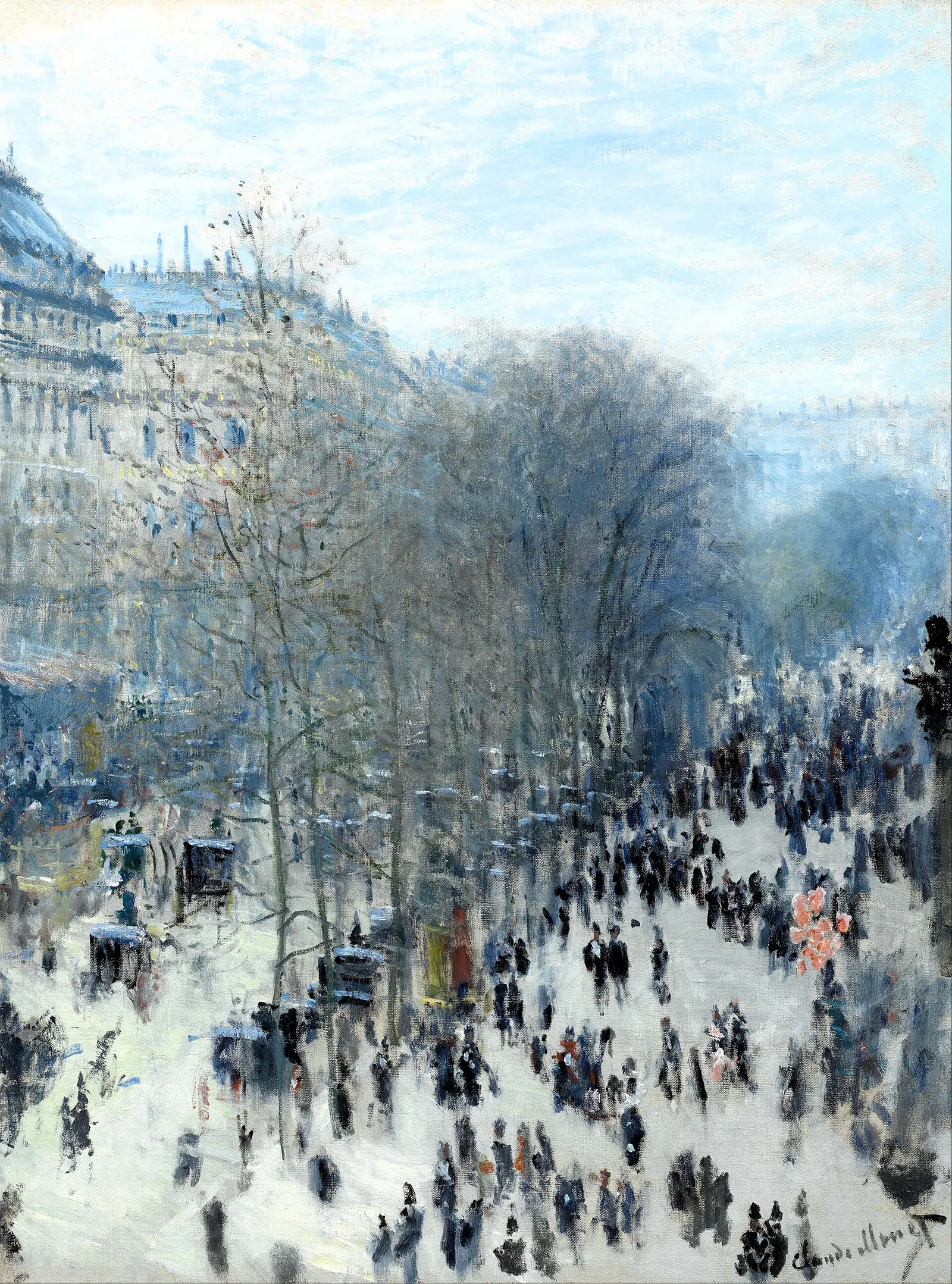
Claude Monet's Boulevard des Capucines, dated 1873, looks down from a high window onto one of the busiest streets in Paris. It is part of the collection of The Nelson-Atkins Museum of Art. Standing in front of it, you can watch a crowd, carriages and trees dissolve into quick strokes of paint.
Where to see it
Boulevard des Capucines is held by The Nelson-Atkins Museum of Art, which is also listed as its location. Artworks can be moved, rotated off view or lent to other institutions, so check The Nelson-Atkins Museum of Art's official website for current display status, opening hours and admission details before you plan your visit. The painting measures 50.8 cm high by 78.2 cm wide, so it is best seen from a few steps back first, then up close to study the brushwork.
What to look for in person
A view from above
Notice where Monet places you: not down on the pavement, but high above the street, looking along the boulevard as it recedes. This raised viewpoint flattens the crowd into a moving pattern and lets the avenue's long diagonal pull your eye into the distance. Step back from the canvas and let the composition settle; the sense of looking out of a window, detached yet absorbed in city life, is central to how the picture works and to its place in the modern street scenes of the period.
A crowd made of brushstrokes
Move closer and the pedestrians stop being people. Each figure is a short, dark dab or a flick of the brush, with no faces or detailed clothing. Monet was not describing individuals; he was recording the impression of a crowd in motion as seen at a glance. Try shifting your distance from the painting: at a certain point the marks snap back into walkers and carriages. That shift between paint and image is one of the most rewarding things to experience in front of the original.
Light, air and atmosphere
Look at how the far end of the boulevard softens and pales, while the nearer buildings and trees carry stronger contrasts. Monet uses colour and loose handling rather than sharp outlines to suggest distance, haze and the quality of daylight. The trees lining the street are built from feathery, broken strokes rather than drawn branch by branch. Pay attention to the overall tonality rather than single details; the painting is as much about the air over the street as the street itself.
About the painting
Claude Monet painted Boulevard des Capucines in the early 1870s, at a time when he and a group of like-minded artists were working outside the official Salon system. The boulevard was one of the grand new streets of Paris, lined with shops, cafes and apartment buildings, and crowded with pedestrians and traffic. For painters interested in modern life, it offered a ready subject: the energy of the city itself rather than history, mythology or posed portraits. It is widely accepted that Monet painted the scene from an elevated position on the boulevard, in the building where the photographer Nadar had his studio. That same address hosted the 1874 exhibition of the independent group later known as the Impressionists, an event now seen as a turning point in modern art. Monet made more than one painting of this view, and the work in The Nelson-Atkins Museum of Art is one of them. What makes the picture important is its method. Instead of carefully finishing every figure and facade, Monet suggested them with rapid, visible strokes, trusting the viewer's eye to assemble the scene. Critics of the time often found this approach unfinished or careless; today it is read as a deliberate attempt to capture a fleeting moment of perception. When you visit, give yourself time to look both from a distance and close up. The painting rewards that back-and-forth, showing how a handful of marks can convey a whole city in motion. Because display arrangements change, confirm on the museum's official website that the work is on view before you go.
Key facts
| Artist | Claude Monet |
|---|---|
| Date | 1873 |
| Size | 50.8 × 78.2 cm |
| Medium | oil paint, canvas |
| Collection | The Nelson-Atkins Museum of Art |
How to visit: The Nelson-Atkins Museum of Art
Kansas City, United States
Hours and prices can change. Please check the official website before you go.
More by Claude Monet
 Madame Monet wearing a kimono — Museum of Fine Arts Boston
 Luncheon on the Grass — Musée d'Orsay
 Hollowed Cliff near Étretat
 Woman with a Parasol – Madame Monet and Her Son — National Gallery of Art
 Women in the Garden — Musée d'Orsay
 Impression, Sunrise — Musée Marmottan Monet
 Garden at Sainte-Adresse — Metropolitan Museum of Art
 The Magpie — Musée d'Orsay
 Rocks at Belle-Île, Port-Domois — Cincinnati Art Museum
 Woman in the Garden