Art! Art! Art! › Works
The Magpie
 Claude Monet, 1868
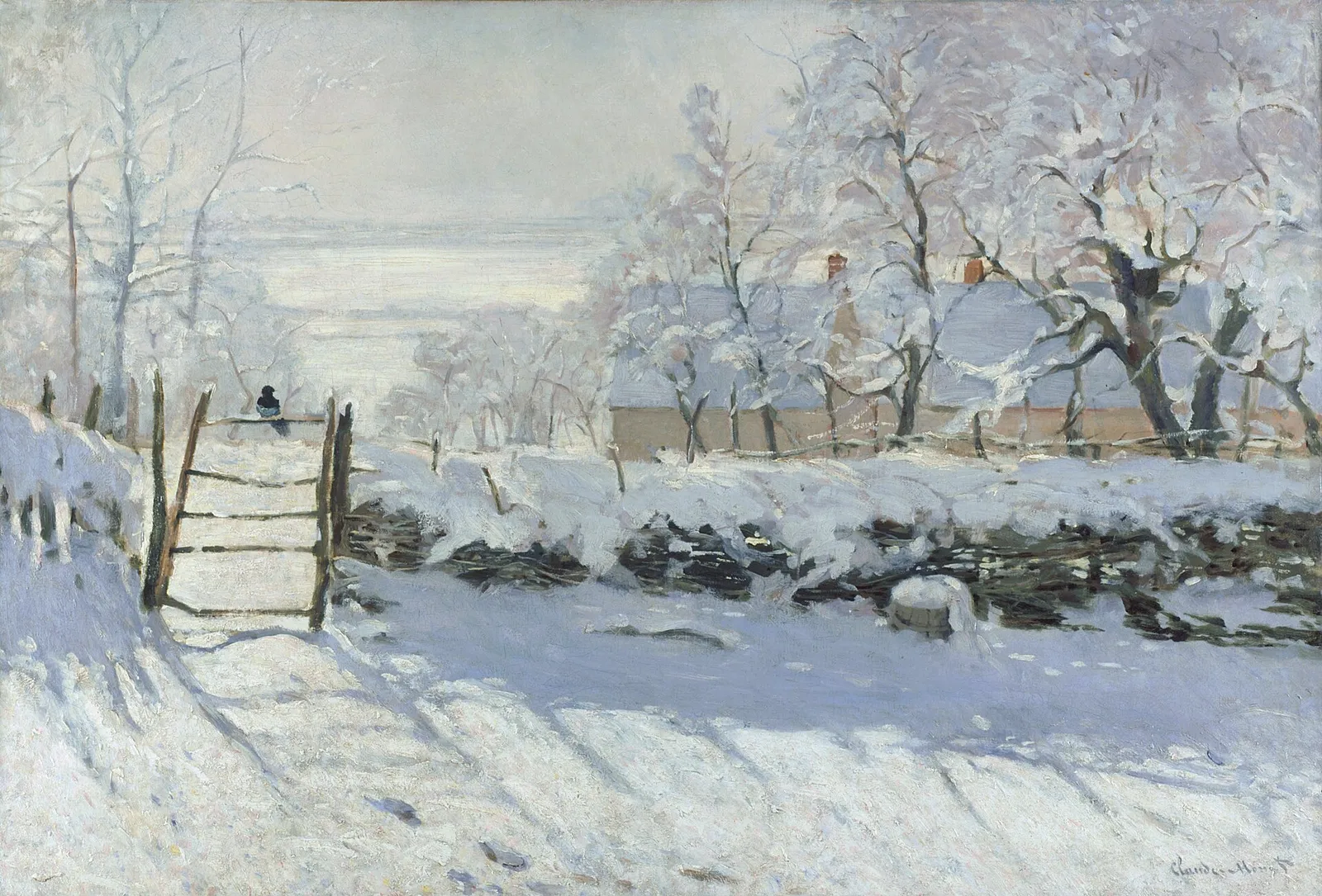
Claude Monet's The Magpie, dated 1868, is a winter landscape in which a single black-and-white bird sits on a gate above a field of fresh snow. The painting belongs to the Musée d'Orsay, where visitors can study how Monet built an entire scene out of the subtle colours of snow and light.
Where to see it
The Magpie is in the collection of the Musée d'Orsay, which is also its listed location. Works in museum collections are sometimes moved, lent or temporarily taken off view, so check the Musée d'Orsay's official website for current display status, opening hours and ticketing before you plan your visit.
What to look for in person
Find the magpie first
The bird is small, and it is easy to miss on a first look. Search the left side of the canvas, where a dark shape perches on the top rail of a rustic gate set into a fence. That one note of near-black is the anchor of the picture. Everything around it is pale, so the magpie works as a focal point that draws your eye in, then sends it outward across the snow toward the trees and buildings beyond.
Look for colour in the shadows
Step close and look at the shadows cast across the snow by the fence and gate. Rather than painting them grey or black, Monet used blues, lilacs and soft violets, with warmer creams and yellows where sunlight strikes the surface. This attention to coloured shadow is one of the features most often discussed in this work, and it rewards slow looking. Notice how few areas of the snow are actually pure white once you begin to compare them.
Read the light across the whole scene
Step back again and take in the full composition. A low winter sun seems to come from the right, laying long shadows across the ground and catching the snow on rooftops and branches. The sky, the fields and the snow-laden trees share a closely related range of pale tones, so the painting feels unified and quiet. Try comparing the brushwork in the foreground snow with the looser handling in the distant trees to see how Monet suggests depth.
About the painting
The Magpie is a winter scene by Claude Monet, dated 1868, painted in the years before the group later known as the Impressionists held their first independent exhibition. It shows a snowy countryside on a bright, cold day: a wattle fence and gate run across the picture, a lone magpie perches on the gate, and trees and buildings appear in the background under a pale sky.
Snow was a demanding subject for painters. A snowfield can look uniformly white, yet it reflects the sky, catches warm sunlight and holds cool shadow all at once. In this painting Monet tackles that problem directly, using delicate shifts of blue, violet, cream and yellow to describe how light behaves on a frozen surface. For visitors, this is the heart of the work: the subject is simple, but the observation of light is careful and sustained.
The painting is widely associated with Monet's time in Normandy around the turn of 1868 and 1869, and it is generally accepted that it was rejected by the official Paris Salon. Its bright palette and treatment of shadow have since made it one of the best-known snow paintings of the period.
When you stand in front of it, give yourself time. Start with the bird, follow the line of the fence, then let your eye travel through the shadows and into the distance. The longer you look, the more colour you will find in what first appears to be a white landscape. Before visiting, confirm on the Musée d'Orsay's official website that the work is on view.
Key facts
| Artist | Claude Monet |
|---|---|
| Date | 1868 |
| Size | 890 × 1300 cm |
| Medium | oil paint, canvas |
| Collection | Musée d'Orsay |
How to visit: Musée d'Orsay
Paris, France · Museum guide
| Opening hours | Tue–Wed, Fri–Sun 09:30–18:00 (galleries close at 17:30) Thu 09:30–21:45 (late opening; galleries close at 21:15) |
|---|---|
| Closed | Every Monday, 1 May and 25 December. |
| Last entry | 17:00 (exhibitions 17:15); Thursdays 21:00 |
| Admission | Full rate, online EUR 16 Full rate, at the museum EUR 14 Reduced rate (on site only) EUR 11 Enfant & Cie, online EUR 13 Enfant & Cie, at the museum EUR 11 Night rate (Thursday), online EUR 12 Night rate (Thursday), at the museum EUR 10 Under 18s; EEA residents under 26 free |
| Free entry | Free for under 18s and residents of the European Economic Area under 26. Free on the first Sunday of the month, with booking required. |
| Booking | Booking is strongly recommended. Entry is by timed slot. |
The museum stays open and all collections and exhibitions remain accessible, but entrances have changed: timed-ticket holders use Entrance 1 (Quay); priority visitors, reseller voucher holders, visitors without tickets and groups use Entrance 2 (Forecourt). Arrive at least 15 minutes before your time slot.
Official ticket page
Official website
View on map
Hours and prices can change. Please check the official website before you go. (Checked on: 2026-11-11)
More by Claude Monet
 Madame Monet wearing a kimono — Museum of Fine Arts Boston
 Luncheon on the Grass — Musée d'Orsay
 Hollowed Cliff near Étretat
 Woman with a Parasol – Madame Monet and Her Son — National Gallery of Art
 Women in the Garden — Musée d'Orsay
 Impression, Sunrise — Musée Marmottan Monet
 Garden at Sainte-Adresse — Metropolitan Museum of Art
 Rocks at Belle-Île, Port-Domois — Cincinnati Art Museum
 Boulevard des Capucines
 Woman in the Garden