Art! Art! Art! › Works
Impression, Sunrise
 Claude Monet, 1872
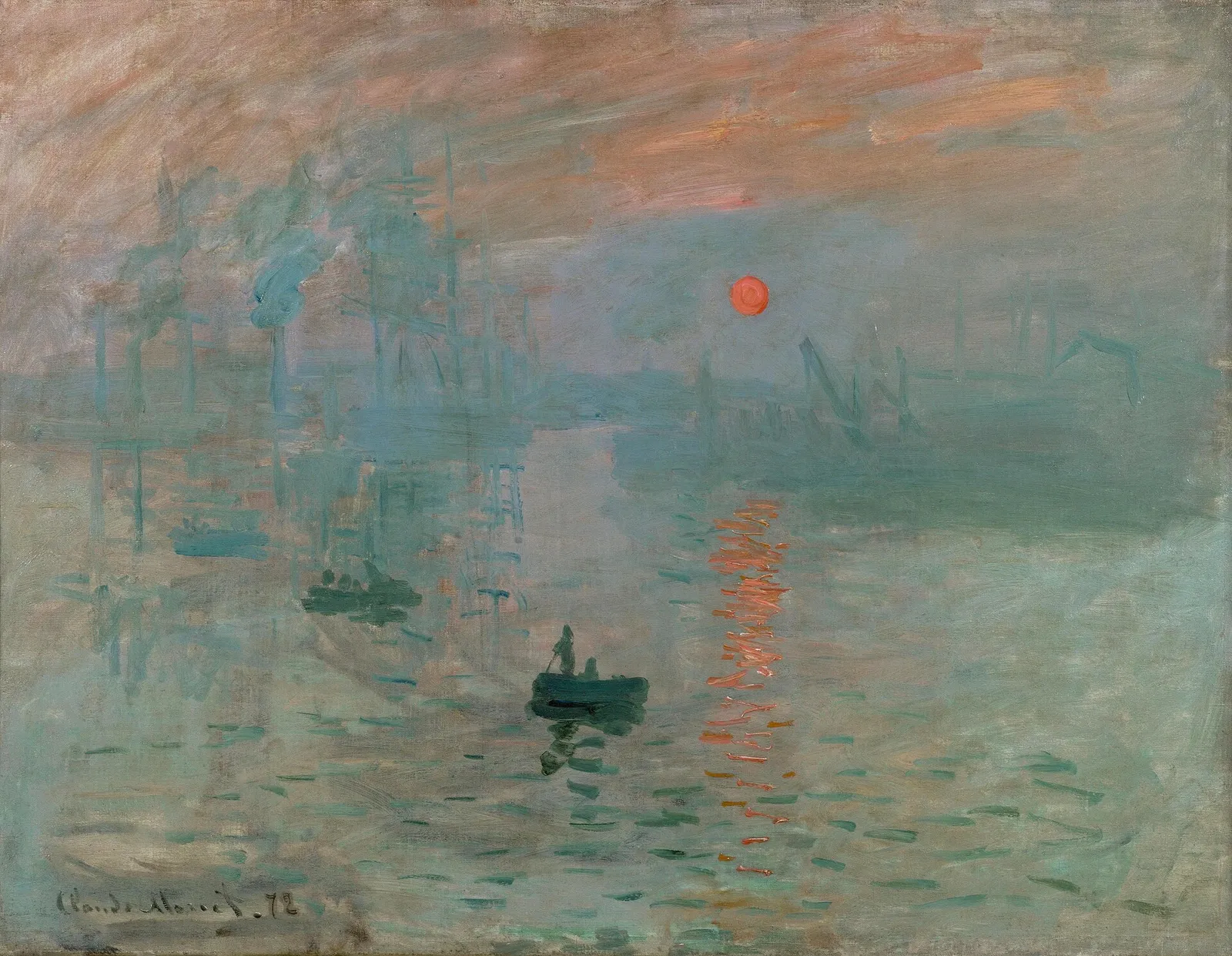
Impression, Sunrise is Claude Monet's 1872 view of a harbour at dawn, a small orange sun hanging over grey-blue water. It is held by the Musée Marmottan Monet. The painting is closely tied to the naming of Impressionism, so it rewards a slow, close look.
Where to see it
Impression, Sunrise is in the collection of the Musée Marmottan Monet. Display arrangements can change because of rehangs, conservation work or loans, so check the museum's official website for current display status, opening hours and ticket information before you visit. The canvas measures 48 × 63 cm, so plan to view it both up close and from a few steps back.
What to look for in person
The orange sun and its reflection
The sun is a small disc of orange set against a grey-blue haze, with a broken streak of the same colour on the water below. Step close and you will see that the reflection is built from short, separate horizontal strokes rather than a smooth band. Step back and those strokes read as light flickering on moving water. Notice how little detail surrounds the sun: its impact comes from the colour contrast with the muted sky, not from brightness. That tension between one bold accent and a soft, unified background is the first thing to look for.
Boats and figures as silhouettes
In the foreground, a small rowing boat with dark figures is set down in a few quick strokes. Further back, more boats fade progressively into the mist. The way these shapes lighten as they recede creates a sense of depth without carefully drawn perspective. Look at the figures themselves: they have no faces or defined features. Monet records how they appear against the light at a particular moment rather than what they look like in detail, an approach central to what later became known as Impressionism.
A working harbour in the haze
Behind the boats, vertical lines of masts, cranes and chimneys rise out of the fog. This is a working port rather than a picturesque view, and it is generally identified as Le Havre, where Monet grew up. These forms are suggested with thin, diluted paint, and in places the texture of the canvas shows through. Because the painting is modest in size, compare how the scene looks from close range, where it breaks into marks, with how it settles into a coherent image from a few steps away.
About the painting
Claude Monet painted Impression, Sunrise in 1872. It is an oil painting measuring 48 by 63 centimetres and is now in the collection of the Musée Marmottan Monet. The subject is a harbour at sunrise, generally identified as Le Havre on the coast of Normandy, seen through morning haze with small boats on the water and the outlines of port structures behind them. In 1874 Monet showed the painting at an independent exhibition organised by a group of artists working outside the official Salon system. The title drew the attention of critics, and a satirical review by Louis Leroy used the word 'impression' to mock the group. The label stuck, and the artists and their approach became known as Impressionists. For this reason the painting is often presented as a starting point for the movement, although the artists' methods had been developing for years before. What makes the work useful to study in person is how openly it shows its making. The brushwork is loose and visible, the paint is thin in many areas, and forms are left unresolved on purpose. Instead of describing the port in detail, Monet concentrates on atmosphere, colour and the effect of light at one moment of the day. Standing in front of it, you can test the idea directly: the closer you get, the more the scene dissolves into strokes, and the further you move away, the more it holds together as mist, water and light. Signature and date can be found in the lower left area of the canvas.
Key facts
| Artist | Claude Monet |
|---|---|
| Date | 1872 |
| Size | 48 × 63 cm |
| Medium | oil paint, canvas |
| Collection | Musée Marmottan Monet |
How to visit: Musée Marmottan Monet
Paris, France · Museum guide
| Opening hours | Tue, Wed, Fri, Sat, Sun 10:00–18:00 (rooms close 15 minutes before closing) Thu 10:00–21:00 (late opening; last entry 20:30) |
|---|---|
| Closed | Closed on Mondays, 1 May, 25 December and 1 January. |
| Last entry | 17:30 (20:30 on Thursdays) |
| Admission | Adult, on site EUR 14 (permanent collection and temporary exhibitions) Reduced, on site (under 18, students under 25) EUR 9 (proof required) Adult, online EUR 14.5 ('Paysages + Collections' ticket, 24.09.26–31.01.27) Reduced, online EUR 10 Free categories (children under 7, disabled visitors and companion, teachers, job seekers, etc.) EUR 0 (ticket collected on site with proof) Audio guide EUR 4 Combined ticket Musée Marmottan Monet + Fondation Monet, Giverny EUR 27 (reduced EUR 16) |
| Free entry | Free with proof for: children under 7, disabled visitors with a companion, teachers, Maison des Artistes members, fine-arts and art-history students, recipients of social minimums, job seekers, journalists, guide-lecturers, ICOM/ICOMOS card holders, Institut de France members and staff, Friends of the museum, war wounded with a companion, and Sentinelle military personnel. |
| Booking | Booking is not required, but entry is by timed slot. |
Official ticket page
Official website
View on map
Hours and prices can change. Please check the official website before you go. (Checked on: 2026-11-12)
More by Claude Monet
 Madame Monet wearing a kimono — Museum of Fine Arts Boston
 Luncheon on the Grass — Musée d'Orsay
 Hollowed Cliff near Étretat
 Woman with a Parasol – Madame Monet and Her Son — National Gallery of Art
 Women in the Garden — Musée d'Orsay
 Garden at Sainte-Adresse — Metropolitan Museum of Art
 The Magpie — Musée d'Orsay
 Rocks at Belle-Île, Port-Domois — Cincinnati Art Museum
 Boulevard des Capucines
 Woman in the Garden