Art! Art! Art! › Works
Rocks at Belle-Île, Port-Domois
 Claude Monet, 1886
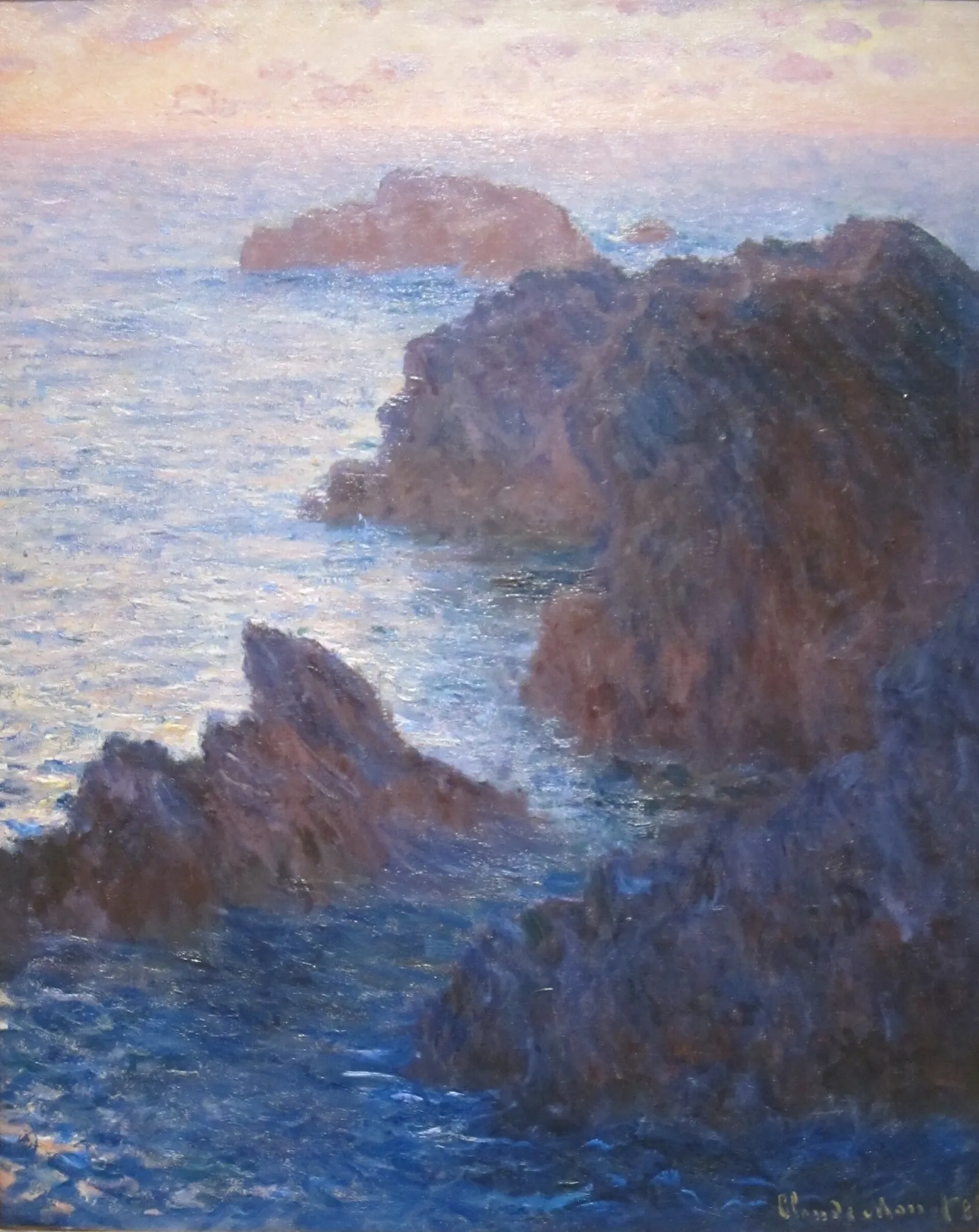
Claude Monet's Rocks at Belle-Île, Port-Domois dates from 1886 and belongs to the Cincinnati Art Museum. It comes from the period when Monet turned his attention to the rugged Atlantic coast of Belle-Île, an island off Brittany, and it rewards viewers who look at it both from a distance and up close.
Where to see it
Rocks at Belle-Île, Port-Domois is in the collection of the Cincinnati Art Museum, which is also listed as its location. Works in a museum collection are not always on view: paintings can be moved, rotated off display, or lent to other institutions. Before you plan a trip specifically to see this painting, check the Cincinnati Art Museum's official website or contact the museum directly to confirm whether it is currently on display.
What to look for in person
An upright seascape
The canvas measures 81.3 cm high by 64.8 cm wide, so it is taller than it is wide. That is a less common choice for a coastal view, where a broad horizontal horizon is the usual starting point. When you first approach, stand a few steps back and consider how the vertical shape guides your eye up and down through rock and water rather than across a wide panorama. Ask yourself how the format affects the sense of height, depth and enclosure in this cove.
Brushwork you can almost feel
Monet's Belle-Île paintings are known for dense, energetic handling, with strokes laid side by side and over one another rather than smoothly blended. Move closer to the surface and look at how individual marks describe the texture of rock and the movement of water. Notice where the paint seems more broken or more heavily worked. Then step back again and watch those separate strokes come together into solid cliffs and restless sea. Moving between the two distances is the best way to see how Monet built the scene.
Dark rock against Atlantic water
Compared with many of Monet's sunnier coastal scenes, the Belle-Île pictures are often described as darker and more severe, setting heavy rock forms against the deep colours of the Atlantic. In front of this canvas, look for how Monet contrasts the mass of the rocks with the more mobile surface of the water. Pay attention to where light catches the sea or the stone, and how colour, rather than outline, separates one form from another. Ask yourself how the painting conveys weather and atmosphere.
About the painting
In 1886 Claude Monet travelled to Belle-Île, an island off the southern coast of Brittany in western France. He had painted the sea many times before, especially along the Normandy coast, but Belle-Île offered something different: the exposed Atlantic shoreline known as the Côte Sauvage, or wild coast, with jagged rock formations, narrow coves and powerful surf. Port-Domois, named in this painting's title, is one of the inlets along that coast.
Monet worked on the island over several weeks, painting outdoors and returning to particular rocks and viewpoints under changing conditions of light and weather. This habit of revisiting a motif became central to his later work, and the Belle-Île campaign is often seen as an important step toward the series paintings he developed in the following years.
For visitors, the interest of a painting like this lies in watching how Monet turns direct observation into paint. There is no human story to follow and no figures to identify. Instead, the subject is the encounter between land and sea: the weight and texture of rock, the motion and colour of water, and the particular light of a coastal day. The 1886 date places the work in the middle of Monet's career, after the first Impressionist exhibitions and before his best-known series.
When you visit the Cincinnati Art Museum, give the painting time. Look from several distances, and compare it, if possible, with other landscapes on view nearby to see how Monet's approach to the coast stands apart.
Key facts
| Artist | Claude Monet |
|---|---|
| Date | 1886 |
| Size | 81.3 × 64.8 cm |
| Medium | oil paint, canvas |
| Collection | Cincinnati Art Museum |
How to visit: Cincinnati Art Museum
Cincinnati, United States · Museum guide
| Opening hours | Tue, Wed, Fri, Sat, Sun 11:00–17:00 Thu 11:00–20:00 Sat–Sun 10:00–11:00 (members only) |
|---|---|
| Closed | Closed on Mondays, and on Thursday 26 November and Friday 25 December. Open on 24 December and 31 December (closing at 17:00) and on 1 January. |
| Admission | General admission free “The Art of Charley Harper: Creatures Wild and Tame” (special exhibition) free for members; ticketed for non-members (price not published) “Nancy Rexroth: Secrets of My Power” (exhibition) free |
| Free entry | General admission is free for everyone every day. Members enter the ticketed Charley Harper exhibition free. Parking is free. |
| Booking | No reservation is required. |
Galleries 224–229 are temporarily closed. On Friday 13 November, most of the first floor, the Terrace Cafe and the REC will be closed, and the Museum Shop will close at 15:00.
Hours and prices can change. Please check the official website before you go. (Checked on: 2026-11-12)
More by Claude Monet
 Madame Monet wearing a kimono — Museum of Fine Arts Boston
 Luncheon on the Grass — Musée d'Orsay
 Hollowed Cliff near Étretat
 Woman with a Parasol – Madame Monet and Her Son — National Gallery of Art
 Women in the Garden — Musée d'Orsay
 Impression, Sunrise — Musée Marmottan Monet
 Garden at Sainte-Adresse — Metropolitan Museum of Art
 The Magpie — Musée d'Orsay
 Boulevard des Capucines
 Woman in the Garden