Art! Art! Art! › Works
Two Sisters
 Pierre-Auguste Renoir, 1881
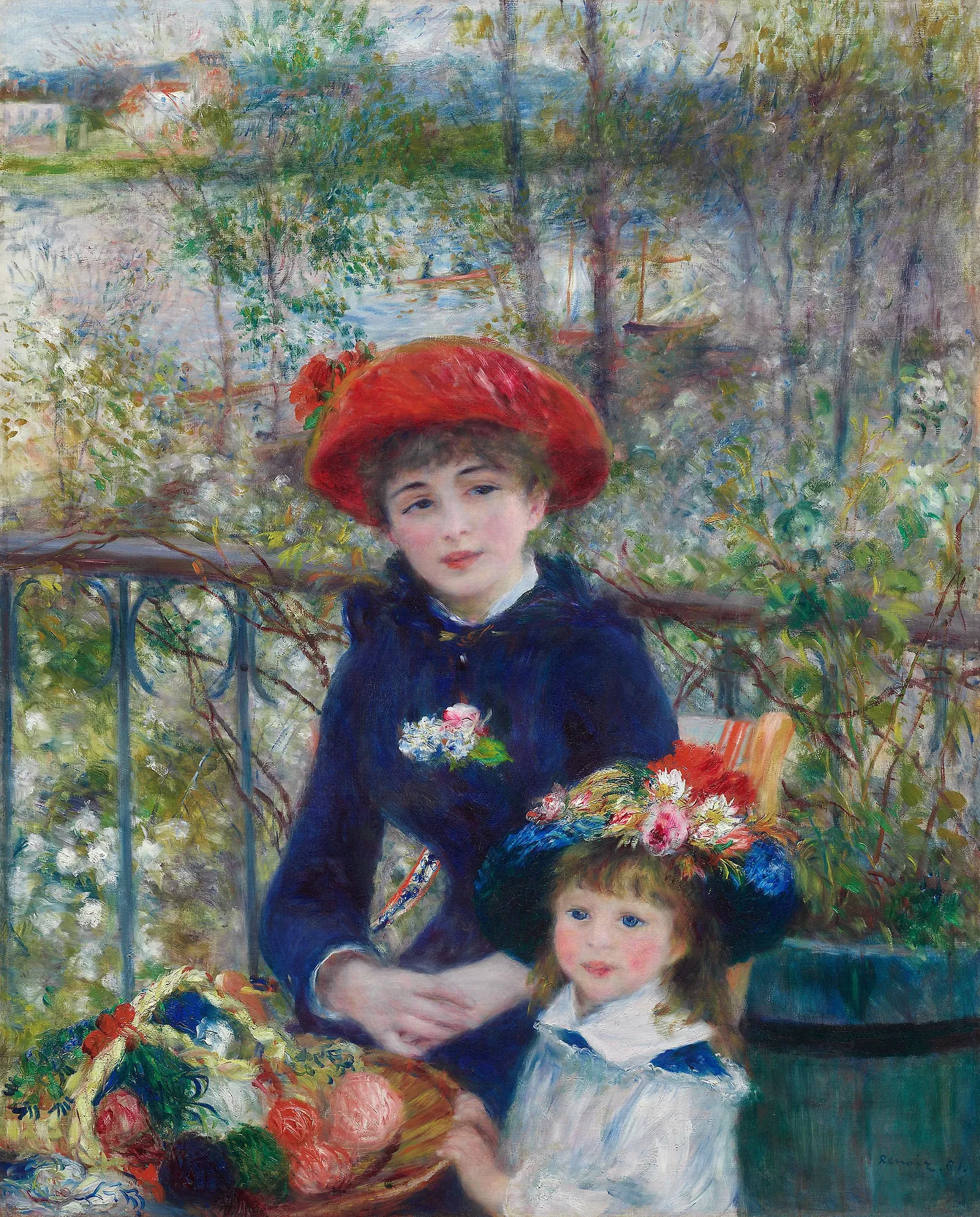
Pierre-Auguste Renoir's Two Sisters, painted in 1881, shows a young woman and a little girl seated outdoors on a terrace with a riverside landscape behind them. The painting is held by the Art Institute of Chicago, where it is one of the best-known Impressionist works in the collection.
Where to see it
Two Sisters is in the collection of the Art Institute of Chicago, in Chicago. Works can be moved, rotated, lent or taken off view for conservation, so check the Art Institute of Chicago's official website for current display status, opening hours and ticket information before you visit.
What to look for in person
Two faces, two levels of finish
Start with the faces. Renoir paints the older girl and the child with smooth, carefully blended skin tones, soft pinks and delicate shading around the eyes and lips. Then let your gaze drift outward. The further you move from the faces, the looser the brushwork becomes. Clothing, flowers and foliage are built from quicker, more visible strokes. This contrast keeps attention on the sitters while the rest of the picture stays fresh and airy. Standing at different distances shows how these strokes either dissolve into texture or resolve into form.
The red hat and color accents
The most striking note of color is the bright red hat worn by the younger girl. Notice how Renoir repeats warm reds and pinks elsewhere, in the flowers on the older girl's hat and in the yarn in the basket on her lap. These echoes link the two figures and carry your eye around the canvas. Against them, the dark blue of the older girl's dress adds weight and depth. Look at how the white of the child's dress picks up reflected tints instead of reading as flat white.
The terrace and the landscape beyond
Behind the figures, a balustrade and potted plants mark the edge of the terrace, and beyond them is a view of greenery and water with small boats. Renoir treats this background with feathery, broken strokes, so the landscape reads almost as a screen of light and color rather than a deep, measured space. The scene is generally associated with the Seine near Chatou, a riverside area popular with Parisians for boating and leisure. Notice how the cool greens and blues behind set off the warm tones of the figures.
About the painting
Two Sisters dates from 1881, a period when Renoir was painting scenes of modern leisure along the Seine outside Paris. Rather than a formal commissioned portrait, the picture presents an informal moment: two figures pausing outdoors, with a basket of yarn, flowers and a river view arranged around them. The title suggests a family bond, but the painting works less as a record of specific people than as an image of youth, warmth and summer light.
The painting also reflects the early 1880s, when Renoir was rethinking his approach. Compared with some of his earlier, more dissolved Impressionist surfaces, the faces here are more firmly modeled, while the setting retains the loose, vibrant handling associated with Impressionism. Seeing both approaches side by side on one canvas is one of the rewards of viewing it in person.
When you visit, give yourself time to look closely and then step back. Up close, you can follow individual strokes in the foliage, flowers and fabrics. From farther away, the composition comes together: the older girl's dark dress anchors the left side, the child in white and red brightens the center, and the landscape opens up behind them. The tilt of the older girl's head and the child's direct, slightly distracted gaze give the scene a quiet, unposed feeling.
The work belongs to the Art Institute of Chicago, which holds an important group of French Impressionist and Post-Impressionist paintings, so it can be combined with other works of the period in a single visit.
Key facts
| Artist | Pierre-Auguste Renoir |
|---|---|
| Date | 1881 |
| Size | 1005 × 810 cm |
| Medium | oil paint, canvas |
| Collection | Art Institute of Chicago |
| Gallery | Gallery 201 Checked in the museum's open data on 2026-11-12 (galleries can change) Source |
How to visit: Art Institute of Chicago
Chicago, United States · Museum guide
| Opening hours | Mon, Wed, Fri, Sat, Sun 11:00–17:00 (10:00–11:00 members only) Thu 11:00–20:00 (10:00–11:00 members only) |
|---|---|
| Closed | Closed on Tuesdays, Thanksgiving, Christmas and New Year's Day. |
| Admission | General adult USD 32 (seniors 65+, students, teens 14–17: USD 26) Chicago residents adult USD 20 (seniors/students: USD 14; teens 14–17: free; proof of residence required) Illinois residents adult USD 27 (seniors/students/teens: USD 21; proof of residence required) Fast Pass adult USD 40 (seniors/students/teens: USD 34; skips general admission lines, expedited access to ticketed exhibitions) Children under 14 free Special exhibition add-on (Mary Cassatt: After Impressionism, through 3 Jan) USD 7 (in addition to general admission) |
| Free entry | Free every day for children under 14, Chicago teens under 18, LINK and WIC cardholders, Illinois educators and University Partner students; active-duty military and families from Armed Services Day to Labor Day. Free for Illinois residents on the third Thursday of each month 17:00–20:00, Wed 11 Nov 11:00–17:00, and weekdays 2–18 Dec 11:00–17:00 (Thu until 20:00). |
| Booking | Booking is recommended; there is no timed entry. |
Arts of the Americas galleries 162–179, 265 and 271 are closed during construction of the Grainger Center for Conservation and Science (the Nighthawks and American Gothic galleries remain open). Galleries 136–137 are now Regenstein Hall (Zurbarán: Divine Light from 28 Feb 2027). Currently off view include Monet's Water Lilies (1906) and Water Lily Pond (1900) and Picasso's The Old Guitarist.
Official ticket page
Official website
View on map
Hours and prices can change. Please check the official website before you go. (Checked on: 2026-11-09)
More by Pierre-Auguste Renoir
 La Balançoire — Musée d'Orsay
 Jean Renoir sewing
 Luncheon of the Boating Party
 The Great Bathers — Philadelphia Museum of Art
 Dance in the City — Musée d'Orsay
 Girls at the Piano — Musée d'Orsay
 La Liseuse — Musée d'Orsay
 Torse, effet de soleil — Musée d'Orsay
 Mlle Irene Cahen d'Anvers
 Dance at Bougival — Museum of Fine Arts Boston
 Bather with a Griffon Dog
 Bal du moulin de la Galette — Musée d'Orsay