Art! Art! Art! › Works
The Great Bathers
 Pierre-Auguste Renoir, 1884
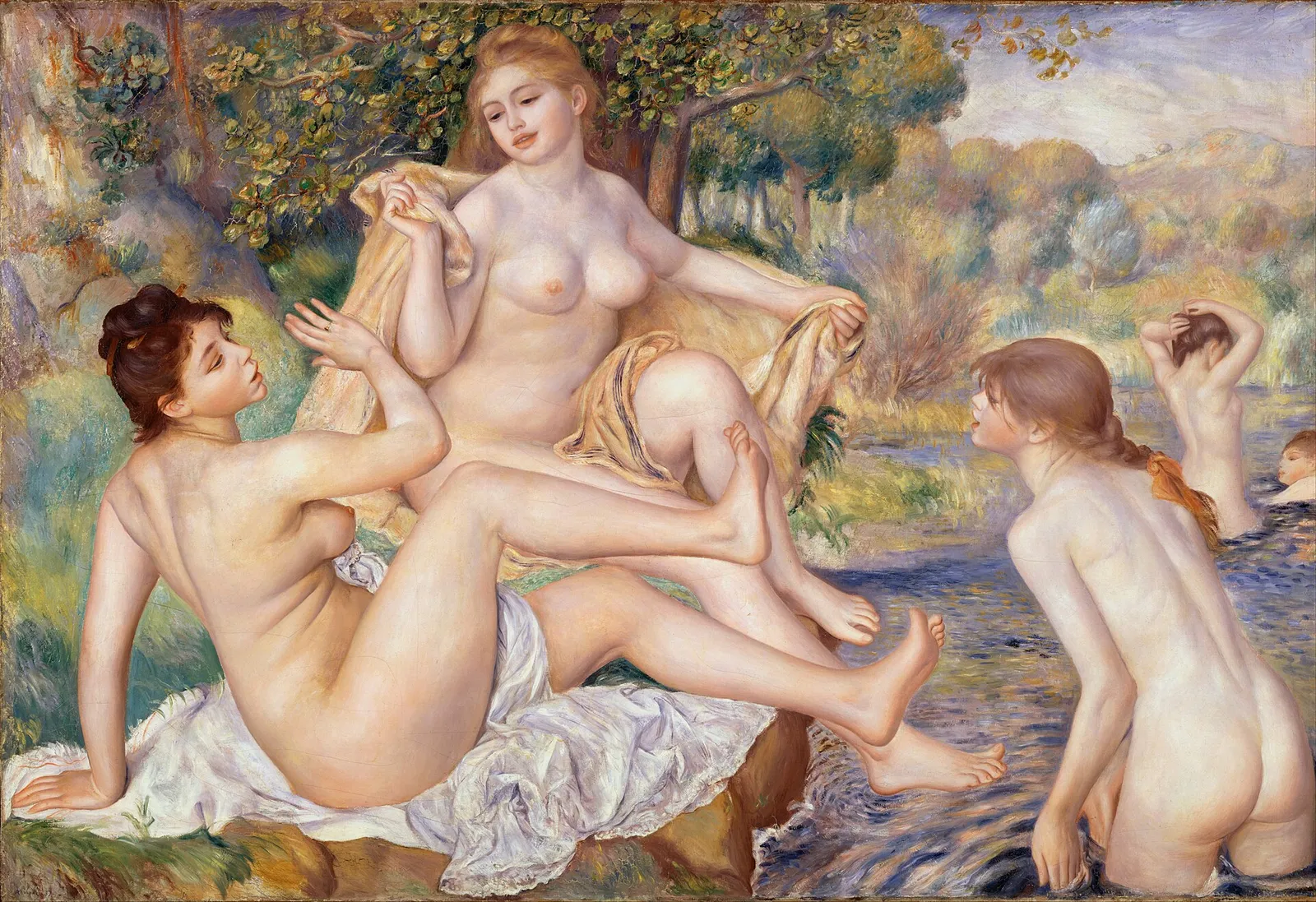
Pierre-Auguste Renoir's The Great Bathers, dated 1884, belongs to the Philadelphia Museum of Art. The painting shows nude women bathing and resting at the water's edge, and it marks a deliberate turn in Renoir's art toward firm drawing and carefully planned composition. For visitors, it offers a clear chance to see an Impressionist painter rethinking his own methods.
Where to see it
The Great Bathers is held by the Philadelphia Museum of Art, which is also listed as its location. Works in museum collections can be moved between galleries, taken off view for conservation, or lent to other institutions, so check the Philadelphia Museum of Art's official website for current display status, opening hours and ticket information before you visit. If the painting is important to your trip, it is worth confirming with the museum directly shortly before your planned date.
What to look for in person
Sharp contours on the figures
Start by looking at the edges of the bathers' bodies. Instead of the soft, broken brushwork associated with Impressionism, Renoir outlines the figures with clear, continuous contours and models their skin with smooth, even transitions. The bodies look almost sculpted, with a polished, porcelain-like surface. This crisp treatment is the main reason the work is linked to what is often called Renoir's 'dry' or 'Ingresque' manner, a phase in which he gave drawing and line a much larger role than before. Step close, then step back, to see how firmly each form is defined.
Figures and landscape painted differently
Compare the women in the foreground with the setting behind them. The trees, foliage and water are handled more loosely and atmospherically than the tightly drawn bodies. This contrast is one of the most discussed features of the painting: the figures seem to sit in front of the landscape rather than melt into it, as figures often do in earlier Impressionist scenes. Notice how the difference in technique pushes the nudes forward and makes them the clear focus, while the surroundings act more like a backdrop.
A carefully built composition
Follow the poses across the canvas. The main group of women at the water's edge is arranged so that arms, legs and torsos lead the eye from one figure to the next, and one bather splashes water toward her companions, adding a moment of movement to an otherwise balanced group. Further back, other bathers appear in the water. Nothing here looks like a quick sketch from life; the arrangement reflects long planning. Renoir is known to have made numerous preparatory drawings and studies for this work, and the deliberate placement of each figure shows that process.
About the painting
The Great Bathers is an ambitious figure painting by Pierre-Auguste Renoir, dated 1884 and now in the collection of the Philadelphia Museum of Art. By the early 1880s Renoir had become dissatisfied with the limits he felt in Impressionism, which favoured capturing fleeting light and atmosphere over firm structure. After travelling in Italy and looking closely at Renaissance painting, including the work of Raphael, he set out to bring drawing, contour and classical composition back to the centre of his art. This painting is widely regarded as the key statement of that shift.
The subject, female nudes bathing outdoors, has a long history in European art, and Renoir consciously placed himself within that tradition. Art historians commonly point to a seventeenth-century relief of bathing nymphs by the sculptor François Girardon at Versailles as a source for the composition. Renoir worked toward the final canvas through many drawings and studies, refining each pose before committing it to paint.
In front of the work, the result is visible at once: smooth, clearly outlined bodies set against a softer, more loosely painted landscape. Some contemporaries found the combination stiff or awkward, and the painting divided opinion. Today it is valued as a record of a painter deliberately testing new directions in mid-career, rather than settling into a familiar style. The firm handling seen here did not last in exactly this form; in later years Renoir returned to a warmer, softer treatment of the nude, but the interest in solid, monumental figures stayed with him. Seeing The Great Bathers helps make sense of that longer development.
Key facts
| Artist | Pierre-Auguste Renoir |
|---|---|
| Date | 1884 |
| Size | 1178.81 × 1709.42 cm |
| Medium | oil paint, canvas |
| Collection | Philadelphia Museum of Art |
How to visit: Philadelphia Museum of Art
Philadelphia, United States · Museum guide
| Opening hours | Mon, Thu, Sat, Sun 10:00–17:00 (Main Building) Fri 10:00–20:45 (Pay What You Wish 17:00–20:45, through June 2027) 24 Dec 2026 (Christmas Eve) 10:00–15:00 |
|---|---|
| Closed | Closed Tuesdays and Wednesdays, as well as 4 July, Thanksgiving (26 Nov 2026) and Christmas Day (25 Dec 2026). |
| Admission | Adult USD 30 (valid two consecutive days, includes the Rodin Museum) Senior (65 and over) USD 28 Student with valid ID USD 14 Youth (18 and under) free (ticket required) Member free Member guest USD 15 (senior guest USD 14) |
| Free entry | Pay What You Wish on the first Sunday of the month and every Friday 17:00–20:45 through June 2027 (suggested donation USD 15). Under-18s are always free. PA ACCESS/EBT cardholders get free general admission for 4 adults. Military personnel and their party are free from Armed Forces Day to Labor Day. |
| Booking | Booking in advance is strongly recommended. There is no timed entry. |
Official ticket page
Official website
View on map
Hours and prices can change. Please check the official website before you go. (Checked on: 2026-11-09)
More by Pierre-Auguste Renoir
 La Balançoire — Musée d'Orsay
 Jean Renoir sewing
 Luncheon of the Boating Party
 Dance in the City — Musée d'Orsay
 Girls at the Piano — Musée d'Orsay
 La Liseuse — Musée d'Orsay
 Torse, effet de soleil — Musée d'Orsay
 Mlle Irene Cahen d'Anvers
 Dance at Bougival — Museum of Fine Arts Boston
 Bather with a Griffon Dog
 Two Sisters — Art Institute of Chicago
 Bal du moulin de la Galette — Musée d'Orsay