Art! Art! Art! › Works
La Balançoire
 Pierre-Auguste Renoir, 1876
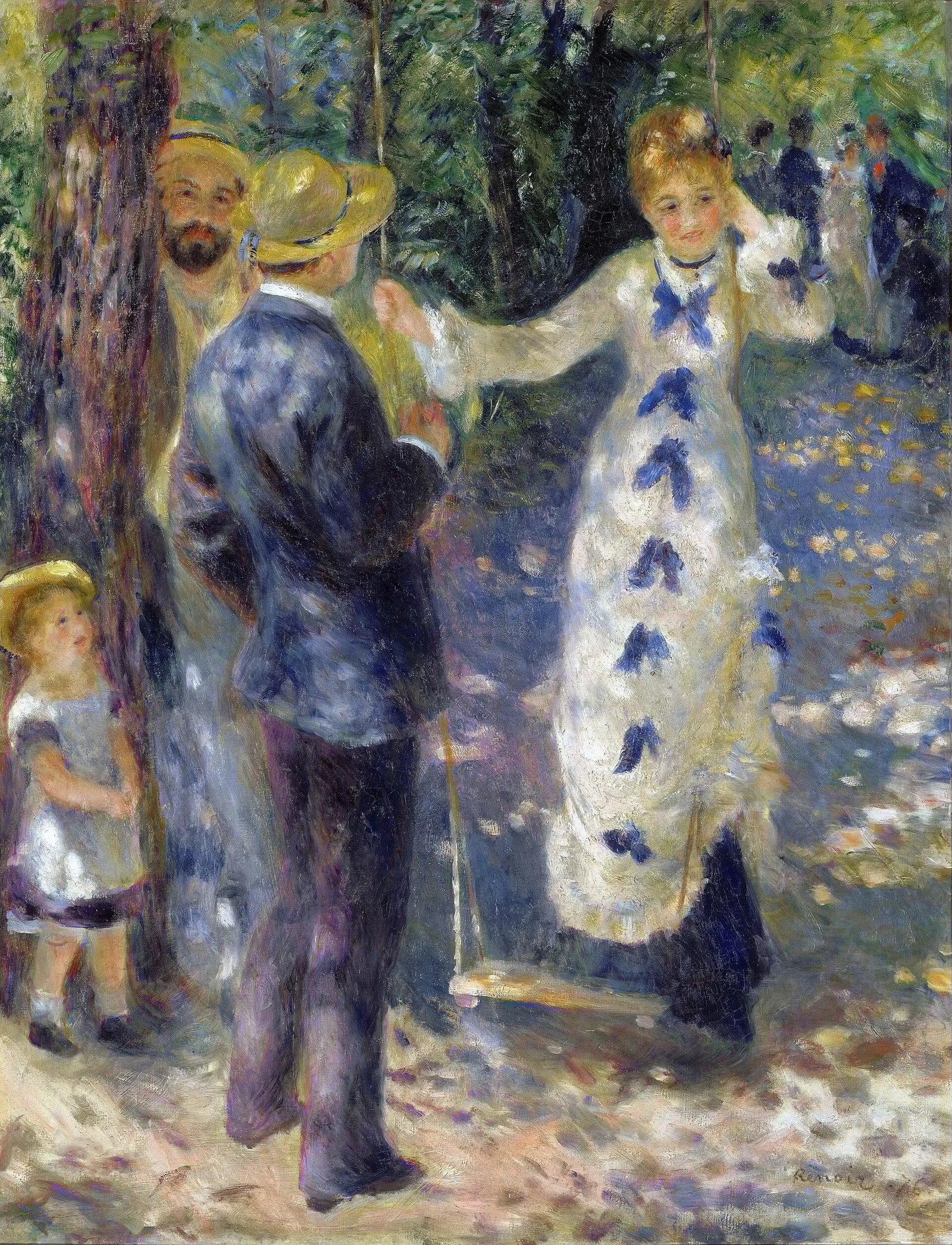
La Balançoire (The Swing) is an oil painting on canvas that Pierre-Auguste Renoir made in 1876. It shows a young woman standing on a swing in a sunlit garden, with companions gathered around her. The painting belongs to the Musée d'Orsay in Paris.
Where to see it
La Balançoire is in the collection of the Musée d'Orsay in Paris. The canvas measures 92 x 73 cm, an upright format that is easy to take in from a few steps back. Display arrangements can change, so check the Musée d'Orsay's official website for the painting's current display status before you plan your visit.
What to look for in person
Sunlight through the leaves
Start a few steps back, then move closer. Pale patches of yellow and white fall across the woman's dress, the men's clothing and the ground, as though sunlight were filtering through the foliage overhead. Up close, these become separate dabs and strokes of paint, and the edges of the figures loosen into the garden around them. This was exactly what unsettled some viewers in 1877, when one critic compared the spots of light to grease stains. Notice how rarely Renoir uses a firm outline, and how his shadows are coloured rather than simply dark.
The white dress and its blue bows
The young woman on the swing is the focal point. Her white dress has a row of blue bows running down the front, and these small notes of colour draw your eye from her face downward. Blue also runs through the shadows elsewhere in the picture. Another critic at the 1877 exhibition called Renoir's blue violent. Fashion historian Birgit Haase has observed that the fabric appears to be white muslin and that the dress's fitted silhouette suggests a cuirass corset. The painting is therefore also a record of what fashionable women wore in the 1870s.
A conversation, and a watching child
Two men and a little girl are near the swing. Look at where each figure's attention is directed, because the scene reads like a moment caught in the middle of a conversation rather than a posed group. Renoir told his friend Georges Rivière that the girl had been watching him while he painted, so he put her into the picture. Then look past the main group. A small cluster of people is chatting in the background, sketched more loosely, and it extends the garden into a wider social scene.
About the painting
Renoir painted La Balançoire outdoors, en plein air, in the garden behind his studio at 12 rue Cortot in Montmartre. That garden now belongs to the Musée de Montmartre. He made the picture in 1876, the same year he was working on Bal du moulin de la Galette, his large scene of an open-air dance in the same neighbourhood. Sources name the models as Jeanne Samary, the painter Norbert Goeneutte and Renoir's brother Edmond, and the same three are said to appear in the dance picture as well. Seeing the two works as companions helps explain Renoir's interest here. He was less concerned with telling a story than with showing people at ease in their surroundings, and with the way light falls on figures and through leaves.
The Swing was shown at the third Impressionist exhibition in 1877, alongside Bal du moulin de la Galette. Reactions were mixed. One critic thought the flecks of sunlight looked like grease stains, and another found Renoir's blue too harsh. Georges Rivière, a friend of the painter, took a more admiring view and compared the picture to Watteau's The Embarkation for Cythera. The comparison links Renoir's modern garden gathering to an earlier French tradition of elegant outdoor leisure.
Gustave Caillebotte, a fellow painter and a collector of his colleagues' work, acquired the canvas in 1877, shortly after the exhibition. It later passed to the Musée d'Orsay, where it belongs today. When you stand in front of it, try to see it the way those first viewers did: as a deliberately unfinished-looking surface in which broken light carries as much meaning as the people.
Key facts
| Artist | Pierre-Auguste Renoir |
|---|---|
| Date | 1876 |
| Size | 92 × 73 cm |
| Medium | oil paint, canvas |
| Collection | Musée d'Orsay |
How to visit: Musée d'Orsay
Paris, France · Museum guide
| Opening hours | Tue–Wed, Fri–Sun 09:30–18:00 (galleries close at 17:30) Thu 09:30–21:45 (late opening; galleries close at 21:15) |
|---|---|
| Closed | Every Monday, 1 May and 25 December. |
| Last entry | 17:00 (exhibitions 17:15); Thursdays 21:00 |
| Admission | Full rate, online EUR 16 Full rate, at the museum EUR 14 Reduced rate (on site only) EUR 11 Enfant & Cie, online EUR 13 Enfant & Cie, at the museum EUR 11 Night rate (Thursday), online EUR 12 Night rate (Thursday), at the museum EUR 10 Under 18s; EEA residents under 26 free |
| Free entry | Free for under 18s and residents of the European Economic Area under 26. Free on the first Sunday of the month, with booking required. |
| Booking | Booking is strongly recommended. Entry is by timed slot. |
The museum stays open and all collections and exhibitions remain accessible, but entrances have changed: timed-ticket holders use Entrance 1 (Quay); priority visitors, reseller voucher holders, visitors without tickets and groups use Entrance 2 (Forecourt). Arrive at least 15 minutes before your time slot.
Official ticket page
Official website
View on map
Hours and prices can change. Please check the official website before you go. (Checked on: 2026-11-11)
More by Pierre-Auguste Renoir
 Jean Renoir sewing
 Luncheon of the Boating Party
 The Great Bathers — Philadelphia Museum of Art
 Dance in the City — Musée d'Orsay
 Girls at the Piano — Musée d'Orsay
 La Liseuse — Musée d'Orsay
 Torse, effet de soleil — Musée d'Orsay
 Mlle Irene Cahen d'Anvers
 Dance at Bougival — Museum of Fine Arts Boston
 Bather with a Griffon Dog
 Two Sisters — Art Institute of Chicago
 Bal du moulin de la Galette — Musée d'Orsay
Sources
- Wikidata Q1118456
- Wikipedia (en) (CC BY-SA 4.0)
- Wikipedia (ja) (CC BY-SA 4.0)
- Wikipedia (it) (CC BY-SA 4.0)
- Wikipedia (fr) (CC BY-SA 4.0)
- billetterie.musee-orsay.fr
- www.musee-orsay.fr