Art! Art! Art! › Works
Dance in the City
 Pierre-Auguste Renoir, 1883
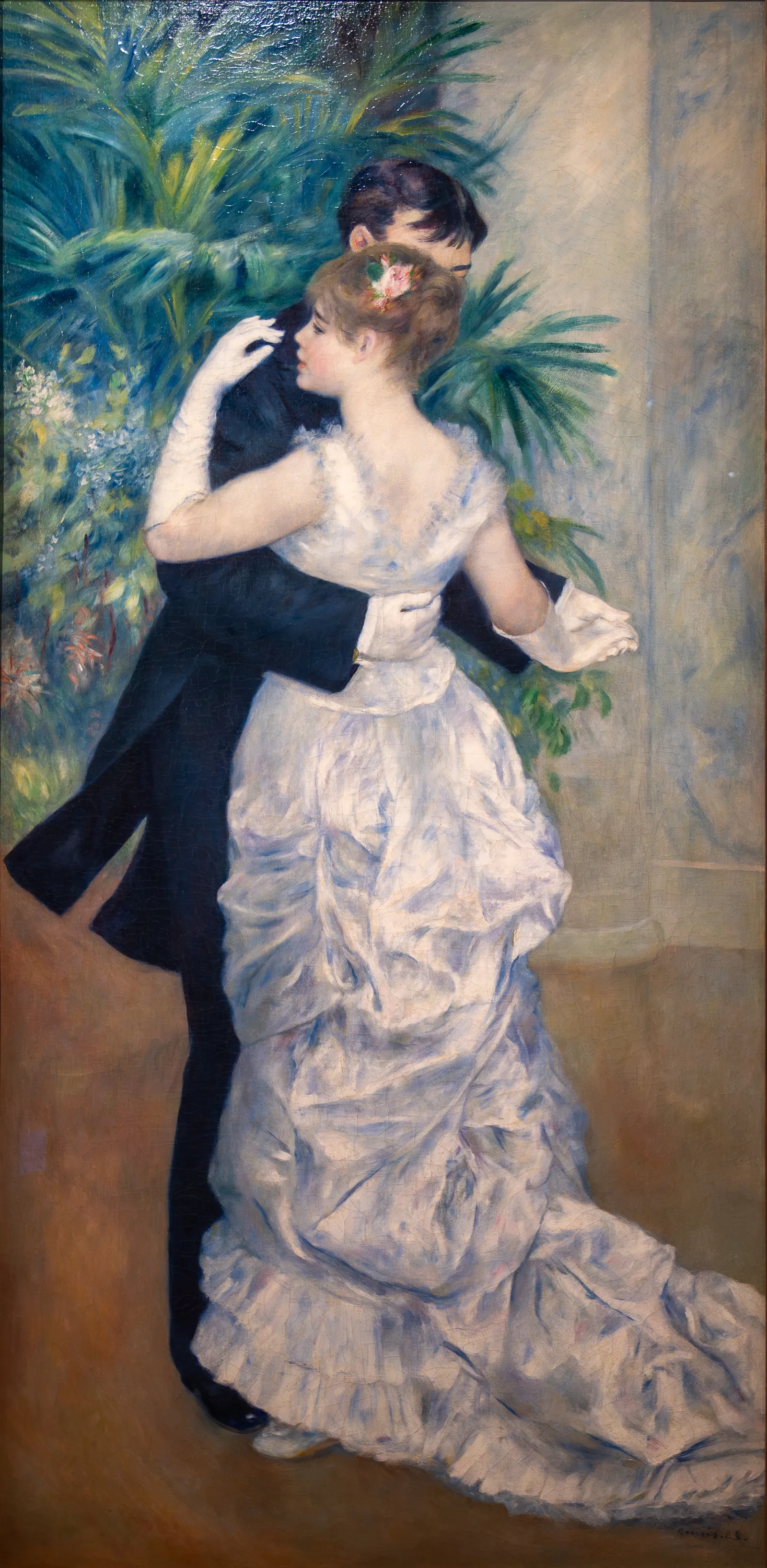
Dance in the City is a painting by Pierre-Auguste Renoir, dated 1883 and held by the Musée d'Orsay. Standing 180 cm tall and 90 cm wide, it shows an elegant couple turning in a dance, painted close to life size in a tall, narrow format that puts you almost face to face with the dancers.
Where to see it
Dance in the City is in the collection of the Musée d'Orsay, and its recorded location is the Musée d'Orsay. Paintings in large collections can be moved, rotated off view or lent to other institutions, so check the Musée d'Orsay's official website for current display status before you plan your visit.
What to look for in person
The white satin gown
The woman's gown dominates the picture. Step close and look at how Renoir builds the satin with cool whites, greys and faint blue and pink tones rather than flat white paint. The fabric catches light along its folds and the train sweeps toward the lower edge of the canvas. Compare this smooth, polished surface with the looser handling you may know from Renoir's earlier scenes of outdoor dances; here the dress reads almost like sculpture, crisp and carefully contained within its contours.
Black against white
The man's black evening suit acts as a dark frame around his partner. Notice how little of him is visible: his face is largely hidden behind her head, and his body becomes a single dark shape that makes the gown look even brighter. This strong contrast between black and white is the key to the painting's formal, restrained mood. Look also at the hands, including the gloves, where the two figures meet and the dance is held together.
A tall, close-up format
At 180 by 90 cm, the canvas is twice as high as it is wide, and the couple fills almost the entire space. Stand back first to take in the full figures from head to hem, then move closer to see how the background, with its greenery and a glimpse of an interior, is kept subdued. The narrow format cuts out any crowd, so the scene feels less like a busy ballroom and more like a single, quiet moment between two dancers.
About the painting
Renoir painted Dance in the City in 1883, at a time when he was rethinking his approach to painting. After years associated with Impressionism, with its broken brushwork and emphasis on fleeting light, he became increasingly interested in firm drawing and clearly defined forms. This painting reflects that change: the outlines of the figures are crisp, the surfaces are smooth, and the composition is carefully balanced rather than casual.
The work is one of a group of large dance paintings Renoir made around this time, and it is widely understood as a companion to Dance in the Country. The two were conceived as contrasting pairs. Where the country scene shows a cheerful, informal couple in everyday clothes, the city version shows a reserved couple in formal evening dress. Seeing Dance in the City with that contrast in mind helps explain its cool palette and composed atmosphere: it is meant to suggest urban refinement rather than open-air pleasure.
The female dancer is generally identified as Suzanne Valadon, who worked as an artist's model in this period and later became a respected painter in her own right. Her face is turned slightly away, which adds to the painting's sense of reserve.
For visitors, the appeal lies in the scale and the surface. Because the figures are close to life size, the painting works best when viewed first from a distance and then up close, where you can follow how Renoir models the satin, the gloves and the dark suit. It rewards slow looking rather than a quick glance on the way through the galleries.
Key facts
| Artist | Pierre-Auguste Renoir |
|---|---|
| Date | 1883 |
| Size | 180 × 90 cm |
| Medium | oil paint, canvas |
| Collection | Musée d'Orsay |
How to visit: Musée d'Orsay
Paris, France · Museum guide
| Opening hours | Tue–Wed, Fri–Sun 09:30–18:00 (galleries close at 17:30) Thu 09:30–21:45 (late opening; galleries close at 21:15) |
|---|---|
| Closed | Every Monday, 1 May and 25 December. |
| Last entry | 17:00 (exhibitions 17:15); Thursdays 21:00 |
| Admission | Full rate, online EUR 16 Full rate, at the museum EUR 14 Reduced rate (on site only) EUR 11 Enfant & Cie, online EUR 13 Enfant & Cie, at the museum EUR 11 Night rate (Thursday), online EUR 12 Night rate (Thursday), at the museum EUR 10 Under 18s; EEA residents under 26 free |
| Free entry | Free for under 18s and residents of the European Economic Area under 26. Free on the first Sunday of the month, with booking required. |
| Booking | Booking is strongly recommended. Entry is by timed slot. |
The museum stays open and all collections and exhibitions remain accessible, but entrances have changed: timed-ticket holders use Entrance 1 (Quay); priority visitors, reseller voucher holders, visitors without tickets and groups use Entrance 2 (Forecourt). Arrive at least 15 minutes before your time slot.
Official ticket page
Official website
View on map
Hours and prices can change. Please check the official website before you go. (Checked on: 2026-11-11)
More by Pierre-Auguste Renoir
 La Balançoire — Musée d'Orsay
 Jean Renoir sewing
 Luncheon of the Boating Party
 The Great Bathers — Philadelphia Museum of Art
 Girls at the Piano — Musée d'Orsay
 La Liseuse — Musée d'Orsay
 Torse, effet de soleil — Musée d'Orsay
 Mlle Irene Cahen d'Anvers
 Dance at Bougival — Museum of Fine Arts Boston
 Bather with a Griffon Dog
 Two Sisters — Art Institute of Chicago
 Bal du moulin de la Galette — Musée d'Orsay