Art! Art! Art! › Works
Bal du moulin de la Galette
 Pierre-Auguste Renoir, 1876
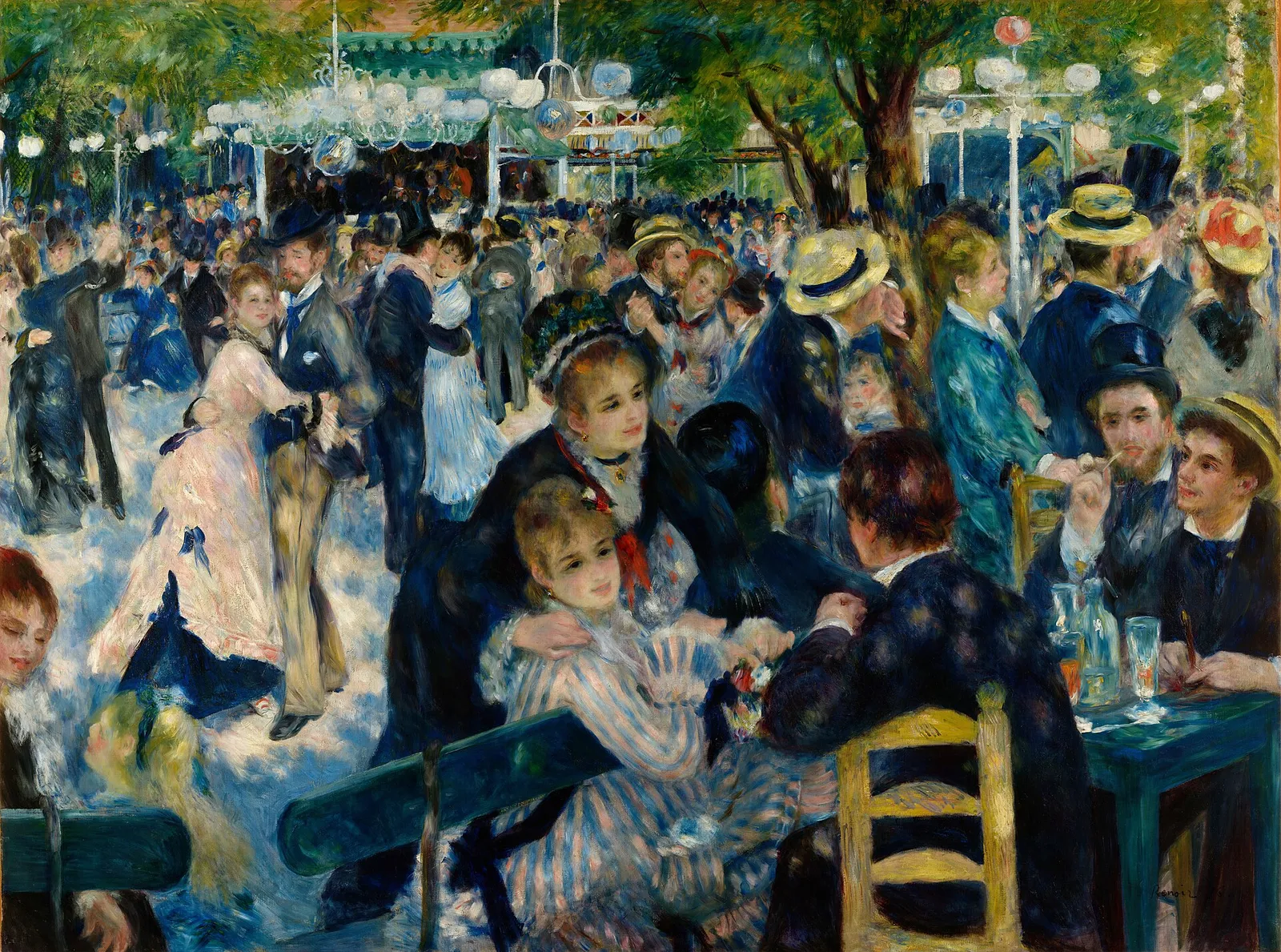
Pierre-Auguste Renoir's Bal du moulin de la Galette, painted in 1876, shows a crowded open-air dance in Montmartre on a sunny afternoon. The canvas belongs to the Musée d'Orsay, where visitors can see up close how Renoir turned sunlight, shade and movement into paint.
Where to see it
Bal du moulin de la Galette is in the collection of the Musée d'Orsay. The canvas measures 131 × 176 cm, so it is large enough to take in from across a gallery and rewarding to study up close. Paintings in major collections are sometimes moved, rehung or lent to other institutions, so check the Musée d'Orsay's official website for current display status before you plan your visit.
What to look for in person
Light falling through the trees
Start with the patches of light. Renoir scattered pale, warm spots of colour across jackets, hats, faces and the ground, as if sunlight were filtering through the leaves overhead. Step back and these touches read as a bright, flickering afternoon; step closer and they become separate dabs of pink, yellow and white laid over blues and violets. Notice that the shadows are coloured rather than simply darkened. This dappled effect is one of the clearest examples of the Impressionist interest in how light changes the appearance of everything it touches.
A crowd in motion
Look at how the scene is arranged. In the foreground, a group sits and leans around a table, chatting and turning toward one another. Behind them, couples dance, and the crowd grows smaller and looser toward the back of the picture until figures dissolve into quick strokes. There is no single focal point that holds your attention for long; your eye moves from face to face the way it would at a real gathering. Renoir handles the space so that the viewer seems to stand at the edge of the party rather than outside it.
Brushwork and finish
Get close to the surface to see how loosely much of it is painted. Faces in the foreground are softly modelled, but clothing, background figures and foliage are built from fluid, visible strokes. Edges blur, especially toward the rear, which helps suggest movement and depth. Look at the striped dresses and dark suits, where blues and blacks are enlivened with lighter touches. This contrast between more carefully treated faces and freer surroundings is a useful key to how Renoir balanced portrait-like detail with the overall impression of a lively, sunlit scene.
About the painting
Bal du moulin de la Galette, dated 1876, depicts a Sunday dance at the Moulin de la Galette, a popular open-air venue in Montmartre where ordinary Parisians gathered to drink, talk and dance. Renoir chose a subject from contemporary leisure rather than history or mythology, which places the painting firmly within the Impressionist project of recording modern life. At 131 by 176 centimetres, it is an ambitious size for a scene of everyday pleasure, a scale traditionally associated with more formal subjects. Many of the figures are generally understood to have been modelled by people from Renoir's own circle of friends and acquaintances, which gives the crowd its relaxed, informal character. The painting was owned by Gustave Caillebotte, a fellow painter and supporter of the Impressionists, and it entered the French national collections through his bequest. The fact sheet records its association with three institutions: the Luxembourg Museum, the Galerie nationale du Jeu de Paume and the Musée d'Orsay, which is the collection that holds it. For visitors, the painting rewards two kinds of looking. From a distance, it reads as a unified impression of warmth, noise and movement under the trees. Up close, it breaks down into individual strokes and patches of colour, showing how Renoir built that impression from carefully judged contrasts of light and shade. Spending time moving between these two viewing distances is one of the best ways to understand both the painting and the wider Impressionist approach it represents.
Key facts
| Artist | Pierre-Auguste Renoir |
|---|---|
| Date | 1876 |
| Size | 131 × 176 cm |
| Medium | oil paint, canvas |
| Collection | Musée d'Orsay |
How to visit: Musée d'Orsay
Paris, France · Museum guide
| Opening hours | Tue–Wed, Fri–Sun 09:30–18:00 (galleries close at 17:30) Thu 09:30–21:45 (late opening; galleries close at 21:15) |
|---|---|
| Closed | Every Monday, 1 May and 25 December. |
| Last entry | 17:00 (exhibitions 17:15); Thursdays 21:00 |
| Admission | Full rate, online EUR 16 Full rate, at the museum EUR 14 Reduced rate (on site only) EUR 11 Enfant & Cie, online EUR 13 Enfant & Cie, at the museum EUR 11 Night rate (Thursday), online EUR 12 Night rate (Thursday), at the museum EUR 10 Under 18s; EEA residents under 26 free |
| Free entry | Free for under 18s and residents of the European Economic Area under 26. Free on the first Sunday of the month, with booking required. |
| Booking | Booking is strongly recommended. Entry is by timed slot. |
The museum stays open and all collections and exhibitions remain accessible, but entrances have changed: timed-ticket holders use Entrance 1 (Quay); priority visitors, reseller voucher holders, visitors without tickets and groups use Entrance 2 (Forecourt). Arrive at least 15 minutes before your time slot.
Official ticket page
Official website
View on map
Hours and prices can change. Please check the official website before you go. (Checked on: 2026-11-11)
More by Pierre-Auguste Renoir
 La Balançoire — Musée d'Orsay
 Jean Renoir sewing
 Luncheon of the Boating Party
 The Great Bathers — Philadelphia Museum of Art
 Dance in the City — Musée d'Orsay
 Girls at the Piano — Musée d'Orsay
 La Liseuse — Musée d'Orsay
 Torse, effet de soleil — Musée d'Orsay
 Mlle Irene Cahen d'Anvers
 Dance at Bougival — Museum of Fine Arts Boston
 Bather with a Griffon Dog
 Two Sisters — Art Institute of Chicago