Art! Art! Art! › Works
Torse, effet de soleil
 Pierre-Auguste Renoir, 1875
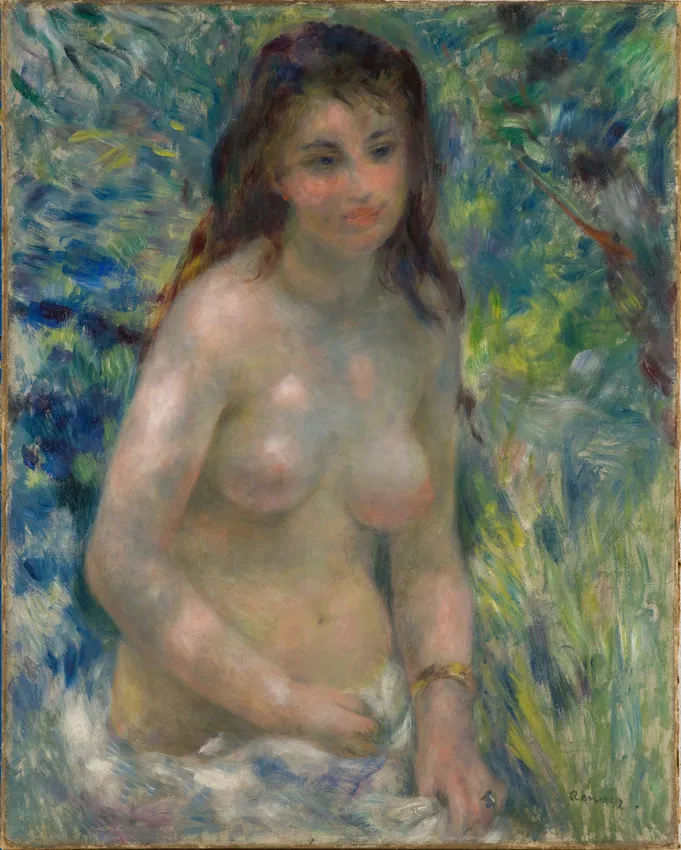
Torse, effet de soleil is an 1875 painting by Pierre-Auguste Renoir in the collection of the Musée d'Orsay. It shows a half-length nude woman outdoors, her skin broken into patches of warm light and coloured shadow by sunlight filtering through leaves. It is a good place to see how the Impressionists rethought the way light falls on the human body.
Where to see it
Torse, effet de soleil belongs to the Musée d'Orsay, and the museum is listed as its location. Displays change, and works can be moved, rotated or lent, so check the Musée d'Orsay's official website for current display status and visiting information before you go. The canvas measures 81 x 65 cm. That is a moderate size, so you can take it in from a few steps back and then move in close to study the brushwork.
What to look for in person
Light that moves across the skin
Start with the figure's body. Renoir does not model the flesh with one smooth, even tone. Instead, the skin is covered in shifting spots of pale, warm light and cooler shadow, as though leaves overhead were breaking up the sun. Step back and the patches read as dappled sunlight. Step closer and they become separate touches of colour. The painting is really about this effect, as its title, which translates roughly as 'torso, effect of sunlight', makes clear.
Coloured shadows
Look at the shadowed areas on the arms, shoulders and torso. Instead of browns or greys, Renoir uses blues, violets and greens to suggest light reflected from the surrounding foliage. This use of coloured shadow is a hallmark of Impressionist practice, and it is one reason the picture looked so unconventional to viewers used to academic nudes with polished, uniform flesh. Compare the cool tones in the shadows with the warm pinks and creams where the sun hits directly.
A figure dissolving into its setting
Notice how loosely the background is painted. The greenery around the model is made of quick, feathery strokes with no sharp outlines, and in places the edges of the body blur into it. Renoir seems less interested in a precise setting than in the atmosphere of a sunlit outdoor space. The face, by comparison, is softly rendered and calm, and the contrast between the stable figure and the flickering surroundings is worth taking a moment to see.
About the painting
Pierre-Auguste Renoir painted Torse, effet de soleil in 1875, during the years when he and his colleagues were developing the approach that became known as Impressionism. Painting outdoors and working directly from observation, these artists tried to capture the passing effects of light and atmosphere rather than the carefully finished surfaces favoured by the official art establishment. The canvas measures 81 x 65 cm and is now in the collection of the Musée d'Orsay.
The subject is a traditional one, the female nude, but Renoir treats it in an untraditional way. Academic painters usually placed the nude in a studio or a mythological setting and gave the skin a smooth, idealised finish. Here the model sits in what appears to be a garden or wooded spot, and the sunlight coming through the leaves covers her body in irregular patches of light and coloured shadow. The painting turns the nude into a study of how light behaves, which is why the word 'effect' appears in the title.
This approach drew criticism when the painting was first seen in public. Some viewers felt that the coloured shadows made the flesh look blotchy or unhealthy, a reaction that shows how new the Impressionists' ideas about colour and light were at the time. Today the work is often cited as a clear example of Renoir's early Impressionist handling of the figure.
When you visit, give yourself time to look at the painting from different distances. From across the room the light effect comes together. Up close you can follow the individual brushstrokes that create it.
Key facts
| Artist | Pierre-Auguste Renoir |
|---|---|
| Date | 1875 |
| Size | 81 × 65 cm |
| Medium | oil paint, canvas |
| Collection | Musée d'Orsay |
How to visit: Musée d'Orsay
Paris, France · Museum guide
| Opening hours | Tue–Wed, Fri–Sun 09:30–18:00 (galleries close at 17:30) Thu 09:30–21:45 (late opening; galleries close at 21:15) |
|---|---|
| Closed | Every Monday, 1 May and 25 December. |
| Last entry | 17:00 (exhibitions 17:15); Thursdays 21:00 |
| Admission | Full rate, online EUR 16 Full rate, at the museum EUR 14 Reduced rate (on site only) EUR 11 Enfant & Cie, online EUR 13 Enfant & Cie, at the museum EUR 11 Night rate (Thursday), online EUR 12 Night rate (Thursday), at the museum EUR 10 Under 18s; EEA residents under 26 free |
| Free entry | Free for under 18s and residents of the European Economic Area under 26. Free on the first Sunday of the month, with booking required. |
| Booking | Booking is strongly recommended. Entry is by timed slot. |
The museum stays open and all collections and exhibitions remain accessible, but entrances have changed: timed-ticket holders use Entrance 1 (Quay); priority visitors, reseller voucher holders, visitors without tickets and groups use Entrance 2 (Forecourt). Arrive at least 15 minutes before your time slot.
Official ticket page
Official website
View on map
Hours and prices can change. Please check the official website before you go. (Checked on: 2026-11-11)
More by Pierre-Auguste Renoir
 La Balançoire — Musée d'Orsay
 Jean Renoir sewing
 Luncheon of the Boating Party
 The Great Bathers — Philadelphia Museum of Art
 Dance in the City — Musée d'Orsay
 Girls at the Piano — Musée d'Orsay
 La Liseuse — Musée d'Orsay
 Mlle Irene Cahen d'Anvers
 Dance at Bougival — Museum of Fine Arts Boston
 Bather with a Griffon Dog
 Two Sisters — Art Institute of Chicago
 Bal du moulin de la Galette — Musée d'Orsay