Art! Art! Art! › Works
Bather with a Griffon Dog
 Pierre-Auguste Renoir, 1870
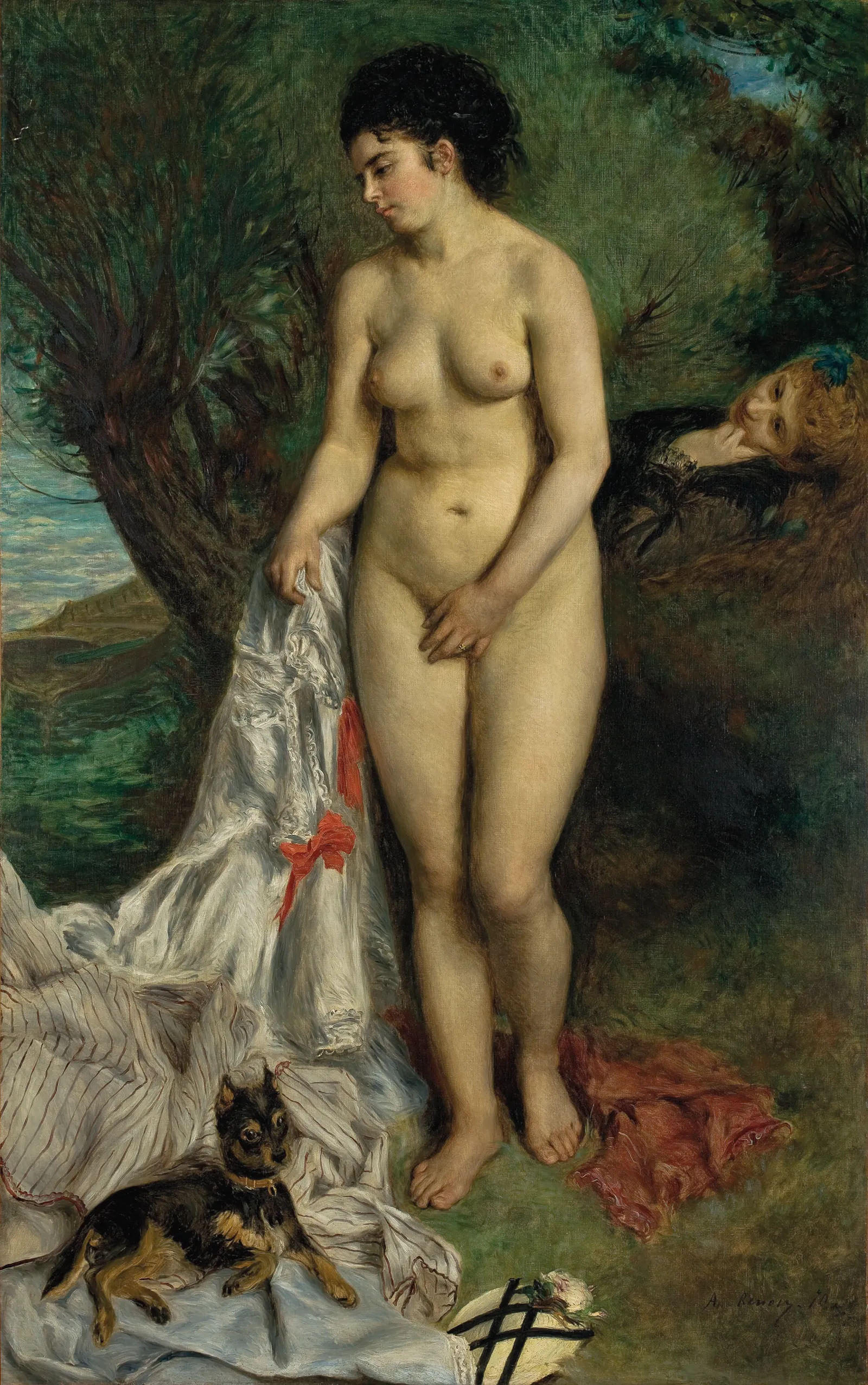
Pierre-Auguste Renoir painted Bather with a Griffon Dog in 1870, a large canvas of a nude woman standing beside a riverbank with a small dog at her feet. The painting belongs to the São Paulo Museum of Art. At 183.5 by 115 cm, it is a work you meet almost at eye level, and it shows Renoir shortly before his mature Impressionist style took shape.
Where to see it
Bather with a Griffon Dog is held by the São Paulo Museum of Art in São Paulo, Brazil. Display arrangements can change because of rehanging, conservation or loans, so check the São Paulo Museum of Art's official website for current display status, opening hours and ticket information before you visit.
What to look for in person
A figure close to life-size
The canvas measures 183.5 cm high and 115 cm wide, so the standing bather is shown on a scale close to that of a real person. Stand back first to take in the full figure against the landscape, then step closer. The size matters: this is a work meant to be judged as a serious figure painting, not a small sketch. Notice how the pale body dominates the vertical format while the surrounding greenery and riverbank are pushed toward the edges.
The pose and its classical echo
Look at how the woman stands, weight shifted, one hand raised toward her chest. Many art historians have linked this kind of pose to classical statues of Venus, a familiar reference in academic art of the time. Renoir places that traditional pose in an ordinary outdoor setting by a river, with modern clothing cast off nearby. Compare the idealised stance with the very real, solid treatment of the body, and you can see the painter balancing tradition and contemporary life.
The griffon dog and the discarded clothes
At the lower part of the picture, find the small griffon dog that gives the painting its title. Small details like the dog and the garments left on the ground help turn a timeless nude into a scene of a particular moment: someone has undressed to bathe. Look at how Renoir handles fabric and fur differently from skin, with the textures of cloth and coat set against the smoother modelling of the figure. These details reward slow looking.
About the painting
Bather with a Griffon Dog dates from 1870, an early point in Pierre-Auguste Renoir's career. At that time Renoir was working alongside the painters who would later be called Impressionists, but he was also still testing himself against the established tradition of the large figure painting. This canvas shows both sides. The broad scale, the carefully modelled nude and the pose that recalls classical sculpture all belong to the world of ambitious figure painting. The riverside setting and the everyday details, such as the clothes on the ground and the small dog, point toward the interest in modern leisure that runs through much of his later work.
The model is usually identified as Lise Tréhot, who sat for several of Renoir's paintings in the late 1860s and early 1870s. Many writers also see the influence of Gustave Courbet in the weighty, physical treatment of the body, a quality that differs from the softer, feathery brushwork Renoir developed in the following decade.
For visitors, the painting offers a useful way to understand how Renoir's art developed. Rather than the shimmering light effects many people associate with Impressionism, here you will find firmer forms and a more deliberate composition. Spend time comparing the figure with the landscape behind her: the background is handled more loosely, while the body is built up with greater care. The work is part of the collection of the São Paulo Museum of Art, which holds a significant group of European paintings; check the museum's website before your visit to confirm whether it is currently on view.
Key facts
| Artist | Pierre-Auguste Renoir |
|---|---|
| Date | 1870 |
| Size | 183.5 × 115 cm |
| Medium | oil paint, canvas |
| Collection | São Paulo Museum of Art |
How to visit: São Paulo Museum of Art
São Paulo, Brazil
Hours and prices can change. Please check the official website before you go.
More by Pierre-Auguste Renoir
 La Balançoire — Musée d'Orsay
 Jean Renoir sewing
 Luncheon of the Boating Party
 The Great Bathers — Philadelphia Museum of Art
 Dance in the City — Musée d'Orsay
 Girls at the Piano — Musée d'Orsay
 La Liseuse — Musée d'Orsay
 Torse, effet de soleil — Musée d'Orsay
 Mlle Irene Cahen d'Anvers
 Dance at Bougival — Museum of Fine Arts Boston
 Two Sisters — Art Institute of Chicago
 Bal du moulin de la Galette — Musée d'Orsay