Art! Art! Art! › Works
Girls at the Piano
 Pierre-Auguste Renoir, 1892
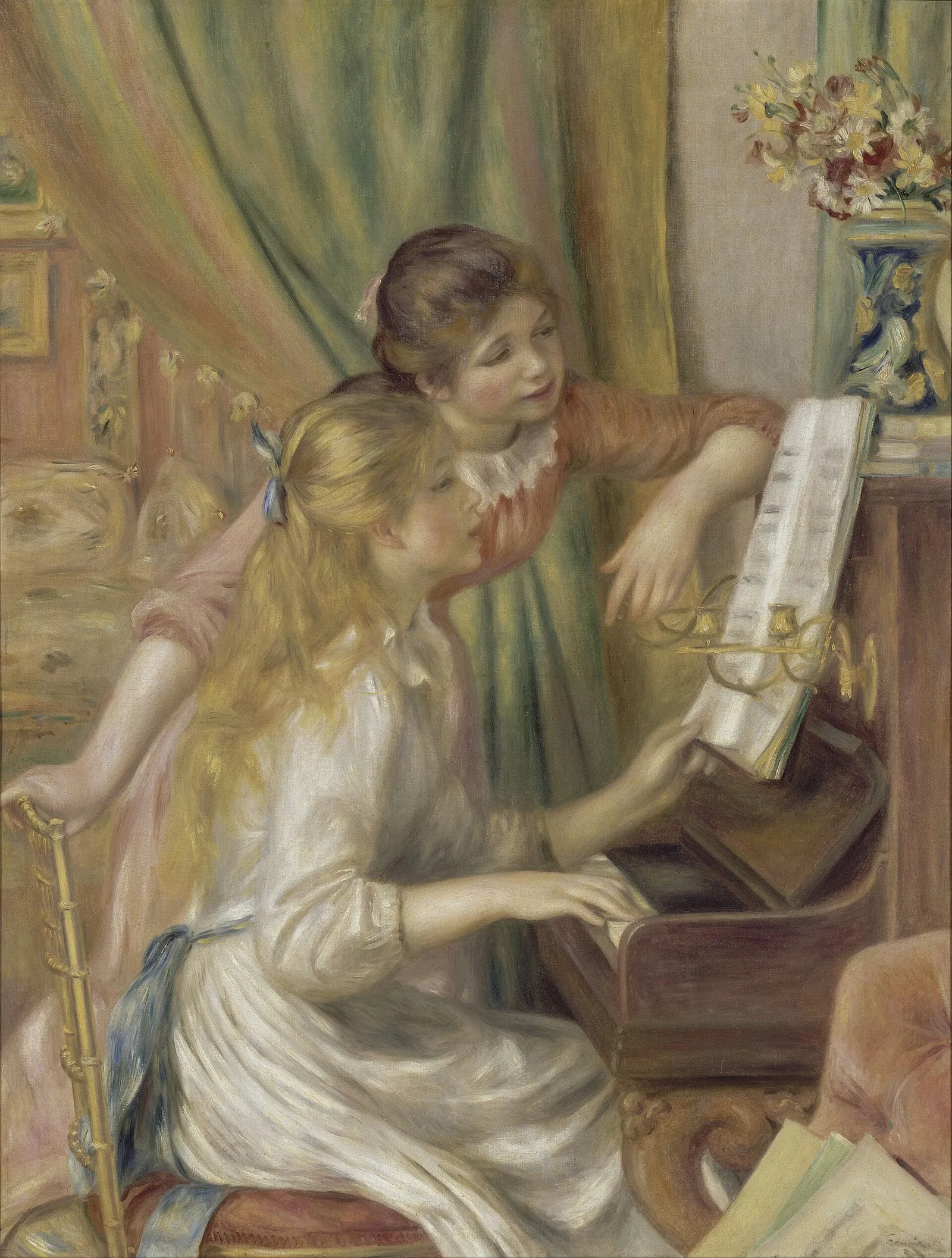
Pierre-Auguste Renoir's Girls at the Piano, dated 1892, is in the collection of the Musée d'Orsay in Paris. It shows two girls gathered at an upright piano, one seated at the keys and the other leaning in to follow the music, and it is one of the best-known domestic scenes of Renoir's later career.
Where to see it
Girls at the Piano belongs to the Musée d'Orsay in Paris. Works in large collections are sometimes moved, rotated, lent or taken off view for conservation, so check the Musée d'Orsay's official website for the painting's current display status before you visit. The website is also the best source for opening hours, ticketing and accessibility information.
What to look for in person
Two figures, one shared moment
Start with the pairing of the girls. One sits at the keyboard while the other leans over her shoulder, and their heads tilt toward the same sheet of music. Renoir builds the picture around this shared attention rather than any action or story. Notice how the leaning figure's arm and body echo the curve of the seated girl, linking the two into a single compact group. The effect is quiet and absorbed: the viewer seems to come upon a private moment of practice or play, not a staged portrait.
Contrasting dresses and hair
Look at how Renoir sets the two girls against each other in colour. One wears a pale white dress with a sash, the other a deeper, warmer pink or red, and their hair differs in tone as well. These contrasts help the eye separate the two overlapping figures while keeping the overall harmony soft. Step closer and see how the fabrics are suggested with loose, feathery strokes rather than crisp outlines, so that light seems to settle gently across the folds of the clothing.
A softly furnished interior
Take time with the setting around the figures. A comfortable bourgeois interior surrounds the piano, with a heavy curtain and a vase of flowers among the details that frame the scene. These elements are painted with the same blended, warm touch as the girls themselves, so the room and its occupants merge into one atmosphere. Notice how edges dissolve and colours flow into one another; this softness is characteristic of Renoir's work in the early 1890s and is best appreciated by viewing from several distances.
About the painting
Girls at the Piano dates from 1892, a period when Pierre-Auguste Renoir had moved away from the sharper, more linear manner he explored in the mid-1880s and returned to a softer, more fluid way of painting. The subject of young women making music at home suited this approach: it allowed him to combine figures, fabrics and furnishings in a warm, unified surface without dramatic narrative.
Renoir painted the composition in more than one version around the same time, and the picture now at the Musée d'Orsay is the one generally identified as having been acquired by the French state in the early 1890s. That purchase is widely regarded as a significant moment of official recognition for Renoir, an artist whose early career had been associated with the independent Impressionist exhibitions rather than with state patronage.
For visitors, the painting rewards slow looking. The piano, the sheet music and the two girls form a tight central group, and the surrounding room is handled with the same delicate, blended brushwork. There is little in the way of hard contour; instead, colour and light define the forms. Comparing the treatment of skin, hair and fabric can reveal how Renoir varied his touch across the canvas while keeping the whole image cohesive.
The scene also reflects a broader interest among artists of the period in everyday middle-class life, particularly the piano as a fixture of domestic leisure and education for young women. Seen in the context of the Musée d'Orsay's holdings of late nineteenth-century French art, it offers a clear example of Renoir's mature style.
Key facts
| Artist | Pierre-Auguste Renoir |
|---|---|
| Date | 1892 |
| Size | 1160 × 900 cm |
| Medium | oil paint, canvas |
| Collection | Musée d'Orsay |
How to visit: Musée d'Orsay
Paris, France · Museum guide
| Opening hours | Tue–Wed, Fri–Sun 09:30–18:00 (galleries close at 17:30) Thu 09:30–21:45 (late opening; galleries close at 21:15) |
|---|---|
| Closed | Every Monday, 1 May and 25 December. |
| Last entry | 17:00 (exhibitions 17:15); Thursdays 21:00 |
| Admission | Full rate, online EUR 16 Full rate, at the museum EUR 14 Reduced rate (on site only) EUR 11 Enfant & Cie, online EUR 13 Enfant & Cie, at the museum EUR 11 Night rate (Thursday), online EUR 12 Night rate (Thursday), at the museum EUR 10 Under 18s; EEA residents under 26 free |
| Free entry | Free for under 18s and residents of the European Economic Area under 26. Free on the first Sunday of the month, with booking required. |
| Booking | Booking is strongly recommended. Entry is by timed slot. |
The museum stays open and all collections and exhibitions remain accessible, but entrances have changed: timed-ticket holders use Entrance 1 (Quay); priority visitors, reseller voucher holders, visitors without tickets and groups use Entrance 2 (Forecourt). Arrive at least 15 minutes before your time slot.
Official ticket page
Official website
View on map
Hours and prices can change. Please check the official website before you go. (Checked on: 2026-11-11)
More by Pierre-Auguste Renoir
 La Balançoire — Musée d'Orsay
 Jean Renoir sewing
 Luncheon of the Boating Party
 The Great Bathers — Philadelphia Museum of Art
 Dance in the City — Musée d'Orsay
 La Liseuse — Musée d'Orsay
 Torse, effet de soleil — Musée d'Orsay
 Mlle Irene Cahen d'Anvers
 Dance at Bougival — Museum of Fine Arts Boston
 Bather with a Griffon Dog
 Two Sisters — Art Institute of Chicago
 Bal du moulin de la Galette — Musée d'Orsay